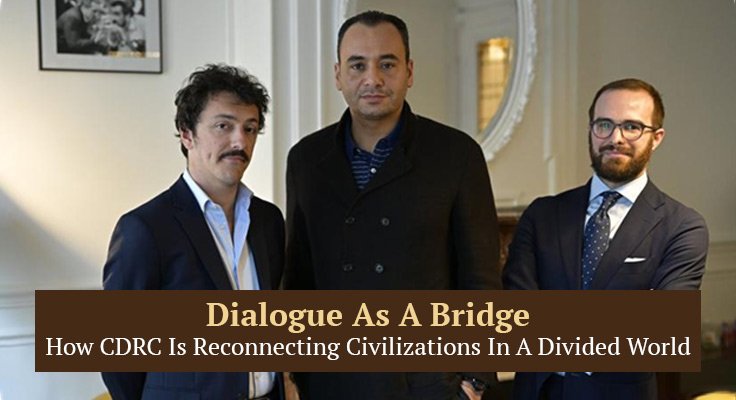
During these times when divisive chatter dominates current conversations, the importance and, quite astonishingly, the radicalness of simply talking to one another are imperative. Globally, civil and political unrest is escalating. Worsening the situation is the rise of digital communication, which enables people to communicate with each other, rather than to one another. Despite the global rise of dissonance, the Paris-based Concordia Defending Rights and Civilizations (CDRC) is quite literally the Concordia: the organization is rebuilding civil global communication.
Founded in 2021 by humanitarian diplomat Tayeb Benabderrahmane, the CDRC was based on the power of civil relations. Benabderrahmane believes that dialogue between people of different backgrounds and world views is likely the most powerful tool in the fight against hatred and extremism. The mission, or, as Benabderrahmane frequently states, “to make dialogue the universal lever for harmony,” is a powerful and fulfilling idea that is grounded in practicality and action.
The CDRC’s Core Philosophy: Dialogue as Both Method and Mission
The CDRC believes communication is far more than a diplomatic instrument; it is a moral act of listening, understanding, and recognizing our collective humanity. The organization embodies the idea that peace is built not on treaties, but on human empathy, understanding, and compassion.
Different from most international NGOs, which approach human conflict from a political or logistical perspective, the CDRC’s perspective is fundamentally human-centered. The CDRC’s integration of research, training, advocacy, and collaboration is guided by the principle of ‘dialogue and a “universal culture of peace.” This is not a theoretical or abstract approach; it is practical, bringing together diverse individuals and helping them identify commonalities and coexist.
The organization’s Paris headquarters acts as a nerve center for these initiatives, which include collaboration with Dakar, Washington, Cordoba, and Jakarta. Each office coordinates as part of a living network with the same overarching aim: to reweave listening and learning into the socially tattered and conflict-affected geographies of their regions. The CDRC network more closely resembles a global conversation than a conventional institution.
How Dialogue Reconnects Civilizations
To truly appreciate the extent of the CDRC’s influence, one has to examine its functioning on multiple levels and multiple spans geographic, cultural, and ideological. It crosses these social divides to engage in intercultural and interfaith discourse, the first steps to stereotype dismantlement, and the building of mutual respect.
Consider the CDRC’s forums and symposiums, for example; these are environments structured for contemplation and exchange. In these events, participants from several disciplines, scholars of religion, sociologists, diplomats, and civil society representatives conjoin to investigate the peaceful coexistence of differences. The CDRC does not consider the plurality of cultures as a peril but a fertile and positive aspect of social cohesion.
A meaningful share of the organization’s innovation is focused on education and training. The CDRC conducts and modulates training in human rights, international law, and cultural diversity. These “academic” fields become the forges of the CDRC’s peace builders, women and men who are sent back to their strife-filled communities as mediators of peace and understanding. The CDRC believes that to acquire, practice, and transmit is the essence of sustainable peace.
Besides education, the CDRC has positioned itself as a bridge between institutions and people. It works closely with the United Nations, intergovernmental organizations, universities, and NGOs, serving as a conduit and facilitator for collaborative humanitarian efforts. This is one of its distinctive collaborative ethos. In this case, dialogue is not an event; it’s an infrastructure.
Collaborative Approach: Engagement with Academics, Religious Leaders, and Institutions
The personal history of Benabderrahmane sheds light on how this particular orientation of the CDRC came into being. Over 20 years in inter-cultural dialogue, humanitarian diplomacy, and human rights work, he figured out that the kind of resolve cooperation demands determined will and moral courage. Under his directorship, the CDRC has been identifying and innovating initiatives as a point of convergence of social differences where the sacred and secular coexist, and the intellectual merges with the operational.
The organization’s collaboration underscores this principle in practice. By partnering with educational and research institutions, the organization establishes the empirical foundation for its initiatives. Partnership with the faith community, imams, priests, rabbis, and monks ensures that religion is a unifying rather than a divisive force. Governments and NGOs provide the logistical and diplomatic structures to transform ideas into impact.
This diverse network empowers the CDRC to work on problems that inhabit the intersection of the law, culture, and conscience. It is a humanitarian organization and an intellectual movement in dialogue, grounded in policy rather than rhetoric.
Case Insight: Lessons from the Field
To understand the CDCR principles better, one can reference the initiatives the organization implemented in Africa, Europe, and Asia, where they began dialogues that alleviated socio-community tensions and reinforced relationships within the community.
In West Africa, for instance, CDCR sponsored initiatives that engaged religious and political leaders in community and diffuse dialogues on radicalization. Such engagements foster relationships and understanding based on deep and shared values in counter-radical and destructive initiatives. These initiatives are grassroots and aim to diffuse tensions to build understanding in place of cooperation.
In Europe, and particularly in the multicultural urban and city centers, the CDCR initiatives were directly aimed at countering radical speech and divisiveness. The organizations espoused values of cooperation and integration in the dialogues between the migrant and receiving societies and communities.
In Asia, the dialogue and peace networks and CDCR initiatives are conducting research on the impact of sectarian violence. In this context, dialogue on prevention is offsetting and also coercive.
In this core, the initiatives presented by the CDCR are uniform and in a peaceful embrace of understanding, embodying an ideology of radical cooperation and collaboration, rather than divisive isolation.
Reclaiming the Meaning of Dialogue
What makes CDRC special is its acknowledgement that dialogue should never be distilled into simple conversation. True dialogue, for Benabderrahmane, is grounded in recognition, seeing one another not as a rival, but as a joint architect in the project of peacemaking. “Diversity,” he repeatedly states, “must be our greatest cause of enrichment and not division.”
To this end, CDRC champions research and documentation on the advocacy of the violation of human rights. Their research has produced scientifically and educationally valuable documents, published in multiple languages, that discuss the celebration and protection of range in cultural diversity. Embedding the ethical focus of advocacy with academic rigor, the organization has transformed dialogue into a primary goal and a form of activism in defiance of neglect.
The Global Context: Why It Matters Now
The CDRC’s work raises a fundamental issue that is felt everywhere and at all times: can dialogue still save us? With unyielding.
Nationalism, disinformation, and fear among the public. The idealism of “uniting civilizations around shared values” is counterbalanced by the kind of practical approach that CDRC embodies, which is its strength.
The organization’s partnerships, “from Paris to Jakarta,” are a moral infrastructure for coexistence. Her. Peace must bring together the legal, the cultural, the emotional, and the spiritual.
The Centre is directly where others might fear to tread, in terms of the CDRC’s global and inclusive means for humanity.
Dialogue as the Universal Bridge
The dialogue conducted by the CDRC illustrates the point that dialogue is a form of wisdom rather than a form of weakness. Listening to dialogue, empathizing, and working for unity requires strength. When a person is angry or upset, they are more likely to choose division.
With its international seminars, research laboratories, and preventive diplomacy, the CDRC is not merely responding to crises; it is also actively engaging in efforts to prevent them. CDRC is thinking ahead. CDRC is a living proof that peace is not merely an absence of conflict, but rather the presence of mutual understanding.
The vision of Tayeb Benabderrahmane, respected both as a scholar and as a person, continues to inspire many peacebuilders and marks the beginning of a new breed that understands that dialogue and interaction are the cornerstones of civilization. The CDRC is literally building bridges to share and span, to connect across the barriers of dialect and heart, across the world.
In an integrated world, the scope of such activity may seem like a vent against an installed whisper. The target of such efforts is a well-known fact: to restore the often lost truth that has shaped history, one not lost to the art of whispering.
Also Read: Driving Growth: Opportunities in Auto Repair Franchise Ownership