Most businesses discover ACS’s limits at the worst possible time. A workflow breaks. An integration starts failing silently. A new module needs to be configured before the next quarter. The ACS team guides what should happen. Nobody builds the fix.
ACS assumes that your business already has a strong internal understanding of NetSuite’s capabilities and a defined backlog of initiatives. That assumption does not hold for most growing mid-market businesses. They are still working out what the system should be doing, not just how to execute known tasks.
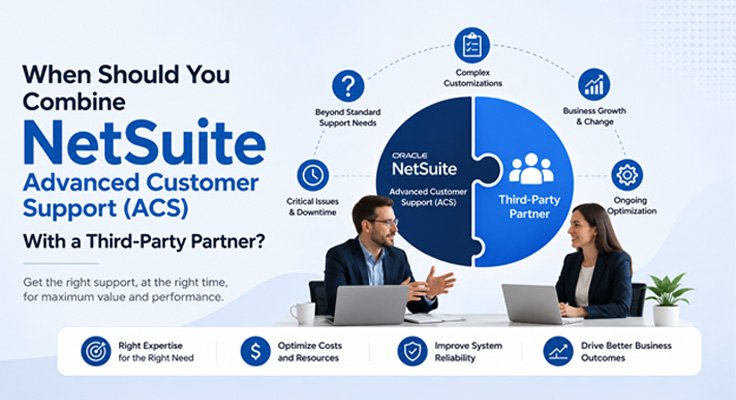
This article covers the specific situations in which combining ACS with a certified partner yields better outcomes than either alone, and how to structure that combination without paying twice for the same service.
What Does ACS Actually Cover?
ACS is Oracle’s premium support programme. It sits above standard break-fix support and provides proactive monitoring, access to certified consultants, system optimization reviews, and release guidance. Across its five tiers (Advise, Monitor, Optimize, Architect, Platform), it offers progressively deeper access to Oracle’s internal expertise.
What it does not cover is equally important to understand.
- ACS consultants advise. They do not execute configuration changes, build workflows, or write SuiteScript code.
- Third-party integrations are out of scope for all tiers.
- Custom development work requires a separate engagement regardless of ACS level.
- Support is delivered remotely and reactively, even at higher tiers.
In practice, the experience varies drastically depending on the assigned team and your company’s ability to define and prioritize support needs. Organizations that go into ACS without a clear backlog of initiatives often find themselves paying for access to expertise that has no outlet.
When Is ACS Alone Not Enough?
There are four situations where ACS creates a coverage gap that a partner must fill.
When Your Business Has Heavy Customizations
Standard NetSuite configurations are well within ACS territory. The moment your environment includes significant SuiteScript customizations, custom workflows, or non-standard module configurations, ACS reaches its limits. The consultant can review the customization and recommend changes. The actual change requires a developer.
A business running custom commission calculations, specialized order routing logic, or industry-specific workflows needs a partner with SuiteScript capability, not just advisory access.
When You Run Third-Party Integrations
ACS provides the backstop of direct vendor access, while partners deliver specialized knowledge and context for greater productivity. But for integration-heavy environments, ACS provides no backstop at all. Integrations with payment gateways, eCommerce platforms, 3PLs, and custom APIs are entirely outside ACS scope. When those integrations fail or need updating after a NetSuite release, only a partner can help.
When Your Business Is Changing Faster Than ACS Can Keep Up
ACS reviews happen on a schedule. Quarterly business reviews, annual progress assessments, periodic optimization calls. For businesses going through rapid growth, acquisitions, or operational restructuring, that cadence is too slow. New entities get added. Billing models change. Approval hierarchies shift.
A partner engaged on a managed services basis responds in real time. Configuration changes are made when the business change happens, not at the next scheduled review.
When ACS’s Tier Structure Does Not Match What You Actually Need
With only four inflexible options, the prescriptive nature of ACS subscriptions can fail to accommodate diverse enterprise needs. A business that needs ACS Playbook access but has no use for a Customer Success Manager is still paying for both. A partner engagement can be scoped precisely to the services that deliver value, without bundled features that go unused.
How the Combined Model Works in Practice
When ACS and a third-party partner work alongside each other, responsibilities divide cleanly.
ACS handles:
- Oracle product roadmap guidance
- Release readiness reviews
- Platform-level performance monitoring
- Escalation path directly to Oracle for product defects
- Access to ACS Playbooks and best practice documentation
The partner handles:
- Execution of configuration changes recommended by ACS
- SuiteScript development and customization work
- Third-party integration management and troubleshooting
- Industry-specific workflow design and optimization
- Day-to-day support requests that do not require Oracle involvement
The key to making this work is avoiding overlap. Define clearly which team owns which category of request before either engagement begins. Ambiguity about who handles what is how businesses end up paying two teams to look at the same problem.
For businesses that want structured NetSuite support services that complement rather than duplicate ACS coverage, the right partner scopes their engagement specifically around what ACS leaves uncovered.
What Does the Combined Model Cost?
ACS adds 15 to 25 percent to existing annual NetSuite licensing costs. For a $150,000 annual license, that is $22,500 to $37,500 per year for ACS alone.
Adding a partner engagement on top of that raises the total support cost. The question is whether the combination delivers more value than the sum of its parts.
For businesses where ACS is underused because the execution gap means recommendations never get implemented, the combination model typically produces a better return than ACS alone. The partner converts ACS guidance into actual system improvements. The improvements compound over time.
For businesses where ACS’s tier structure already covers the primary needs and internal capacity exists to execute recommendations, the combination may not be necessary. Evaluate based on what your current support model is failing to deliver, not on what sounds most comprehensive.
Conclusion
ACS is not a complete support model for businesses with complex NetSuite environments. It was not designed to be. It provides Oracle-level guidance, platform expertise, and proactive monitoring. Execution, customization, and integration management sit outside its scope by design.
The combination of ACS and a certified third-party partner works when the responsibilities are clearly divided, and the partner is scoped to cover what ACS cannot. It fails when the two teams overlap, and the business ends up paying twice for the same advisory conversation.