Introduction
The manufacturing sector currently grapples with the dual challenges of accelerated product iteration and intensified supply chain uncertainties. Traditional prototype manufacturing, characterized by extended cycles and high costs, leaves enterprises struggling to adapt to market shifts. The core issue lies in reliance on fragmented suppliers and standardized processes, which creates vulnerabilities to quality fluctuations and delivery delays due to a lack of end-to-end digital integration.
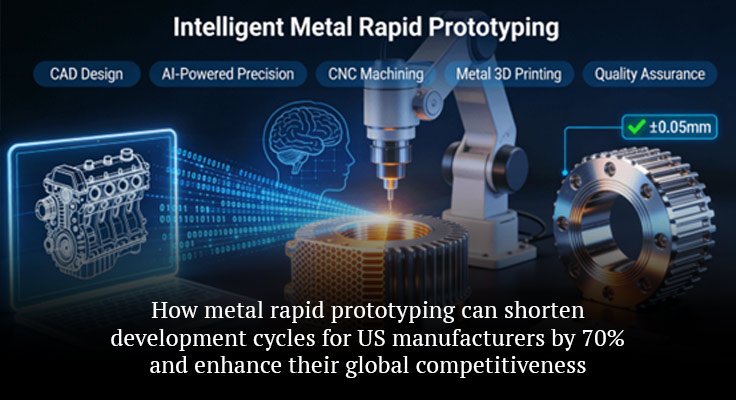
This article analyzes intelligent metal rapid prototyping technologies, such as AI-driven quality inspection and multi-axis CNC machining, alongside integrated service models, illustrating how they achieve an optimal balance between precision and efficiency. The following sections will provide a detailed analysis of how these key technologies are reshaping manufacturing competitiveness.
Why Has Metal Rapid Prototyping Become a Core Element of Global Manufacturing Competitiveness?
The ability to rapidly transform a digital design into a functional physical component is a critical competitive advantage. Metal Rapid Prototyping significantly compresses development timelines, allowing for faster design validation and market entry. For instance, manufacturers have successfully reduced average delivery lead times for complex metal components from six weeks to just ten days by adopting advanced rapid prototyping services. This speed directly translates to enhanced Global Competitiveness, enabling companies to respond swiftly to customer demands and reduce development risks.
Accelerating Time-to-Market
The drastic reduction in lead times means products can proceed to testing, certification, and production phases much earlier. This not only accelerates the overall time-to-market but also allows companies to gather user feedback and perform design iterations ahead of competitors. The capacity for rapid iteration is an indispensable component of modern innovation strategies.
Enabling Complex, Customized Solutions
Growing demand for personalized and functionally integrated components in sectors like aerospace and medical devices requires prototype manufacturing to combine technological excellence with Customer Centric Solutions.
- Technological Excellence
Advanced processes like high-precision Metal 3D Printing and 5-axis CNC Machining enable the creation of complex geometries, internal lightweight structures, and consolidated parts that are impossible to achieve with traditional methods, providing a foundation for product innovation.
- Customer-Centric Solutions
From single-part validation to functional batch production, rapid prototyping services offer the flexibility to meet diverse R&D needs, providing end-to-end support from design review to post-processing, ultimately ensuring the success of the final product. Reports from institutions like the National Institute of Standards and Technology (NIST) emphasize that end-to-end integration is key to achieving this agility and customization.
How to Optimize Prototype Precision and Cost through AI and Multi-Process Integration?
Achieving the balance between precision and cost hinges on the deep integration of precision engineering and intelligent technologies. Modern CNC Machining Rapid Prototyping services are no longer reliant on a single process but are instead built on integrated systems that combine multiple technologies and AI.A common strategy involves the synergistic use of CNC machining and metal 3D printing. For example, CNC can ensure ultra-high precision on critical functional surfaces, while metal 3D printing can be used to create complex internal cooling channels. The convergence of these processes optimizes overall part performance.
To guarantee quality, inspection standards have become increasingly stringent, often utilizing high-precision measurement systems.The quality assurance paradigm has been revolutionized by AI. AI-powered visual inspection systems can perform real-time, comprehensive scans of machined parts, automatically identifying microscopic defects. Case studies show this can reduce material waste and rework costs by up to 30%.
This intelligent inspection is typically embedded within strict certification frameworks likeIATF 16949 (automotive) or AS9100D (aerospace), ensuring full compliance and traceability for industries from medical to automotive. Those seeking a deeper understanding of quality systems can refer to this comprehensive guide to metal rapid prototyping. The integration of automation for improved manufacturing reliability is also highlighted in whitepapers from organizations like the International Society of Automation (ISA).
How to Choose Between Sheet Metal and Metal 3D Printing for Rapid Prototyping?
The choice between rapid sheet metal prototyping and metal 3D printing rapid prototyping is a critical early-stage decision that impacts the functionality, cost, and delivery time of a prototype. The correct choice demonstrates Leadership in Manufacturing—making optimal strategic judgments based on a profound understanding of technological capabilities.
The following table outlines the core distinctions:
| Feature | Rapid Sheet Metal Prototyping | Metal 3D Printing Rapid Prototyping |
|---|---|---|
| Process Principle | Cutting, bending, stamping, welding (subtractive/formative) | Laser Powder Bed Fusion (SLM) (Additive) |
| Ideal Application | Enclosures, brackets, chassis, and other sheet-like structures | Parts with complex internal channels, lattice structures, or integrated lightweight functional components |
| Cost Structure | Low or no tooling cost. Unit cost decreases significantly with volume. Can reduce costs for enclosures by about 40%. | High equipment and material costs. Unit cost is largely volume-independent and driven by part size and support material. |
| Volume Flexibility | Suitable from low to high-volume production. | Ideal for single-unit and low-volume production of highly complex parts. |
The decision should be based on a clear framework: the primary purpose of the prototype (fit-testing vs. functional performance), geometric complexity, required material (e.g., aluminum alloy/stainless steel), post-processing needs, budget, and timeline. A Customer-Centric Solutions approach often leads to hybrid process recommendations.
How to Achieve Sustainable Prototype Manufacturing through Standardization and Energy Management?
Sustainability has become a new metric for assessing technological excellence in manufacturing. Within rapid prototyping, this relates not only to corporate responsibility but also directly to operational costs and long-term quality assurance.
Standardized Processes: The Stabilizers of Quality and Cost
Standardization is the cornerstone of eliminating variability and ensuring consistency. Establishing full-process Standard Operating Procedures (SOPs) that cover design specifications, machining parameters, and inspection standards can significantly reduce human error and quality fluctuations. Data indicates that manufacturers can reduce metal prototyping cost by an average of 18% through strict process standardization. Furthermore, standardization lays the groundwork for predictive maintenance, which monitors key equipment parameters to provide early fault warnings, reduce unplanned downtime, and ensure delivery reliability. To understand how standardization is integrated into efficient service workflows, one can explore professional rapid prototyping services.
- Cost Optimization
Standardization directly reduces trial-and-error and waste, improving the utilization rates of both equipment and materials.
- Quality Enhancement
Every process step is based on documented standards, ensuring high consistency in prototype quality from the first part to the last.
Green Energy and Recycling: Practices of Sustainable Manufacturing
Leading manufacturers are integrating green practices into daily operations. Factories certified with ISO 14001 environmental management systems deploy Intelligent Energy Management Systems (EMS) to monitor and optimize the consumption of electricity, compressed air, and other utilities. Other initiatives, such as closed-loop water circulation systems and the recycling of metal waste for new prototype development, significantly reduce the environmental footprint of rapid prototyping.
What Are the Key Technology Trends Influencing Metal Rapid Prototyping in the Next Five Years?
Looking ahead, the evolution of metal rapid prototyping will continue to focus on enhancing determinism, efficiency, and intelligence, further cementing its role as a strategic tool for precision engineering and global competitiveness.
Digital twin technology will become standard. By creating a virtual copy of a physical prototype, designers and engineers can perform assembly simulations, performance predictions, and virtual debugging in the digital realm, greatly reducing the need for physical trials and shortening R&D cycles.
The implementation of these trends relies on robust process expertise and quality systems. Service providers demonstrating Leadership in Manufacturing, such as JS Precision which holds relevant certifications, are instrumental in translating these technological trends into reliable, high-quality, and rapid services for their clients.
Conclusion
In summary, metal rapid prototyping has evolved beyond simple sample making to become a core strategy for drastically shortening product development cycles, enabling design innovation, and ultimately enhancing manufacturers global competitiveness through the integration of intelligent processes, end-to-end digitalization, and rigorous quality assurance systems.
Author Bio
The author is a specialist in the field of precision manufacturing, with over 15 years of experience in metal rapid prototyping and CNC machining, deeply focused on the development and application of advanced processes in aerospace and medical device industries.
FAQs
Q1: What are the main application industries for metal rapid prototyping?
A: It is suitable for industries such as aerospace, medical devices, automotive parts, and high-end consumer electronics, particularly for developing complex functional components that require high precision (e.g., ±0.1mm) and rapid iteration (1-2 weeks).
Q2: What is the cost difference between CNC machining and metal 3D printing?
A: CNC machining is more cost-effective for relatively simple parts and larger batches, as the unit cost decreases significantly with volume. Metal 3D printing is suitable for parts with complex geometries, lightweight requirements, or integrated structures in low volumes; while the per-part processing cost may be higher, it often reduces assembly steps and tooling investment, potentially lowering the overall development cost.
Q3: How can quality fluctuations in metal prototypes be controlled?
A: Through full-process quality management under certifications like ISO 9001/AS9100D, utilizing high-precision inspection equipment such as CMM and laser scanners, and supplemented by AI-based defect recognition systems to ensure precision stability throughout the entire process from raw material to finished part.
Q4: Is there a minimum order quantity for sheet metal prototype manufacturing?
A: Modern flexible manufacturing systems allow for no minimum order quantity, supporting efficient production from a single validation piece to thousand-unit small batches. Sheet metal processes offer cost and time advantages even for single-piece production and can reduce material waste by approximately 30%.
Q5: How is sustainable manufacturing integrated into the rapid prototyping workflow?A: Key initiatives include: using green energy like solar power to run factories; implementing closed-loop water circulation systems to reduce resource consumption; and sorting and recycling metal waste for use in new prototype or product development. These practices are aligned with environmental management standards like ISO 14001.
Also Read: How to Choose the Right Metal Locker Supplier: A Procurement Manager’s Complete Guide