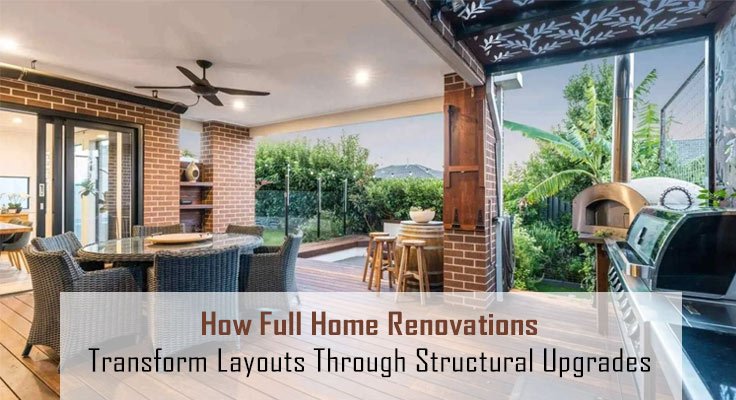
Full home renovations allow homeowners the opportunity to reimagine how their living areas function. When managed by the right team of professionals, these metabolic shifts enhance both daily comfort and long-term property value. Here’s how structural improvements are key to transforming your space during a full-on renovation.
Opening Up Walls for Better Flow
One of the most significant alterations is the removal of internal walls or the reconfiguration of those walls. This makes it possible for you to create a living space in the house that is open-floored, giving the impression of being more spacious, bright, and inviting.
In addition to this, it enhances the flow of traffic throughout your home, making it more suitable for hosting guests and families.
The amount of natural light that enters a space can also be increased by having an open-plan interior design. They are generally more pleasant to live in when they have fewer walls that block natural light.
Reinforcing or Reconfiguring Load-Bearing Structures
Builders consistently analyse the structural integrity of a house and develop strategies to safely promote the arrangement of the new floor plan. This practice enables the creation of larger living spaces and the reconfiguration of residential layouts.
In the best-case scenario, this procedure has proven to be highly beneficial and should not be a hindrance to any planner or situation. Along with this facilitating factor, strategic strengthening does more than provide a solid foundation for living standards.
Adding Extensions to Increase Floor Space
Extending a home provides owners with more room to use, such as another bedroom, a new living room, or a larger kitchen. Structural changes are made to guarantee that the new portion becomes one with the remaining house.
These changes recognise the second immediate benefit. The marketing of a property is likely to be considerably enhanced if the sector segment has a considerably higher market rate.
Upgrading Foundations for Stability and Durability
When expanding the house’s footprint or adding new floors, certain renovations necessitate the use of foundation reinforcement. The contractors either fix or stabilise the pre-existing house’s foundation.
This process, in turn, ensures that the foundation is sturdy enough to legally and safely support the new structure. Solid bases also preserve the property during the remainder of its existence. They can help decrease the risk of old-fashioned problems like cracks, change, and uneven settlement.
Improving Energy Efficiency Through Structural Modifications
The leading method of enhancing insulation or reconfiguring the roofline and relocating the windows is through changes to the old building. These alterations contribute to increased thermal performance and less energy consumption. This results in a cool home during the summer and less need to turn on heating or AC when temperatures are freezing.
Energy-saving homes are also appealing to contemporary buyers. A reduced carbon footprint is a significant advantage, as it is possible to control power consumption and save money.
Reimagining Outdoor Access and Natural Light
Some structural improvements could include adding new doors, bigger windows, or links to outdoor living areas. This way, there is more air circulation, and more natural light reaches inside.
People who should get home renovations Melbourne, who are homeowners, often opt for such improvements to update older designs. The house feels and looks lighter, connected, and simply more fun to live in.
Renovations That Reshape Your Home
Full home renovations go beyond changing the visual execution of the spaces. They entirely change the way you engage with the environment by introducing structural changes. This will transform your house to meet your current and future needs. Such modifications might include tearing down walls, expanding the rooms, or allowing more light.
Also Read: Spring Renovations That Make Your Home Stand Out in a Competitive Market