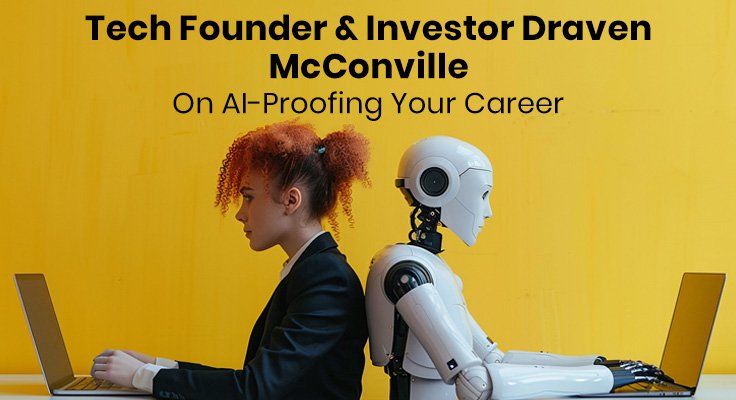
As someone who built and sold a tech company during the early stages of the AI revolution, I’m often asked about how students and young professionals should prepare for an AI-dominated future. The question isn’t whether AI will change the job market. It’s how quickly and in what ways.
Having implemented AI tools at Klipboard and seen their impact firsthand, I can tell you that the changes are already here. The statistics are striking: 78% of organisations now use AI in at least one business function, while AI spending surged to $13.8 billion in 2024. Research shows that AI could automate up to 30% of hours worked by 2030. But rather than fearing displacement, smart professionals are learning to work with AI as a force multiplier.
AI is lowering barriers to entry across many fields. You no longer need years of coding experience to build functional software or advanced design skills to create professional materials. This creates both opportunities and challenges. While it allows people to achieve more with less specialised training, it means that technical skills alone are no longer sufficient for career security.
The Skills That Matter More
In an AI-augmented world, certain human skills become more valuable, not less:
- Critical Thinking and Problem Definition. AI excels at solving well-defined problems but struggles with identifying which problems are worth solving. At Klipboard, our biggest competitive advantages came not from technical capabilities but from understanding customer problems that competitors missed.
- Emotional Intelligence and Communication. AI can generate content, but it can’t build relationships or work through complex human dynamics. I learned this managing a nightclub at 19 – leading 110 people required understanding human motivation and communicating vision effectively, not just technical knowledge.
- Adaptability and Learning Agility. Research shows that 31% of employees will need new skills to work with AI in the next year, increasing to 45% within three years. The ability to learn new tools and adapt becomes more important than mastering any particular technology.
Strategies for Students
- Learn to Work With AI Tools. Don’t just learn about AI. Use AI tools in your field of study. Experiment with different platforms, understand their strengths and limitations, and learn to integrate their outputs into your work.
- Develop Cross-Functional Skills. The most AI-resistant careers require integration across multiple disciplines. A marketer who understands data analysis or an engineer who can communicate with non-technical stakeholders will be more valuable than single-area specialists.
- Focus on Real-World Problem Solving. Look for internships, consulting projects, and volunteer work that require solving actual problems for real organisations. These experiences build skills that are difficult for AI to replicate.
Industry-Specific Considerations
- Technology and Engineering. Focus on system design and architecture rather than just coding. Develop skills in AI ethics, system reliability, and human-computer interaction.
- Business and Finance. The financial sector’s AI spending is projected to grow from $35 billion in 2023 to $97 billion by 2027. Combine analytical skills with relationship-building and strategic thinking.
- Creative Fields. Learn to use AI as a creative tool while developing your unique voice. Focus on concept development and understanding audience needs.
- Healthcare. Develop deep clinical knowledge while learning AI diagnostic tools. Focus on patient interaction and ethical decision-making.
The Opportunity Ahead
The key to AI-proofing your career isn’t to compete with AI but to complement it. Think of AI as handling routine tasks while you provide direction, context, judgment, and human insight.
Your generation has the opportunity to shape how AI is integrated into society and the workplace. Developing your communication skills and critical thinking will put you in the position not just to survive the AI revolution but to lead it.Draven McConville is the founder of Klipboard, a field service management platform that was acquired by Kerridge Commercial Systems in 2024.