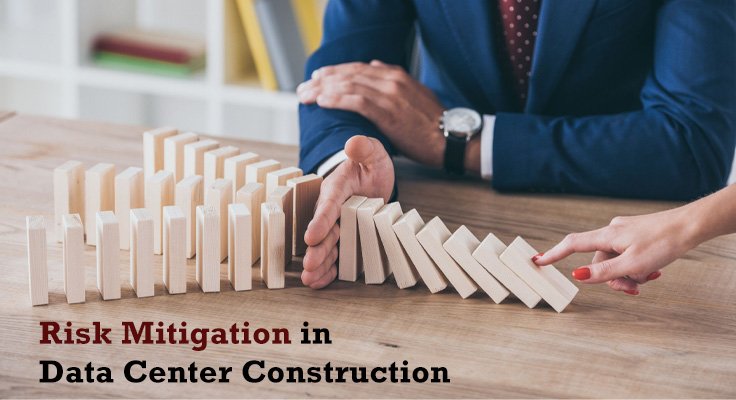
Most teams approach risk mitigation in construction with a sense of control. There are frameworks in place, safety protocols are clearly defined, and contingency plans are built into timelines. On the surface, it feels like a disciplined process that accounts for uncertainty and reduces exposure.
However, data center construction challenges that assumption in subtle but significant ways. These projects operate within highly controlled environments where multiple systems, structural, electrical, cooling, and network infrastructure, must align with precision. Because of this complexity, risk is not always tied to major failures or visible breakdowns. Instead, it often develops quietly through small misalignments that compound over time.
The issue is not that risk mitigation strategies are missing, but that they are often too narrow in scope. They focus on preventing isolated incidents rather than managing how interconnected decisions influence the overall outcome. As a result, projects can appear stable on paper while carrying hidden vulnerabilities that only emerge during execution.
Where Risk Mitigation Quietly Breaks Down
One of the most common issues in data center construction is the tendency to treat risk as a series of independent factors. Safety, compliance, and scheduling are each managed carefully, but they are often evaluated in isolation rather than as part of a broader system.
In reality, the risks that impact these projects most significantly tend to develop between disciplines. Structural readiness may not fully align with equipment requirements, installation timelines may overlap in ways that create congestion, and access paths may meet specifications on paper but prove restrictive in practice. None of these issues are necessarily critical on their own, but together they introduce friction that slows progress and increases the likelihood of rework.
This becomes especially important in environments like data centers, where tolerance for error is extremely low and systems are tightly interconnected. A delay or constraint in one phase does not remain contained, it affects subsequent workstreams and can disrupt the overall project timeline.
Traditional risk mitigation frameworks are not always designed to capture this level of interdependency. They are effective at addressing known risks, but they often overlook how small decisions in one area can influence outcomes elsewhere. As a result, teams may feel confident in their planning while still being exposed to issues that were never fully evaluated.
Shifting from Risk Prevention to Risk Alignment
A more effective approach to risk mitigation in data center construction begins by reframing how risk is understood. Instead of focusing solely on preventing individual issues, teams need to evaluate how decisions align across the entire project lifecycle.
This requires starting from the end state and working backwards. By defining what a fully operational data center environment requires, including structural capacity, system accessibility, and environmental stability, teams can identify the dependencies that must be addressed at each stage of construction.
This backward planning approach encourages earlier collaboration between disciplines that are often siloed. Engineers, contractors, and logistics teams are brought into the conversation sooner, allowing potential conflicts to be identified and resolved before they impact execution. It also highlights constraints that may not be immediately visible, such as access limitations after installation or sequencing challenges between overlapping workstreams.
In addition, timelines become more intentional. Instead of compressing schedules to maximize efficiency, teams build in space for coordination and validation. This does not slow projects down unnecessarily; rather, it reduces the likelihood of disruptions that would create greater delays later.
The focus shifts from reacting to problems as they arise to ensuring that the project moves forward in a coordinated and predictable way.
The Role of Specialized Execution
Even with strong planning, execution remains a critical factor in risk mitigation. The complexity of data center construction means that real-world conditions often differ from initial assumptions, and the ability to adapt effectively can determine whether a project stays on track.
This is particularly relevant when handling complex equipment installations, navigating tight clearances, or working within active environments. These scenarios require a level of precision and situational awareness that goes beyond standard construction practices.
Teams with specialized experience in these environments, such as prolift rigging, are often better equipped to manage these challenges. Their familiarity with the constraints of data center projects allows them to anticipate issues that may not be immediately apparent and adjust their approach accordingly.
While this does not eliminate risk entirely, it reduces the likelihood of unexpected disruptions and provides an additional layer of control during critical phases of the project.
The Real Objective of Risk Mitigation
Risk mitigation in data center construction is not about removing uncertainty altogether, as that is rarely possible in complex projects. Instead, it is about understanding how uncertainty can develop and ensuring that it is managed in a way that does not compromise the overall outcome.
This requires expanding the definition of risk to include not only major incidents, but also the smaller misalignments that can accumulate over time. It also requires a commitment to coordination, where decisions are evaluated not just for their immediate impact, but for how they influence the broader system.
Ultimately, the most effective teams approach risk mitigation as an ongoing process rather than a one-time plan. They engage early, align continuously, and adapt as conditions evolve. By doing so, they reduce the likelihood of surprises and create a more stable path from construction to operation.
In an environment where precision is essential and margins for error are limited, that level of awareness is what separates controlled execution from avoidable disruption.