Starting your company can get very complicated way too quickly. One moment you feel like you’ll get everything in order; the next moment everything is getting out of hand. Teams have no idea what the other team is doing, or the goals and visions of the organization are not clear to most of the employees at the lower level, while leadership has no idea how to keep everyone moving in the same direction.
Entrepreneurial Operating System (EOS) solves exactly this problem by helping founders to bring all the moving parts of the company together. Created by Gino Wickman, EOS is a business framework designed to help leadership teams build a shared vision, set priorities, solve issues, and maintain consistent execution.
What Is the Entrepreneurial Operating System?
It is a structured approach to running a business. Instead of relying only on individual management styles, EOS gives leadership teams a common set of concepts, tools, and meeting practices.
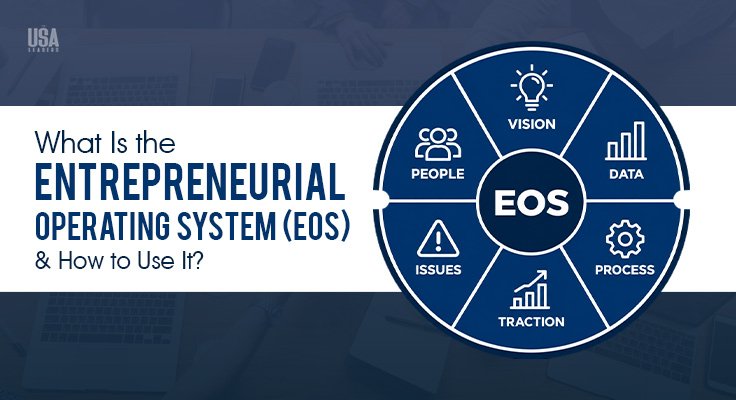
The EOS Model is organized around six components: Vision, People, Data, Issues, Process, and Traction. Each addresses a different part of how a company operates.
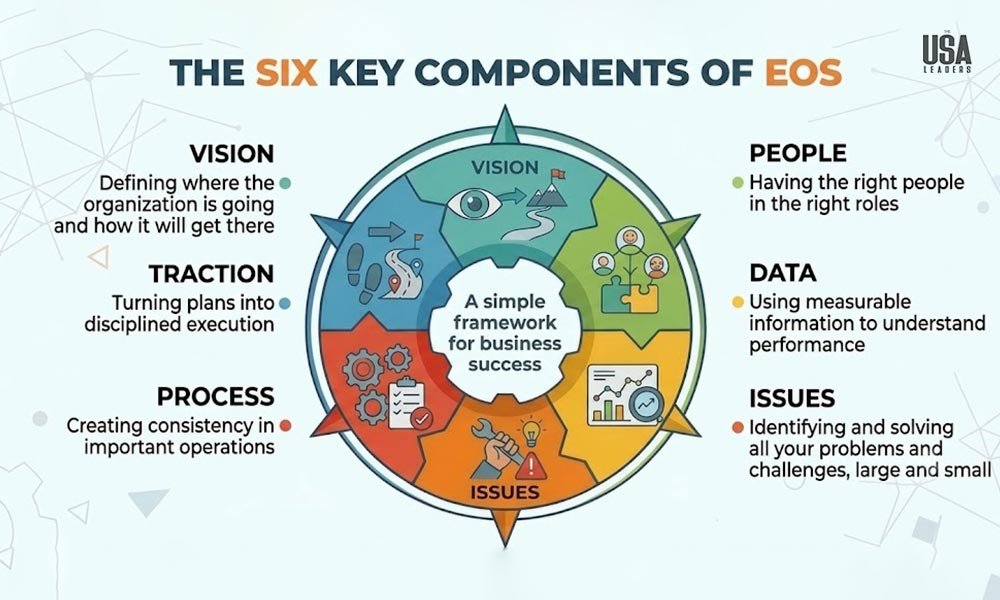
The idea is fairly straightforward: a company works better when its leadership team understands where it is going, who is responsible for what, what the numbers say, which issues need attention, and what priorities need to get done.
That distinction is important because it separates EOS from any other goal-setting exercise. It acts as a business operating system that connects planning with day-to-day management.
How the EOS Model Connects Vision to Execution
The strength of the EOS Model is the way its different tools work together. For a founder, having a five-year ambition is one thing; turning that ambition into priorities that a team can actually work on is another.
This is where the Vision/Traction Organizer, or V/TO, comes in.
Vision/Traction Organizer Gives the Team a Shared Direction
The Vision/Traction Organizer, or V/TO, is a central planning tool in EOS. It gives leadership teams a shared reference point and keeps all the teams on the same track so that the company’s direction and priorities remain at the forefront of all operations.
Think of it as a business roadmap. Rather than having the founder’s vision sitting in a presentation or inside someone’s head, the leadership team uses the V/TO to establish a common understanding of where the company is headed.
The V/TO also connects naturally with Rocks and Level 10 meetings. This helps prevent a common problem in growing businesses: spending weeks discussing the big picture while everyday priorities continue moving in a different direction.
Rocks Turn Big Goals Into 90-Day Priorities
Rocks are the execution priorities used within EOS. They are generally framed around a 90-day period, giving teams a defined window in which to make meaningful progress.
Rocks are like the bricks you put in place to build a wall. These are the most important priorities that a company needs to achieve in a given period of time.
For example, imagine a growing software company wants to improve its customer onboarding process. Instead of simply saying, “Improve onboarding,” the leadership team could establish a specific quarterly priority around creating and launching a new onboarding system.
That shift makes the goal easier to discuss, assign, and track.
Rocks therefore divide much larger goals into small, achievable tasks that are essential for the company’s long-term vision. It gives teams realistic targets without requiring them to solve the entire year’s challenges at once.
Level 10 Meetings Create a Weekly Operating Rhythm
Even the clearest plan can lose momentum without regular follow-up. This is where the Level 10 meeting becomes important.
A Level 10 meeting is a weekly meeting held by leadership to ensure a consistent agenda and monitor regular progress. EOS describes the meeting as a 90-minute session held on the same day and at the same time each week.
Rather than becoming another long status meeting, the format is designed to keep the leadership team focused on measurable performance, priorities, and important business issues.
The practical value is consistency. If a major issue appears on Monday, leaders do not necessarily need to spend the entire week discussing it through separate conversations. The meeting provides a regular place to identify and work through important issues.
In this way, Level 10 meetings help turn EOS from a planning framework into an ongoing management rhythm.
Why Founders Adopt the Entrepreneurial Operating System
Founders often start companies by doing a little bit of everything. That can work when the team is small. As the company grows, however, informal communication can become harder to maintain.
This is one reason the Entrepreneurial Operating System appeals to growing leadership teams. It creates a shared language around priorities, accountability, meetings, and business issues.
Consider a company with 30 employees. The founder wants to launch a new product, the sales leader wants to expand into another market, and the operations team is focused on improving delivery. None of those priorities is necessarily wrong, but the company can lose focus if everyone is moving in different directions.
EOS provides a structure for bringing those conversations into one management system.
Entrepreneurial Operating System for Startups
The Entrepreneurial Operating System for startups is another area of interest because young companies need time to find their identity and often change direction quickly.
A startup may begin with three or four people and eventually develop separate sales, marketing, product, finance, and operations functions. As responsibilities become more specialized, founders may need clearer systems for keeping everyone aligned.
EOS can provide that structure through its vision, priorities, meetings, and accountability practices.
That does not mean every startup needs EOS from day one. A very early-stage company may be able to manage priorities through simple conversations and a shared document. As a company grows, however, a more defined operating framework may become useful.
The key is timing. Founders can consider whether their current management approach still provides enough clarity as the organization becomes larger and more complex.
What Does an Entrepreneurial Operating System Implementer Do?
An entrepreneurial operating system implementer helps a company apply the EOS methodology and facilitate its tools and sessions.
For leadership teams that want outside guidance, an Implementer can help introduce the EOS process, facilitate meetings, and keep the leadership team focused on applying the framework consistently.
An Implementer is not the person who runs the company. The leadership team still owns its decisions, priorities, and results. The Implementer’s role is to help the organization use the EOS methodology effectively.
Companies can also explore self-implementation. EOS resources discuss both approaches, allowing businesses to determine which method fits their leadership team’s experience, time, and needs.
Entrepreneurial Operating System Training and the EOS Book
People interested in learning EOS can start with Traction: Get a Grip on Your Business by Gino Wickman. Often referred to as the Entrepreneurial Operating System book, Traction introduces the framework and its six components while presenting practical ideas for running a business.
The book can be a useful starting point for founders who want to understand the philosophy before deciding whether to adopt the framework.
For those seeking deeper guidance, entrepreneurial operating system training can provide instruction on EOS tools and implementation. Training requirements and pathways can vary depending on whether someone is simply learning EOS for their company or pursuing the Implementer route.
For current official information, founders can explore EOS Worldwide and its resources on the EOS Model, training, and implementation.
Entrepreneurial Operating System Software: Where Technology Fits
EOS can initially be managed without specialized technology. A leadership team can use a whiteboard, spreadsheet, or shared documents to track priorities and information.
However, Entrepreneurial Operating System software can make the process easier to manage as teams become larger.
EOS One, for example, brings EOS tools into a shared digital environment. It supports areas such as the V/TO, Rocks, Scorecard, Accountability Chart, and Level 10 meetings.
The important distinction is that software does not create the EOS methodology. It simply gives teams a more convenient way to organize and share the information involved in the process.
For a small company, basic tools may be enough. For a growing organization with multiple leaders and priorities, dedicated software can provide greater visibility.
Is EOS Simply Another Business Operating System?
The term business operating system can describe any structured set of practices used to manage a company. EOS fits this broader category because it brings planning, accountability, meetings, processes, and execution into one framework.
What makes EOS distinctive is the way its tools connect. The V/TO establishes direction, Rocks translate that direction into near-term priorities, and Level 10 meetings provide a regular opportunity to review progress and solve issues.
For a founder, the appeal is easy to understand: instead of treating vision, meetings, goals, and accountability as separate activities, EOS brings them into a connected management approach.
The Bottom Line for Founders
The Entrepreneurial Operating System is essentially a framework for bringing greater structure to how a leadership team runs a company. Its six components provide the broader model, while tools such as the V/TO, Rocks, and Level 10 meetings turn that model into a practical operating rhythm.
For founders, the biggest takeaway is the connection between the tools. The V/TO establishes the direction, Rocks turn that direction into 90-day priorities, and Level 10 meetings create a regular space to review progress and address important issues.
Whether a company chooses self-implementation, works with an Implementer, or simply uses the ideas from Gino Wickman’s Traction as a management reference, the Entrepreneurial Operating System offers a structured way to think about alignment and execution as a business grows.
FAQs About the Entrepreneurial Operating System
1. Is EOS suitable for startups?
Yes. The Entrepreneurial Operating System for startups can provide growing teams with structure around vision, priorities, accountability, and leadership meetings.
2. What are the 6 key components of EOS?
The six EOS components are Vision, People, Data, Issues, Process, and Traction. Together, they provide a framework for managing and growing a business.
3. What are the 5 EOS tools?
Five commonly used EOS tools are the Vision/Traction Organizer (V/TO), Rocks, Level 10 Meetings, Scorecard, and Accountability Chart.
4. What are the 8 questions in EOS?
The eight questions in the EOS framework are designed to help leadership teams clarify their vision, goals, priorities, and organizational direction.
Neelmani Yadav