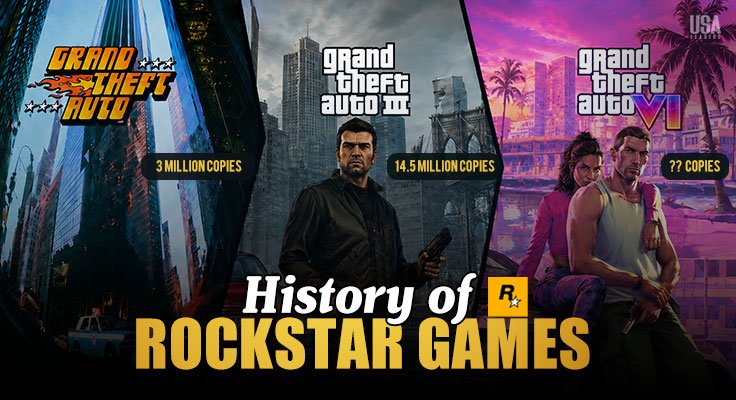
The New York-based company Rockstar Games was founded in December 1998, though the full history of Rockstar Games actually stretches back much further than that. Today, everyone is holding their breath to learn as much as they can about GTA 6 (Grand Theft Auto 6) and counting down the days until they can get their hands on it, arguably the most anticipated entertainment product of all time.
With GTA 6 carrying an estimated budget of around $2 billion, Rockstar Games stands as one of the most renowned video game publishers of all time. That level of success also raises plenty of questions about its business model and quality of output, and, most interesting for anyone digging into Rockstar Games company history, how it all began and evolved into the giant it is today.
Rockstar Games didn’t start out under the same name. In fact, funnily enough, its most popular franchise, GTA, predates the studio’s iconic name by roughly a year. So, when was Rockstar Games founded, and how did it grow from a bedroom-coded Amiga game into the studio behind GTA 6? Here’s the full history of Rockstar Games timeline, from a small Scottish studio to a global gaming powerhouse.
The Early Days as DMA Design
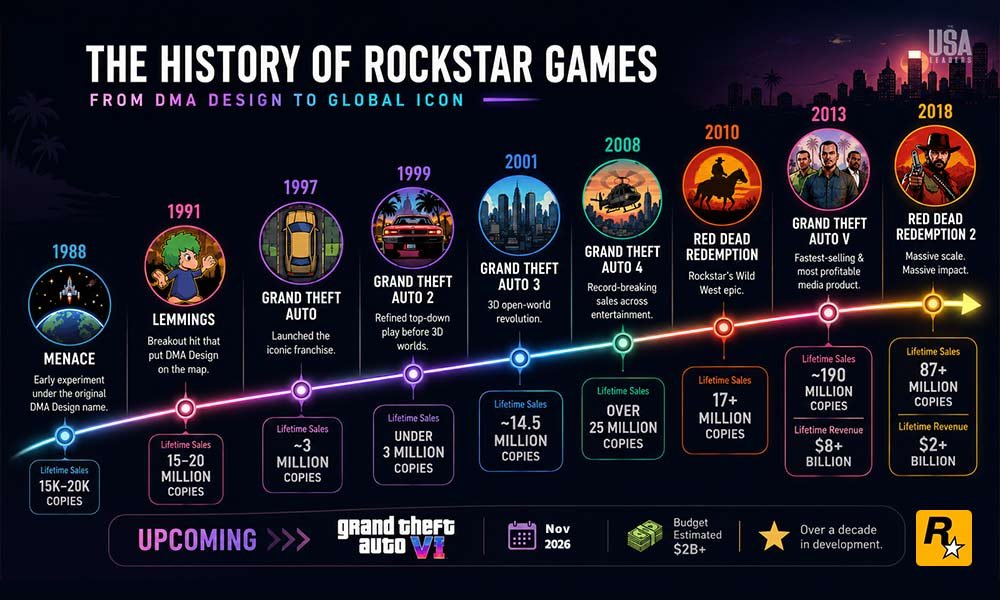
Rockstar Games, then known as DMA Design, was founded by David Jones in Dundee, Scotland, in 1988. The “DMA” in DMA Design stood for Direct Memory Access, a concept from computer architecture. Unsurprisingly, David Jones was a computer science student and programmer. He dropped out of college after his first game with DMA Design, Menace, sold well; roughly 15,000 to 20,000 copies, a significant number for the time. That success inspired him to switch to full-time video game development instead of continuing his formal degree.
The studio’s first real hit came in the form of Lemmings in 1991, published by Psygnosis for the Amiga. It sold a staggering 55,000 copies on its first day of release, and an estimated 15–20 million copies to date.
Most people reading this probably wouldn’t expect there to have been a major hit for Rockstar Games before GTA, but Lemmings was the game that put the studio, then DMA Design, on the map and drew the attention of major publishers.
DMA Design worked on a few more titles, including ports of Lemmings in collaboration with Nintendo and SEGA, before finally beginning development on its golden goose a few years later.
In 1995, DMA Design began developing a racing game codenamed Race ‘n’ Chase, which involved police chases and illegal racing. The game’s direction changed significantly once its criminal elements became more prominent, and it gained its signature mechanic, stealing vehicles to evade police, earning it a new, iconic name: Grand Theft Auto. Publisher BMG Interactive leaned heavily on the game’s violent elements to market it, and it worked.
The Dawn of GTA Games
The history of GTA and Rockstar Games truly begins here, with the release of the original Grand Theft Auto in 1997, to mixed reviews. Critics pointed to dated graphics and awkward controls, but that didn’t stop the game from becoming a massive commercial success. It sold over a million copies in its first year, with lifetime sales reaching an estimated 3 million copies.
Following the game’s success, the studio caught the attention of publisher Take-Two Interactive, which had just gone public in 1997. Take-Two acquired BMG’s games business in 1998, which included DMA Design and the GTA IP.
With the first GTA’s commercial success, a sequel was greenlit, and development began shortly after the original’s 1997 release. After two years of development, GTA 2 launched in 1999.
Like the first game, the sequel released to mixed reviews. Critics argued that although the controls felt much better than in the first game, the top-down perspective had become outdated by 1999. The game performed slightly better at launch, with an estimated 1.2 million copies sold, but its lifetime sales fell a little short of the first game’s.
The GTA That Changed Everything
GTA 3 was released in 2001 and is considered, to this day, one of the most influential games ever made, a title credited with changing the landscape and raising the standard of open-world gaming. Development began in 1998 and lasted almost three years.
The game was released to critical acclaim, with major publications praising its groundbreaking mechanics and its successful transition from 2D to 3D. The freedom it offered through its massive open world and interactivity wasn’t something gamers expected at the time.
GTA 3 sold over 2 million copies at launch, quickly becoming the best-selling video game of 2001. It became the first video game ever to earn a “Diamond” award in the UK for crossing one million regional sales, and went on to sell approximately 14.5 million copies over its lifetime, making it one of DMA Design’s best games, not just for its impressive sales, but for its lasting impact on the gaming industry as a whole.
The Dawn of Rockstar Games
In 2002 came the rebranding of DMA Design as Rockstar Games, the name we’ve all come to recognize. Sam Houser and Terry Donovan are credited as the co-founders of this new version of Rockstar Games following Take-Two Interactive’s acquisition. Knowing who the Rockstar Games founders were helps explain the creative direction the studio took over the following two decades.
Under this new banner, the studio developed and published multiple projects that became critically acclaimed and are considered culturally significant in gaming. Max Payne, Midnight Club, Manhunt, and Bully, to name just a few, became successful both commercially and critically.
Rockstar Games’ output was so consistent and powerful that Take-Two reached a market cap of around $1.3 billion by 2007, before the release of GTA 4, a game that would go on to break every sales record at the time.
The Debut of Red Dead Redemption
Another IP that quickly became Rockstar Games’ second cash cow was set in the Wild West. It started out with mediocre performance by the studio’s standards; Red Dead Revolver sold only around 140,000 copies at launch, with estimated lifetime sales of 920,000 copies. That changed dramatically with the release of Red Dead Redemption, a game with a much larger combined development and marketing budget of roughly $100 million.
Red Dead Redemption released in 2010 to outstanding critical acclaim. The game spent around five years in development, reflecting Rockstar Games’ faith in this new concept, a bet that paid off, as it sold more than 17 million copies in just its first 12 days.
Like GTA 3, Red Dead Redemption is considered one of the most iconic and influential games ever made, beautifully tying the action-adventure elements of the Wild West to the melancholic story of resilient bounty hunter John Marston. The game resonated with a massive audience as a result.
Rockstar Games raised the stakes even further with Red Dead Redemption 2, giving it a combined development and marketing budget of over $540 million. The game spent almost eight years in development, reflecting the studio’s growing confidence in the IP following the first game’s success.
Red Dead Redemption 2 was released in 2018, somehow surpassing even the first game’s critical reception and sales, selling over 17 million copies in its first two weeks and a staggering 87 million lifetime copies. The troubled new protagonist, Arthur Morgan, resonated with players just as much, if not more, than the first game’s protagonist did.
To date, the Red Dead Redemption franchise has sold over 116 million copies, reportedly earning Take-Two Interactive approximately $2 billion. The franchise has also built a passionate fanbase that’s still eagerly waiting for the next entry in the series.
The Impact of GTA
Rockstar Games showed no signs of slowing down elsewhere either, with each new GTA entry outperforming its predecessor. GTA 4 had a budget of approximately $100 million and spent almost four years in development.
GTA 4 released in 2008 to widespread praise, selling 6 million copies in its first week alone. As confirmed by publisher Take-Two Interactive, GTA 4 broke every entertainment-industry sales record by dollar value upon release, beating out previous giants like Halo 3 and major film releases.
The momentum continued with a $265 million total budget and nearly five years of development time for the next entry. GTA 5 released in 2013, and by this point, one-upping the previous release had almost become tradition for Rockstar Games.
Rockstar Games and Take-Two Interactive made history this time, as the game sold more than 11 million copies in under 24 hours and earned more than $1 billion in just its first three days, making it the fastest-selling entertainment product of all time. If that doesn’t scream market presence, nothing does.
GTA 5 remains the most profitable and fastest-selling entertainment product ever released, with lifetime revenue surpassing $8 billion. Rockstar Games continues to earn from it today through sales and digital in-game products, such as Shark Cards in the game’s online mode.
GTA 6 and What’s Next for Rockstar Games
Rockstar Games has built so much goodwill among fans that people are calling GTA 6 “impossible to fail,” even with a reported budget of approximately $2 billion and more than a decade of development. For comparison, the Burj Khalifa, the tallest building in the world, cost around $1.5 billion and took about six years to build.
On paper, GTA 6 sounds far too ambitious, but the history of Rockstar Games shows a studio that has repeatedly taken bigger risks and pushed for new technical and commercial heights with every release. With GTA 6 standing as one of the most anticipated entertainment products in history, the road ahead looks bright for Rockstar Games.
From a small Scottish studio coding Lemmings on the Amiga to the company behind the biggest entertainment launch ever, the history of Rockstar Games is, at its core, a Rockstar Games success story built on patience, risk-taking, and an obsession with quality. And if the wait for GTA 6 has taught fans anything, it’s that this story is far from over.
Frequently Asked Questions
Who is the GTA 5 owner?
GTA 5 was developed by Rockstar Games and is owned by its parent company, Take-Two Interactive, which acquired the studio (then DMA Design) back in 1998.
Why did GTA 6 take 12 years?
Development on GTA 6 reportedly ramped up not long after GTA 5’s 2013 release, and Rockstar’s track record shows the studio consistently extends its timelines and budgets with each new release, Red Dead Redemption 2 alone took almost eight years. With a reported $2 billion budget and one of the most ambitious open worlds ever built, a development cycle stretching past a decade fits Rockstar’s pattern of prioritizing scope and polish over speed.
What was Rockstar’s first game?
As DMA Design, Rockstar’s earliest game was Menace, released in 1988. Its first true hit was Lemmings (1991), which came years before the Grand Theft Auto franchise, or the Rockstar Games name, ever existed.
Is GTA 6 80 hours long?
Rockstar North co-studio head Rob Nelson has said his own playthrough, covering the main story along with some optional objectives, took around 80 hours to complete, reportedly the longest main story in the franchise’s history. Players who explore the full map and complete all side content should expect that number to climb well past 100 hours.
Who founded Rockstar Games?
Rockstar Games was founded in 2002 by Sam Houser and Terry Donovan, following Take-Two Interactive’s acquisition of the studio’s earlier incarnation, DMA Design, which David Jones had founded in 1988.
Related Readings –
History of Walmart: From a Small Arkansas Store to America’s Retail Giant
History of KFC: The Recipe Behind The Finger Lickin’ Taste
Neelmani Yadav