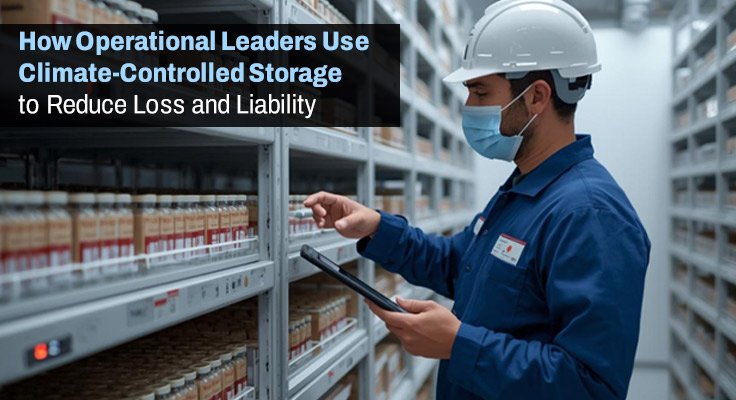
If you manage storage, logistics, or facilities handling temperature-sensitive or high-value goods, this article breaks down:
- Temperature controlled storage risks
- Why systems fail
- How smart operators prevent loss, lawsuits, and write-offs by aligning equipment, monitoring, and storage design before problems start
Keep reading to see how it works in practice.
1. All The Ways Climate-Controlled Storage Can Backfire on You
Climate‑controlled storage fails most often in three ways:
- Systems don’t hold the promised conditions
- Monitoring is inadequate
- Design/maintenance doesn’t match the actual risk profile
The thing is, when temperature or humidity drift, goods spoil, warp, corrode, or develop condensation. This often triggers direct inventory loss and customer claims, even though the facility was marketed as “climate-controlled.”
Mold and moisture are an especially nasty trap, as over 60% humidity accelerates growth on wood, textiles, paper, and furnishings, causing property damage and potential health complaints from employees, visitors, or neighboring tenants.
Another thing worth noting is that it’s not just the stored goods at risk. For instance, slippery floors from condensation, collapsing racks, or mold-triggered illnesses can all create third-party liability for anyone entering or working around your facility.
So, while “climate-controlled” sounds safe, every lapse is a potential financial and legal trap unless your systems, monitoring, and maintenance actually deliver.
2. Why Storage Systems and Climate Controls Must Work Together to Reduce Loss and Liability
Did you know that U.S. warehouse injuries nearly doubled from 42,500 in 2019 to over 80,500 in 2022, with rack collapses, forklift impacts, and overloaded beams driving fatalities and inventory loss?
Yup. And do you know why?
Because so many of these incidents came from ignored inspections, skipped repairs, or exceeding load capacities—basically cutting corners on the “reasonable care” that industrial storage systems demand.
Of course, environmental controls carry a separate but equally critical risk. Even brief temperature excursions can compromise pharmaceuticals, reduce food shelf life, or trigger mold growth.
These risks are tightly linked.
For instance, dense or poorly arranged racking blocks airflow, creating hot or humid dead zones. Meanwhile, cold rooms and freezers stress racks with frost, condensation, and thermal cycling, increasing collapse risk.
Upgrading one without the other simply shifts the problem—either structural accidents or product loss. Therefore, addressing both together is essential, because only then can operational leaders meet the “reasonable care” standard and shield themselves against claims.
3. What Smart Operators Do to Prevent Loss and Liability in Climate-Controlled Storage
Preventing loss isn’t about one upgrade. It comes down to aligning three variables:
- Product sensitivity
- Environmental precision
- Storage system safety
When those match, claims and write-offs usually don’t. Here’s how that plays out in real operations:
- If you’re storing vaccines or biologics, use validated pharma cold rooms
When using validated pharma cold rooms, it’s important that you:
- Keep temperatures at 2–8°C, with mapped profiles and independent data loggers
- Set real-time alarms with clear SOPs for excursions
- Pair them with corrosion-resistant open shelving or pallet racks
- Follow load ratings
- Inspect monthly, plus after forklift impacts
Proper control here can prevent patient-harm incidents and reduce liability.
- If you’re running a food distribution center, maintain proper frozen and chilled zones
If you’re running a food distribution center, keep your freezers at 0°F, chill rooms at 32–40°F, and dry storage near 50°F with humidity control.
Also, use heavy-duty, corrosion-resistant pallet racking, and don’t forget to stabilize pallets.
Together, these measures cut U.S. grocers’ ~$18 billion annual spoilage losses and reduce negligence exposure.
- If you’re storing electronics or microchips, control temperature and humidity
To prevent product loss, corrosion, and static damage, set controlled-room HVAC (mid‑60s–70s °F) with moderate humidity, and position sensors to capture warmest spots.
Place high-value items on anchored, anti-static shelving in low-traffic zones, ensuring airflow isn’t blocked. This also prevents reputational risk masked by per-pound liability limits.
- If you’re holding archives, records, or personal goods, moderate climate and ventilate
If you’re holding archives, records, or personal goods, it’s best that you keep temperature and humidity steady.
All items should be stored off floors and away from walls, and ventilation should be maintained at all times.
Don’t forget to align marketing promises with actual climate control to prevent mold-related disputes and legal claims.
- If you’re a multi-client 3PL, segment zones and monitor continuously
For multi-client 3PLs, it is advisable to:
- Divide frozen, chilled, and controlled zones with independent HVAC and redundant power
- Integrate real-time monitoring into WMS/TMS for automated quarantines and alerts
- Design rack layouts for airflow, frost management, and safe forklift operations, placing high-value items in the safest spots
Documented practices strengthen liability defense and insurance coverage.
Also Read : From Operations to Strategy: How a Supply Chain MBA Builds Leadership Skills