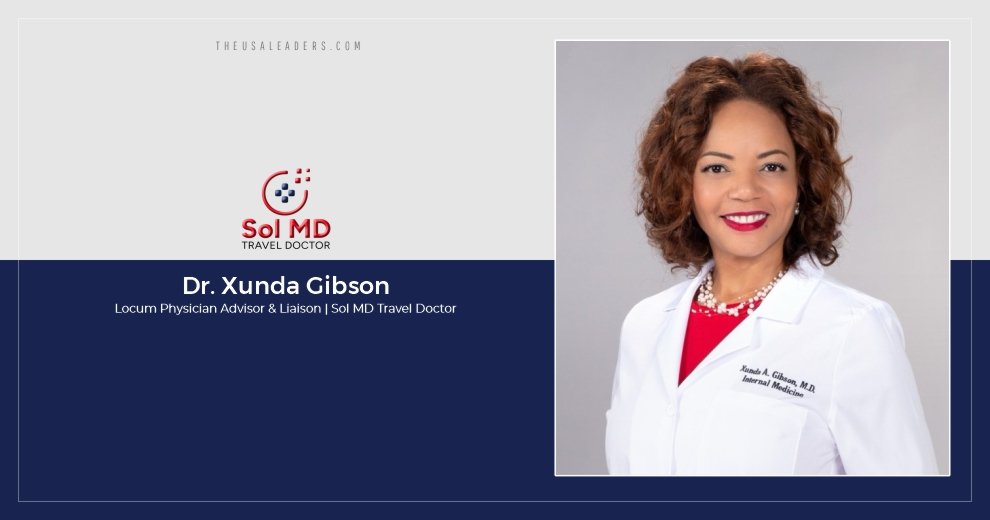
The noise of a modern medical practice is a specific kind of cacophony. It is not just the beep of monitors or the shuffle of feet in a hallway; it is the invisible, crushing static of administrative duties, the hum of rising costs, and the relentless pressure of a system that demands everything and promises very little in return. For fifteen years, Dr. Xunda Gibson lived inside that noise. She did everything she was supposed to do. She attended medical school at the University of Kansas. She flew south to the humid heat of Miami for an internship at Jackson Memorial Hospital, and then west to the coastal calm of Santa Barbara Cottage Hospital for her residency. She became Board Certified in Internal Medicine. She was capable. She was established. She was successful.
And she was drowning.
It wasn’t a dramatic drowning, flailing arms, and screaming for help. It was the quiet, professional drowning of a doctor who realizes that the very thing Dr. Gibson set out to do: help people, form relationships, and heal. However, it was being slowly suffocated by the business of medicine. She had a solo practice, the American medical dream, but the margins were shrinking. Reimbursements were decreasing. The cost of keeping the lights on was rising. It came down, as it so often does in the fractured landscape of healthcare, to a cash flow decision.
So, Dr. Gibson did the unthinkable. She sold the practice. She walked out of the building, away from the politics and the endless charting, and stepped into a void. She didn’t know yet that she wasn’t just leaving a job; she was walking toward a reclamation of her own soul.
The Architecture of Silence
When Dr. Gibson talks about that period now, there is a calmness in her voice that suggests a storm that has long since passed. She speaks with the precision of a scientist but the introspection of a philosopher. After selling her practice, she didn’t immediately rush into the next frantic thing. She took time off and allowed herself to sit in the uncertainty.
It was during this pause that she realized something profound: she could finally do what she truly loved, but she had to strip away the scaffolding of “traditional” medicine to find it.
She accepted a travel assignment in the U.S. Virgin Islands.
It was there, perhaps between the shift in latitude and the shift in attitude, that the reboot happened. The U.S. Virgin Islands offered more than just a change of scenery; they offered a change in gravity. Dr. Gibson found that the crushing weight of administration had lifted. She had time. She could mentally process her life with a clarity that had been impossible in the fluorescent glare of her previous existence.
For the last ten years, Dr. Gibson has worked as a travel doctor across the United States and its territories. She found that when she removed the golden handcuffs of ownership and employment, she didn’t lose stability. She gained it. She found she had more time with her patients, less administrative stress, and, crucially, the flexibility to actually live.
But as she moved through these spaces, a pattern emerged. Everywhere she went, other physicians, tired, burned out, looking for an exit ramp, would corner her. They looked at her life not just with envy, but with a desperate curiosity. They all asked the same question: “How do you do it?”
She realized then that she wasn’t just saving herself. She was prototyping a life raft.
The Meaning of Sol
In 2023, established in Florida, Dr. Gibson launched Sol MD Travel Doctor. The name is not accidental. It is a linguistic and spiritual triptych.
“Sol” is the Latin word for sun, the sustainer of all life on earth. It is the light that burns away the fog. But “Sol” is also a nod to the spiritual “soul” of the individual, the part of us that requires alignment with a higher power to function. And then, there is the third layer, one deeply rooted in her identity. In American culture, “soul” refers to a genre of music—gospel, rhythm and blues—rooted in Black culture. It is a sound that carries an underlying theme of resilience.
Life. Spirit. Resilience.
This is the “Why” that drives Dr. Gibson. It is not merely a staffing agency or a consultancy. It is a permission structure.
Dr. Gibson observed that the current medical model is designed to keep physicians so busy that they do not have time to think for themselves. It is a system that thrives on exhaustion. Her counter-move was a shift in mindset. She realized, “I am an intelligent woman with a variety of experiences… Use it.” And, perhaps more radically: “Stop being so busy.”
Sol MD was built to be the resource she wished she had when she was standing at the crossroads. It is a platform designed to help other physicians trade burnout for freedom, providing a clear, step-by-step blueprint. It strips away the mystery of the business side of travel medicine, teaching doctors how to organize themselves to maximize success.
The Myth of Stability
There is a pervasive fear in medicine that to leave the employed model is to court disaster. We are taught to value the familiar discomfort over the unknown possibility. Dr. Gibson challenges this fear with data and experience.
She argues that the travel doctor actually possesses more stability than the employed physician. An organization can terminate an employee at any time, subject to budget cuts or corporate restructuring. As a travel doctor, Dr. Gibson explains, you are never terminated. You simply choose to renew or exit the assignment. The power dynamic shifts from the institution to the individual.
She advises doctors to work with two or three locum or travel doctor companies simultaneously. This diversification creates a menu of options. It allows a physician to schedule shifts around their life, around their children’s school breaks, around family vacations, around the need to just breathe, rather than squeezing their life into the gaps left by the hospital schedule.
She has spent years debunking the three great myths of the industry.
Myth one: Travel doctors don’t have stable work. The truth, she says, is that there is stable and continuous work available for those who know where to look.
Myth two: It is impossible unless you are highly specialized. The truth is that any doctor, with the right guidance and network, can make this transition.
Myth three: It can’t be done if you have a family. This is perhaps the most damaging myth. Dr. Gibson insists it can be done, whether you are a mother, father, guardian, or caretaker for aging parents. The resources exist; the logistical support is there. It just requires a different kind of planning.
Service through Presence
When we ask who Dr. Gibson is serving, the answer is twofold. She is serving the physician, yes, by offering them a key to the cage. But through them, she is serving the patient in a way that traditional medicine often fails to do.
In the churn of a high-volume private practice, a doctor is often thinking about the next patient, the insurance paperwork, and the overhead. As a travel doctor, Dr. Gibson found she was more present. That presence creates an almost instant connection.
“Patients text me for input even when my assignment has ended,” Dr. Gibson notes.
When the administrative burden is removed, what is left is the doctor and the patient. It is a return to the primary atomic unit of medicine. By serving her own need for balance, she became a better servant to the sick. Dr. Gibson proved that it is possible to give excellent, cost-effective care to patients while maintaining personal balance. When these components align, the result is a fulfilled physician who is actually there, in the moment, with the human being in front of them.
The Quiet Morning
Dr. Gibson is now a leader, an entrepreneur, and a mentor, but she safeguards her peace with the ferocity of a guardian. Her routine is non-negotiable. She reads for pleasure. She takes long walks. She spends quality time with close friends and family.
Her advice to the doctors who feel trapped in the grind, who are standing where she stood fifteen years ago, is deceptively simple. It does not require a grand gesture or an immediate resignation letter.
“Take 30 minutes each day to sit in silence,” she advises. “Preferably in the morning. After that silent period ends, write down any insights that come to you. This is your subconscious nudge.”
She believes that the answers emerge only when we give ourselves the space to just be. She quotes Lisa Nichols: “We are more committed to a familiar discomfort than to an unknown possibility.”
Dr. Gibson believes that balance, peace, joy, and freedom are waiting on the other side of that unknown possibility. She sees the role of travel doctors growing exponentially in the next five to ten years as healthcare demands evolve and global mobility increases. She tells the next generation of female physicians to stop ignoring their intuition. “It is always speaking and guiding you,” she says.
She is no longer the doctor drowning in the noise. She is the one standing on the shore, pointing toward the horizon, showing her colleagues that the water is fine, the sun is shining, and they are free to swim.
Quotes
“Stop ignoring your intuition. It is always speaking and guiding you.”
“Balance, peace, joy, and freedom are awaiting you on the other side of the unknown possibility.”
Also Read: The 10 Prominent Leaders in Healthcare, 2026