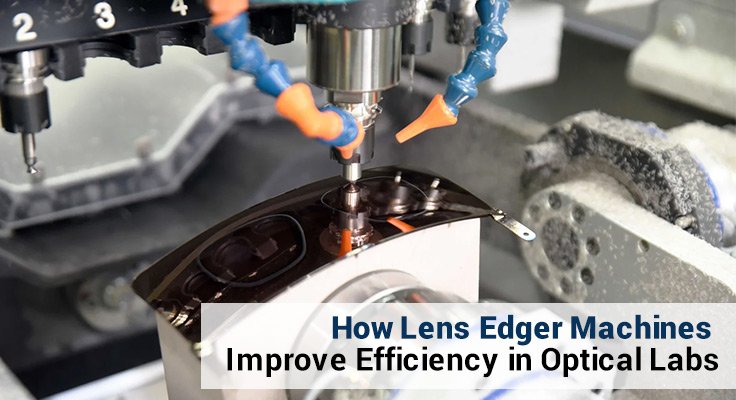
Your glasses weren’t always this good.
Once upon a time (read: not that long ago), crafting your prescription lenses was part science, part black magic. A stressed-out tech in a lab coat would manually trace your frames, squint at alignment marks, and hope the lens didn’t crack mid-cut. Honestly, it was impressive anything ever came out right.
Then came lens edger machines. Precision-driven, software-powered, and built to slice through materials like a sushi chef on espresso.
The result? Optical labs got faster, cleaner, sharper. And yeah—your glasses did too.
Speed isn’t a flex—it’s survival
You can’t run a modern optical lab on 1990s timelines. Customers want their glasses yesterday, and retailers promise same-day turnaround like it’s no big deal.
But it is a big deal. Unless you’ve got a lens edger that can whip out custom cuts in 5–7 minutes flat—with bevels, polishes, and smart alignment baked in—you’re losing the race before it starts.
Time is money. Delays are death. Let’s not sugarcoat it.
Precision without sweat
Here’s the magic trick: automation doesn’t just make things faster, it makes them better.
Modern lens edgers use digital tracing and 3D modeling to cut lenses with obsessive accuracy. Want to fit a wraparound sports frame with a tricky curve? Done. Need to edge polycarbonate progressives with a nano-bevel? Easy. Your tech doesn’t even have to lift a pen.
Less waste. Fewer do-overs. More money.
Let’s talk economics.
Miscalculations mean wasted blanks. Wasted blanks mean wasted money. And when high-index lenses cost as much as your monthly Wi-Fi bill, that’s not a line item you want ballooning.
Modern edgers optimize every cut. Auto-centering, real-time error detection, and smart mapping all reduce scrap. You’re not just edging lenses—you’re cutting overhead.
And yes, we said “smart mapping.” It’s like GPS for optics, but it saves you from headaches instead of traffic.
One machine to rule them all
You’d think a machine this capable would be a diva. Needy. Specialized. Maybe allergic to older systems.
Nope.
Today’s best edgers are the Swiss Army knives of the optical world. Rimless frames? Check. Safety bevels? Yep. Freeform progressives in Trivex? Let’s go.
They talk to your lab management software, sync with digital job tickets, and play nice with your EHR. Integration is the name of the game, and these machines speak fluent workflow.
Data isn’t just for nerds anymore
The really slick labs—the ones running lean, fast, and scalable? They’re using lens edgers that spit out data as they work.
Think: real-time productivity tracking. Automated logs. Performance diagnostics. It’s like having a second pair of eyes on the floor—except these ones don’t blink, get tired, or forget to hit “save.”
And when something goes wrong (because it will), predictive maintenance features often flag the issue before it tanks your workflow. That’s not just smart—that’s future-proofing.
So what’s the catch?
Honestly? There isn’t one. If you’re still relying on manual or semi-automated systems, the catch is you—you’re the bottleneck.
Labs that have upgraded to top-tier edgers aren’t just “keeping up.” They’re winning. Scaling faster. Reducing rework. Delivering better outcomes, and doing it with machines that practically run themselves.
It’s not just about better lenses.
It’s about a better lab.
Also Read: How often should you change your contact lenses? We explain