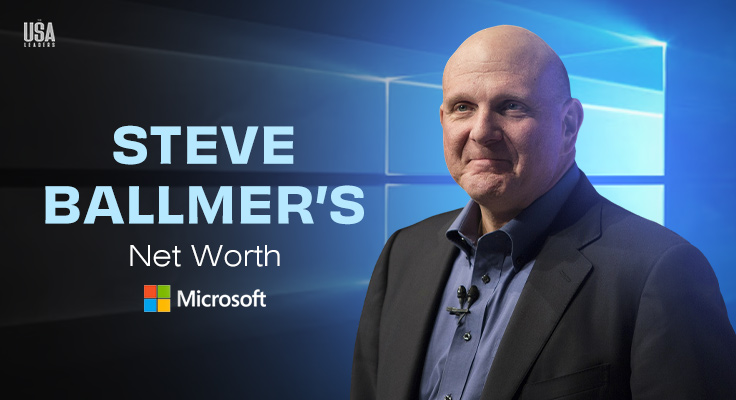
Let’s get one thing straight. Steve Ballmer’s net worth is widely estimated in the mid‑hundreds of billions, and a reasonable 2025 figure is around $146 billion, depending on how Microsoft and his other assets are valued at any given moment.
How on earth does a guy who joined as employee #30—not a founder, not an originator—end up outpacing the very legends of tech, sports, and investing? It wasn’t a lottery ticket. This wasn’t just being in the right place at the right time.
This is a story of incredible, gut-level conviction. It’s about making audacious strategic bets and having an almost religious devotion to data and long-term value. Let’s pull back the curtain and unravel, piece by incredible piece, the definitive story of how Ballmer built his empire. From his days as a math whiz at Harvard to his wild tenure as Microsoft’s CEO, and now as the architect of a $5+ billion NBA powerhouse and a game-changing philanthropist, we’re dissecting it all. You’re about to experience his journey. Most of that fortune still comes from his Microsoft stake, with the rest tied to the Los Angeles Clippers and a smaller mix of other assets.
Let’s Explore Steve Ballmer’s Net Worth Journey
To really understand Steve Ballmer’s net worth today, you have to follow his path from math student at Harvard to Microsoft’s first business manager, its CEO, and ultimately the richest sports team owner in the world.
1. The Foundation: From Harvard to Microsoft Employee #30
Our story starts in Detroit, Michigan, on March 24, 1956. As the son of a Ford Motor Company manager, a young Steve Ballmer learned the value of discipline and sheer hard work from day one. That drive took him to Harvard University, where his brilliant, analytical mind shone. He graduated magna cum laude in applied mathematics and economics—a skill set that would become his secret weapon in the ruthless world of tech.
But the real twist of fate? Meeting his dorm-mate, a guy named Bill Gates. That friendship would change everything.
After a quick spin as a product manager at Procter & Gamble and a brief stop at Stanford’s business school, history came calling. In 1980, Gates made the pitch: drop out of Stanford and become Microsoft’s first-ever business manager. Employee #30.
● The Pivotal Compensation Package: The Deal That Changed Everything
Ballmer’s starting salary was a solid $50,000. But the real genius was in the contract he negotiated: a 10% cut of the profit growth he generated. As profits exploded, that deal quickly became too good to be true. So, they renegotiated.
Ballmer swapped his profit share for something far more powerful: an 8% equity stake in Microsoft. Think about that. Bill Gates himself reduced his own share to make it happen, a true sign of how much he valued Ballmer’s contribution.
That 8% stake, worth just $56 million at Microsoft’s 1986 IPO, was the tiny acorn from which a colossal financial oak tree would grow. It was his first, and most important, bet on long-term ownership over quick cash. What a bet that turned out to be! That 8% stake, worth about $56 million at Microsoft’s 1986 IPO, became the tiny seed that eventually grew into the core of Steve Ballmer’s net worth
2. The Microsoft Era: Forging a Behemoth (1980 – 2014)
Ballmer’s climb at Microsoft was nothing short of relentless. He joined in 1980 and immediately became the operational engine of the company, masterminding sales, support, and the entire business side of the most important software company on the planet.
● The Highs: Billions in Revenue and Industry Dominance
When he took the CEO reins in 2000, the results were simply dazzling. Under his leadership, annual revenue skyrocketed from $25 billion to $78 billion by 2013. Net income nearly tripled, jumping from $7.8 billion to an incredible $21.8 billion in his final full fiscal year.
Product Wins That Defined a Generation:
- Windows XP:
This wasn’t just an operating system; it was a cultural phenomenon. XP became one of Microsoft’s best-selling and most beloved products, cementing its absolute dominance of the PC world for years.
- The Xbox Gamble:
Ballmer pushed Microsoft into the high-stakes gaming world, and boy, did it pay off. The Xbox and Xbox Live platforms carved out a massive piece of the market, brilliantly diversifying the company’s future.
- Laying the Cloud Foundation:
He was the driving force behind Microsoft’s push into the enterprise space with titans like Windows Server, Exchange, and SQL Server. Crucially, he laid the very groundwork for what would later become Microsoft Azure—the cloud giant that powers the company today. People didn’t fully see it then, but his foresight was setting the stage for the next era.
● The Lows: Gut-Wrenching Missteps and Criticism
But let’s be real—Ballmer’s journey wasn’t a perfect highlight reel. Acknowledging the failures is key to understanding the full picture.
- The Big Mobile Miss:
This is the one that stings. Microsoft was late and clumsy in the smartphone revolution. Its Windows Phone just couldn’t compete with Apple and Google. Ballmer himself famously laughed off the iPhone’s potential—a moment he and others would later admit was likely a $400 billion missed opportunity. Ouch.
- The Nokia Fiasco:
In a desperate attempt to catch up, Microsoft bought Nokia’s mobile phone business for $7.2 billion in 2013. The move was a disaster, leading to one of the biggest, most painful write-downs in tech history.
- A Frustrating Stock Price:
Despite the soaring profits, Microsoft’s stock price just treaded water for much of his time as CEO. Investors grew frustrated watching other tech stocks fly to the moon. When the stock took off under Satya Nadella, many saw it as proof of value that Ballmer hadn’t managed to unlock, even though he’d built the foundation for it.
- A Controversial Management Style:
His ‘stack-ranking’ performance review system was notorious. It was accused of killing innovation and making employees compete against each other instead of collaborating. It was a practice so intense that even Ballmer himself—and Microsoft later—scrapped it for a better way.
3. The Anatomy of His $146 Billion Fortune: A Detailed Breakdown
● Pillar 1: Microsoft Stock—The Greatest ‘Hold’ in Corporate History
The bedrock of Ballmer’s wealth is his unwavering insistence on holding his Microsoft shares. By the end of his CEO era and into retirement, Ballmer held roughly 333 million shares, accounting for about 4% of Microsoft’s outstanding equity. Recent billionaire trackers and business outlets now estimate that his Microsoft stake, past stock sales, and dividends together put Steve Ballmer’s net worth somewhere between roughly $140 billion and over $160 billion. While ultimate founders like Gates and Allen diversified or donated much of their wealth, Ballmer’s loyalty to his stake transformed his position from ‘rich executive’ to ‘tech demigod’.
Capital Appreciation Under Satya Nadella:
When Ballmer stepped down in 2014, Microsoft’s market cap was about $315 billion. Thanks to Nadella’s bold pivot to cloud and AI, Microsoft soared to a $3.3 trillion market cap by 2024. That surge is also why, in some billionaire rankings, Steve Ballmer has recently overtaken Bill Gates in net worth. This ten-fold leap in valuation multiplied Ballmer’s already-massive fortune, demonstrating the unparalleled upside of conviction-based holding.
The ‘Dividend Machine’:
Perhaps more remarkable—the single most extraordinary passive income in business history—is Ballmer’s annual dividend stream:
- Current Shares: ~333,000,000
- Annual Dividend per Share (2025): $3
- Annual Dividend Income: $3 × 333,000,000 = $999,000,000 ($1 billion)
Using those ranges as a guide, $146 billion is a reasonable 2025 midpoint estimate for his total fortune.
Yearly, Ballmer’s Microsoft position generates about $1 billion in pure dividend cash, a testament to the compounding power of holding a great, dividend-paying stock for decades.
● Pillar 2: The Los Angeles Clippers—From NBA Scandal to Sports Empire
In 2014, Ballmer made history with a $2 billion all-cash acquisition of the Los Angeles Clippers. A decade later, estimates put the Clippers’ value at around $4.5–$4.6 billion, meaning the franchise is now worth more than double what he paid. paying nearly four times the previous NBA franchise record. Skeptics panned the move—yet, under Ballmer’s stewardship, the Clippers became perennial playoff contenders, and the franchise’s value ballooned:
- 2024 Forbes Valuation:
Intuit Dome: Ballmer invested a further $2 billion of private funds into the Intuit Dome, granting the Clippers their own state-of-the-art arena (a major value proposition previously lacking). This move is expected to vault the franchise’s revenue and long-term worth well beyond current figures.
Ballmer’s hands-on energy and willingness to invest in fan experience (e.g., “no lines for toilets!” and hypersensor-laden crowd tech) have transformed the Clippers from a distressed asset to one of the NBA’s crown jewels. This explosive rise also helps explain why Steve Ballmer consistently ranks as the richest sports team owner in the world.
● Pillar 3: The Ballmer Group & USAfacts.org—Philanthropy as Systemic Investment
Ballmer’s philanthropic endeavors are themselves monumental multi-billion-dollar engines aimed at structural change. The Ballmer Group, founded with his wife Connie, is dedicated to improving economic mobility for children and families in the United States. Its investments tackle areas like education, child welfare, housing, criminal justice reform, and now climate change—all through a rigorously data-driven, trust-based approach.
- USAfacts.org:
Born of Ballmer’s frustration with government data opacity, USAfacts provides nonpartisan, accessible, government-sourced data to empower citizens and decision-makers. The scale of these initiatives, with many billions of dollars committed, underscores just how large Steve Ballmer’s net worth has become and how much of it is being directed toward long‑term social impact. Ballmer’s substantial investment of personal capital turned it into one of the most authoritative resources for understanding American government spending, outcomes, and policies—a philanthropic venture that mirrors his business obsession with numbers and transparency.
● Pillar 4: Real Estate & Other Ventures—Maintaining, Not Chasing, Diversification
Compared with his giant Microsoft stake and the Clippers, Ballmer’s real estate and other private holdings are only a small slice of his overall net worth. Though real estate and private investments comprise a fractional portion of Ballmer’s fortune, they are nonetheless significant by ordinary standards. His primary residences are in Washington state (notably on Whidbey Island and Hunts Point), acquired over decades and perfectly reflecting his understated personal lifestyle. Additionally, Ballmer maintains luxury sports assets like LA’s Kia Forum (purchased for $400 million) to augment the Clippers/Intuit Dome ecosystem.
Unlike many of his billionaire peers, Ballmer intentionally dials back broad diversification, shunning private equity and “exotic” investments in favor of the two engines he understands most deeply: Microsoft and the Clippers.
4. The Ballmer Philosophy: Strategy, Challenges, and Legacy
● ‘Go All In’:
Ballmer’s trademark energy is more than meme fodder—it’s a core leadership principle. He funnels total commitment into every pursuit, whether closing a partnership at Microsoft or firing up fans at the opening of a Clippers game. This ‘go all in’ ethos inspired enormous loyalty from teams and, crucially, triggered the very risk-taking that underpinned Microsoft’s transformation into a diversified tech powerhouse.
● Data-Driven Decisions:
Ballmer has long championed decisions rooted in hard numbers, not intuition alone—a trait that birthed USAfacts and suffused his philanthropic strategies with the same rigor as his business ones.
● Persistence and Long-Term Vision:
Few tenures have been so steadfast, and few leaders have weathered as much criticism. Ballmer’s willingness to persist—amid stagnant stock prices, harsh media narratives, and aggressive internal politics—shows a leader comfortable with playing the long game. Holding his massive Microsoft stake required unusual conviction, as many of his peers diversified or sold amid media skepticism.
● Challenges and Awards:
Chief among his career trials were the missed mobile moment, the Nokia misfire, and a sometimes-controversial management style (e.g., stack ranking).
Yet, Ballmer’s perseverance is evident in his numerous accolades: Harvard Business School Alumni Achievement Award, U.S. National Medal of Technology and Innovation, Legion of Honour, and, most symbolically, his induction among the world’s leading philanthropists.
On Endorsements: Ballmer’s investing philosophy is as pragmatic as his management: invest, don’t endorse. He’s vocal about not publicly backing politicians or brands, even while privately believing in the value of transformative, metrics-based organizations.
My Opinion on Steve Ballmer’s Net Worth Strategy
Let’s be clear: Steve Ballmer’s net worth story is almost one-of-a-kind. He’s not a founder-billionaire like Gates or Bezos. His playbook wasn’t about starting company after company.
It was about something rarer: unwavering conviction in a single, incredible company. He became richer than his old boss not by cashing out and diversifying, but by ‘hodling’—a term from the crypto world for holding on for dear life. While Gates moved his fortune into a diverse portfolio, Ballmer’s wealth engine remained the very company he helped build. It’s a contrarian path that few have dared to walk, and almost none have mastered on this scale.
Here Are Some Lessons From His Journey
● Own a Piece of the Rocket Ship.
Ballmer’s fortune is the ultimate proof that owning a small piece of something explosive is infinitely more powerful than the biggest salary you can imagine. That initial 8% stake, won through negotiation, was the masterstroke.
● ‘Boring’ Income Can Be Mind-Blowing.
Who knew dividends could be so thrilling? That $1 billion annual cash flow is a testament to the fact that sometimes the most extraordinary wealth comes from patience, not constant, frantic activity.
● Your Second Act Can Define Your Legacy.
He could have retired and sailed off into the sunset. Instead, he poured his passion into the Clippers and philanthropy, proving that true wealth is also about impact and building something that lasts beyond you.
● Conviction is Your Most Valuable Asset.
Ballmer nearly sold his shares after retiring. Think about that. But his loyalty to Microsoft, even when it wasn’t popular, made him an ‘accidental’ beneficiary of the company’s greatest growth era. That’s the power of sticking with quality.
● Passion Is a Compounding Asset.
Ballmer’s famous enthusiasm isn’t just for show; it’s a strategic tool. The same energy that fired up Microsoft developers now creates real, tangible value for his NBA team and his philanthropic work. Passion, when fully applied, compounds just like money.
FAQ
1. What is Steve Ballmer’s net worth in 2025?
Estimates for Steve Ballmer’s net worth in 2025 generally fall in the 140‑plus billion dollar range, with some billionaire trackers placing him between roughly 140 and 160 billion, depending on Microsoft’s share price at any given time. Using those ranges as a guide, 146 billion dollars is a reasonable mid‑point estimate for his fortune in 2025.
2. How did Steve Ballmer build a net worth of around $146 billion?
More than 90% of Steve Ballmer’s net worth comes from his massive Microsoft stake: about 333 million shares that still make him the company’s largest individual shareholder. On top of that, he owns the Los Angeles Clippers, now valued at several billion dollars, and has earned billions from selling Microsoft stock and collecting annual dividends that are estimated at around 1 billion dollars a year.
3. Is Steve Ballmer the richest sports team owner in the world?
Yes, recent rankings of the world’s richest sports team owners consistently list Steve Ballmer at the top, ahead of other NBA, NFL, and European football club owners. His combination of a huge Microsoft stake and the rapidly appreciating value of the Los Angeles Clippers makes him the wealthiest team owner in global sports.