The USA Leaders
February 27, 2026
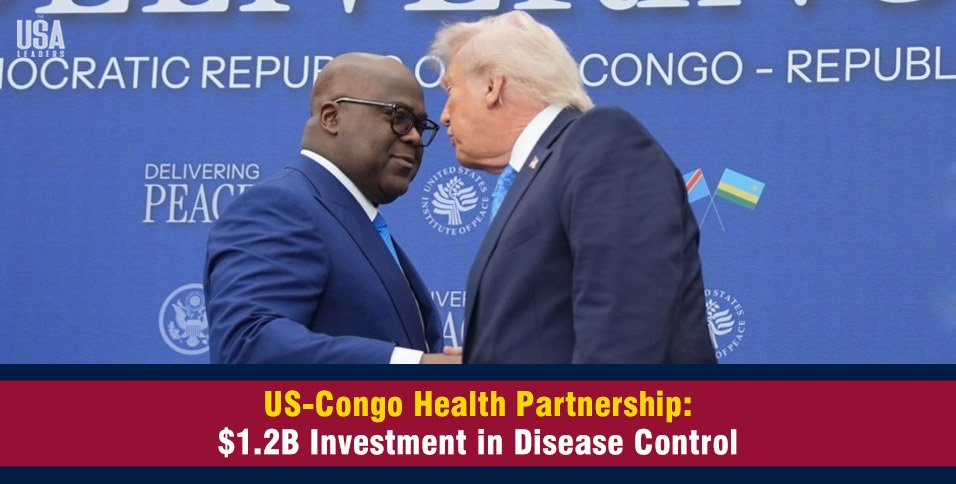
The US Congo Health Partnership marks a major shift in Washington’s global health strategy after the United States signed a $1.2 billion agreement with the Republic of Congo on February 26, 2026.
The five-year deal commits $900 million in U.S. funding and $300 million in Congolese domestic spending through 2031.
The agreement stands as one of Washington’s largest recent bilateral health commitments in Africa. At the same time, it reflects President Donald Trump’s move toward country-specific partnerships under his “America First” framework.
However, similar agreements also arrive amid growing debate over data-sharing provisions attached to similar agreements across Africa.
Funding Structure and Priority Areas
Under the Health Partnership, Washington will provide $900 million over five years, while Congo will allocate $300 million from its national budget.
Together, both governments will focus funding on high-burden diseases and systemic health reforms. Priority areas include:
- HIV/AIDS
- Tuberculosis
- Malaria
- Maternal and child health
- Polio eradication
- Disease surveillance
- Workforce training
- Emergency preparedness
U.S. officials said they designed the financing structure to promote co-investment and measurable outcomes. They emphasized that Congo’s financial contribution demonstrates national ownership rather than long-term aid dependence.
Meanwhile, Congo’s health ministry said it will expand access to antiretroviral therapy, strengthen tuberculosis detection networks, and scale up malaria prevention tools such as bed nets and rapid diagnostics.
The ministry also plans to increase vaccination coverage, modernize laboratories, and train frontline health workers, particularly in rural provinces.
Broader Policy Context
The US Congo Health Partnership forms part of a broader restructuring of U.S. global health assistance.
In previous years, much funding flowed through agreements managed by the United States Agency for International Development. Now, the United States Department of State has taken a more direct role in negotiating bilateral compacts.
Officials said the State Department has signed 19 similar health partnerships with African governments under the new framework.
- Administration officials argue the model will:
- Align funding more closely with national priorities
- Establish clearer performance benchmarks
- Require co-financing from partner governments
- Encourage long-term domestic health investment
However, global health policy analysts warn that the shift could disrupt established delivery systems if the transition is not managed carefully.
Data-Sharing Controversy Raises Questions
The debate over data governance has become sensitive. The Africa Centres for Disease Control and Prevention raised concerns that some agreements require countries to share data on viruses with Washington as a condition for funding.
“There are huge concerns regarding data, regarding pathogen sharing,” said Dr. Jean Kaseya, Africa CDC director-general.
Zimbabwe rejected a similar $367 million agreement, with government spokesperson Nick Mangwana calling it an “unequal exchange.”
“When financial assistance is contingent upon concessions that touch upon national security, data sovereignty, or access to strategic resources, it fundamentally alters the nature of the relationship. This we cannot accept,” Mangwana said.
It remains unclear whether the Congo agreement includes comparable data-sharing requirements.
Neither government has released the full text. Congolese authorities have not publicly indicated that data-sharing provisions posed an obstacle during negotiations.
Implications for Congo’s Health System
For Congo, the US Congo Health Partnership could significantly strengthen disease control programs and health infrastructure.
The country continues to face high burdens of malaria and tuberculosis, while rural regions often lack sufficient medical personnel and diagnostic capacity.
The five-year funding timeline provides predictable financing, which supports long-term planning. Investments in workforce training and laboratory modernization could also strengthen overall system resilience beyond individual disease programs.
Still, implementation will determine the partnership’s success. Observers say attention will focus on:
- Data governance and reporting transparency
- Timely disbursement of funds
- Performance monitoring and oversight
- Long-term sustainability beyond 2031
Co-financing requirements also place pressure on Congo’s public finances. If economic conditions tighten, maintaining the $300 million domestic contribution could prove challenging.
Outlook for U.S.-Africa Health Cooperation
Public health experts say the size of the commitment shows that Washington remains deeply engaged in African health security, even as it restructures its aid model.
Congo’s officials have framed the US Congo Health Partnership as a long-term investment in durable systems rather than temporary assistance.
Over the next five years, policymakers and health leaders will closely monitor whether the partnership:
- Strengthens national disease surveillance and response capacity
- Delivers measurable reductions in HIV, tuberculosis, and malaria
- Maintains transparency in funding and reporting
- Preserves national sovereignty over health data
- Encourages long-term domestic investment in health systems
Ultimately, the performance of the US Congo Health Partnership will help shape the future of U.S.-Africa health cooperation and determine whether this bilateral model becomes the new standard for global health engagement.
Policymakers across the continent will watch closely to see whether this new model delivers measurable public health gains while respecting sovereignty and strengthening local systems.
Neha Shekhawat