The USA Leaders
January 20, 2026
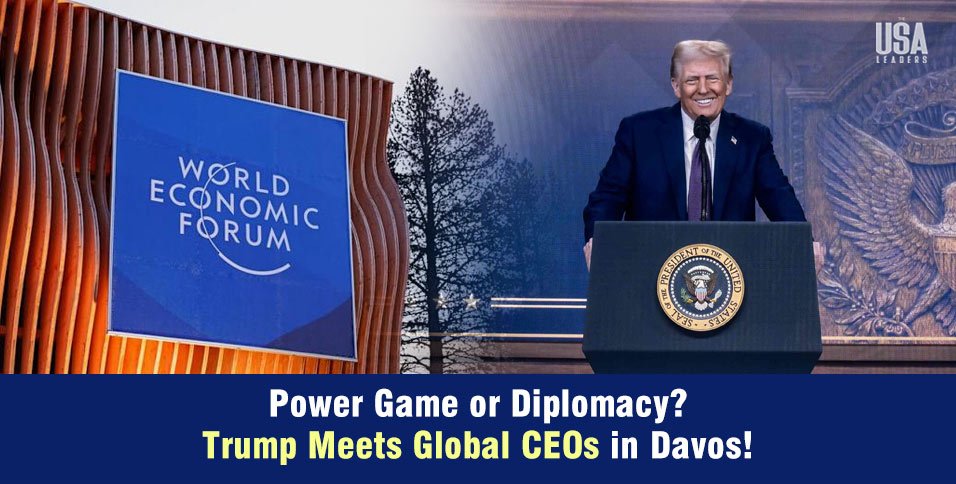
Davos — On the opening day of the World Economic Forum’s annual meeting, U.S. President Donald Trump seized a central stage not for climate pledges or AI talk, but to position American policy at the heart of global corporate strategy and geopolitical interest.
In a departure from recent Davos norms, Trump has personally invited top global CEOs — spanning financial services, consulting, and crypto to a special reception following his address, marking a clear shift in how U.S. leadership is engaging with the forum’s business elite.
With more than 3,000 delegates from over 130 countries attending this year, Trump’s presence is amplifying debates over trade, national strategy, and global economic alignment setting the tone for discussions through the week. This focus reflects broader tensions between U.S. policy priorities and long-established pillars of global cooperation.
For CEOs and policymakers alike, the message is unmistakable: Davos is now a place where Washington’s economic and strategic narratives may outweigh traditional Davos themes.
Trump’s Distinct Agenda at Davos
President Trump’s agenda at WEF centers on U.S. policy prominence over traditional Davos themes of collaborative multilateral agendas. Rather than positioning climate or inclusive growth at the top of his agenda, his engagements tilt toward economic nationalism, trade leverage, and U.S. strategic priorities — from housing affordability messaging to contentious diplomatic negotiations.
The White House has directly invited CEOs from major sectors, including financial services, technology, and consulting, to a reception scheduled after Trump’s official address — an unusual step that underscores a melding of state policy with corporate strategy dialogues.
A Broader U.S. Delegation
Trump arrives in Davos flanked by senior officials, including Treasury Secretary Scott Bessent, housing his policy narratives early in the week. This coordinated push suggests the administration is aiming to signal U.S. economic strength and strategic priorities to both global markets and business leaders.
Geopolitics Meets Global Business
This year’s Davos takes place against a backdrop of heightened geopolitical tensions. Trump’s recent threats to impose tariffs on European allies over the Greenland issue — a matter framing Washington’s strategic calculus — have drawn sharp responses from European leaders, with potential repercussions for transatlantic relations and markets.
Business leaders at Davos are vocal about uncertainty in global trade and investment climates. Industry surveys referenced at the forum show a decline in CEO confidence in growth prospects, citing geopolitical and trade policy uncertainty as key headwinds.
These developments demonstrate how U.S. policy signals are filtering into boardrooms and investor strategy discussions worldwide — not just into diplomatic circles.
Corporate Leaders’ Calculus
Executives attending the forum describe mixed views on Trump’s approach.
Some see direct U.S. engagement with Global CEOs as an opportunity to clarify expectations, while others express concern that unpredictable trade stances and geopolitical frictions could dampen investment sentiment and complicate long-term planning.
The prominence of U.S. policy at an event historically shaped by broader global agendas — like climate cooperation or supply chain resilience — reflects shifting priorities among sovereign actors and private sector stakeholders alike.
Real-Time Market and Policy Signals
The Trump focus at Davos has already rippled into markets and policy discussions:
- Trade uncertainty linked to tariff threats has pressured European stock markets, highlighting potential cross-border economic impact.
- Global inequality debates, fueled by reports on rising billionaire wealth, are filtering into public and investor conversations, tying into concerns over policy direction.
For investors, boardrooms, and policymakers, the Davos agenda is now as much about national strategy as it is about traditional economic cooperation.
Expert Opinion
The World Economic Forum has historically been an arena for global consensus on economic collaboration.
This year, however, U.S. policy narratives are reshaping the conversation toward national economic strategy and competitive positioning.
Trump’s direct engagement with CEOs signals an intent to insert U.S. geopolitical aims into global corporate strategy discussions, a departure from conventional forum norms. For business leaders, this means calibrating strategy not just to market fundamentals but to dynamic policy signals emanating from Washington.
The risk, of course, lies in increased fragmentation: if national agendas overshadow cooperative frameworks, capital allocation and supply chain strategies may become more conservative. Leaders should watch whether this approach catalyzes new investment commitments or prompts caution among global boards concerned about trade and regulatory volatility.