The USA Leaders
April 1, 2026
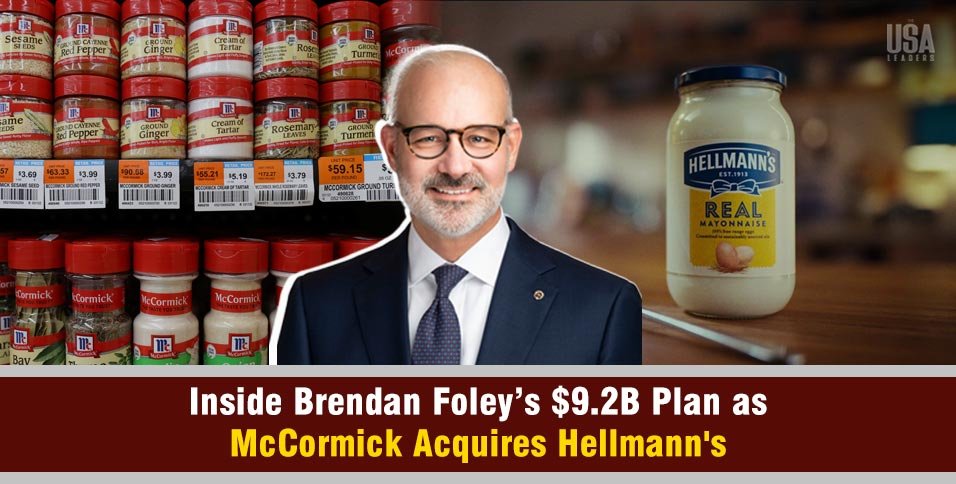
When McCormick announced its $9.2 billion deal, in which McCormick acquires Hellmann’s, the condiment industry took notice.
At first glance, the move looked straightforward. A spice company bought a mayonnaise brand. But CEO Brendan Foley had a larger goal.
He wanted to consolidate the flavor category. The strategy brings spices, mustard, hot sauce, and mayonnaise under one company.
This approach changes the balance of power in grocery stores across the United States. If McCormick controls multiple essential condiments, retailers must depend on the company for a larger share of the pantry aisle.
Foley effectively turned McCormick into what analysts now call a flavor powerhouse.
From Spice Company to Pantry Leader
McCormick built its reputation on spices. For decades, the company dominated seasonings such as pepper, paprika, and oregano.
However, Foley saw a broader opportunity.
Consumers do not buy spices alone. They buy products that create flavor experiences. McCormick began expanding into condiments to capture that demand.
Earlier acquisitions included Frank’s RedHot and French’s mustard. Those deals strengthened McCormick’s position with retailers.
Every additional brand increased the company’s influence in negotiations with chains like Walmart, Kroger, and Costco. Yet one major category remained outside McCormick’s portfolio.
Mayonnaise.
When Unilever decided to sell Hellmann’s to focus on beauty and personal care products, which the company confirmed in its announcement on combining its foods business with McCormick & Company.
The result was a $9.2 billion deal where McCormick acquires Hellmann’s, one of the most recognized condiment brands in American households.
The Consolidation Play
The key advantage of the acquisition lies in category consolidation. Retailers typically negotiate aggressively with suppliers when multiple brands compete for shelf space.
Before the acquisition, McCormick controlled spices but not mayonnaise. Retailers could pressure the company on pricing or promotions. Now the equation has changed.
McCormick sells spices, mustard, hot sauce, and mayonnaise. That combination increases its bargaining power with grocery chains.
Retailers cannot easily reduce shelf space for McCormick products without risking empty shelves in several key categories.
Industry analysts say this leverage may reduce promotional spending. Buy-one-get-one promotions and coupon discounts may become less common.
Instead, McCormick may keep more of the margin that previously funded discounts.
The Premium Strategy
Foley’s strategy goes beyond consolidation. He also believes consumers will pay more for flavor innovation.
McCormick has already proven this concept in spices. The company sells premium seasoning blends, organic options, and specialty products at higher prices than basic spices.
The same approach could apply to mayonnaise.
After the deal where McCormick will acquire Hellmann’s, product development teams began testing new variations.
These may include garlic aioli, chili-infused mayo, and organic varieties.
Traditional Hellmann’s sells for roughly $3 to $4 per jar in many US supermarkets. Premium versions could sell for $5 to $6 per jar.
This shift creates higher profit margins while offering consumers more options. Retailers also benefit because premium products increase average transaction value.
As a result, both suppliers and retailers gain incentives to expand shelf space for new variants.
The $600 Million Synergy Target
Financial markets focused on another number in the acquisition announcement. McCormick expects $600 million in cost synergies from the integration.
These savings will likely come from several areas.
- First, supply chains can merge. McCormick already sources oils, spices, and vinegar for multiple products.
- Second, manufacturing efficiency may improve as facilities produce larger volumes across brands.
- Third, larger ingredient purchases can reduce costs through scale or shift toward simpler formulations and cleaner ingredients.
However, the company does not need to change Hellmann’s recipe to achieve these savings. Operational efficiencies alone could generate much of the expected $600 million.
This approach allows McCormick to protect product quality while improving margins.
Why Unilever Sold the Brand
The acquisition also reflects a strategic shift at Unilever.
The company decided to focus on higher growth categories such as beauty and personal care. Brands like Dove and TRESemmé deliver stronger margins and faster growth than traditional packaged foods.
Selling Hellmann’s allowed Unilever to redirect investment into those segments. Meanwhile, McCormick doubled down on its core strength.
Flavor.
The deal reinforces McCormick’s identity as a focused company built around seasoning and condiments.
Investors often reward companies that specialize in a single category rather than spreading resources across many industries.
The Three-Year Integration Plan
Industry observers expect the integration to unfold gradually. Year one will likely focus on stabilizing operations.
McCormick will maintain Hellmann’s core product while aligning supply chains and manufacturing.
Year two may introduce new premium mayonnaise varieties. Retailers could reduce discount promotions while expanding shelf space for these higher margin products.
By year three, analysts expect McCormick to strengthen pricing influence across several condiment categories.
At that point, the company may consider additional acquisitions in related areas such as sauces or salad dressings.
The Leadership Lesson
The deal where McCormick acquires Hellmann’s for $9.2 billion demonstrates a broader strategy in the food industry.
Companies increasingly pursue category leadership rather than scattered portfolios. By controlling multiple products that appear in the same shopping trip, suppliers gain stronger negotiating power with retailers.
Foley’s strategy reflects that trend. Instead of competing in isolated categories, McCormick aims to lead the entire flavor segment of the grocery aisle.
The Takeaway
Many observers initially saw the Hellmann’s acquisition as a simple expansion. However, the strategy behind it runs deeper.
By uniting spices, sauces, mustard, and mayonnaise, McCormick acquires Hellmann’s and strengthens its position as the dominant flavor company in US grocery stores.
The move increases retail leverage, opens the door to premium innovation, and supports higher margins.
Over the next three years, shoppers will likely see more variety in the condiment aisle.
But the bigger shift may occur behind the scenes.
The company that once sold spices now shapes the entire flavor economy.
Neha Shekhawat