The USA Leaders
March 31, 2026
Key Takeaways
- Ackman’s asymmetry thesis depends primarily on regulatory reform rather than housing demand
- Decisions by the Federal Housing Finance Agency could determine the timeline for privatization
- Critics, including Michael Burry, expect a slower restructuring process
- The next six months will clarify whether Ackman’s bet proves prescient or premature.
- Key announcements from housing regulators and economic policymakers will provide the first signals about the future of Fannie Mae and the structure of the US mortgage market.
Fannie Mae & Freddie Mac guarantee a large share of US home loans, making their policy future critical to the $12 trillion American mortgage market.
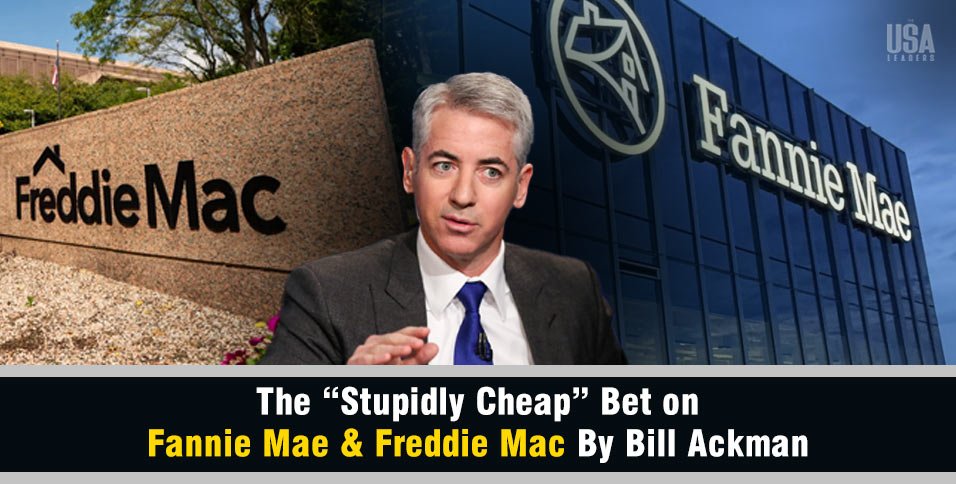
The two government-sponsored enterprises, Fannie Mae and Freddie Mac, sit at the center of the American housing finance system. In March 2026, billionaire hedge fund manager Bill Ackman revealed a large position in Fannie Mae (FNMA).
He described the mortgage giant as “stupidly cheap.” The comment quickly spread across institutional trading desks and retail investor forums.
However, the trade is not simply about a stock. Ackman’s thesis centers on a potential restructuring of the US housing finance system.
The timeline depends heavily on the Federal Housing Finance Agency (FHFA), which has overseen Fannie Mae since the 2008 financial crisis.
If policymakers move toward privatization, the shift could influence housing markets and the broader $12 trillion US mortgage system that underpins American home lending.
Why Fannie Mae & Freddie Mac Remain Central to US Housing Policy
Ackman’s investment centers on what he calls an asymmetry thesis. In simple terms, the potential upside significantly outweighs the downside.
If Fannie Mae & Freddie Mac remain under government conservatorship, the stock could deliver limited gains. However, if policymakers end federal control and recapitalize the company, the equity value could rise dramatically.
Through Pershing Square Capital Management, Ackman has built a reputation for identifying policy-driven opportunities. His strategy often targets companies where regulatory change unlocks hidden value.
Retail investors have also amplified the story. Discussions on platforms like Reddit highlight the simplicity of the trade narrative. A small downside combined with a large potential payoff creates a compelling investment thesis.
The Ackman Bet Breakdown
| Scenario | Probability (Ackman’s view) | Potential Payoff |
| GSE Privatization (2026-2027) | 60% | 10x return |
| Extended regulatory limbo | 30% | 1-2x return |
| Regulatory clampdown | 10% | 0.5x value |
Housing policy researchers at the Urban Institute say the timeline remains uncertain. Analysts note that privatizing government-sponsored enterprises would require capital restructuring and regulatory approval.
Economists at Moody’s Analytics also point out that new capital buffers created after the 2008 housing crisis could complicate any rapid transition to private markets.
Why Personnel Decisions Matter More Than Market Fundamentals
Housing policy decisions rarely come from markets alone. They emerge from leadership inside federal institutions and advisory bodies such as the PCAST 2026, which help shape federal economic and regulatory priorities.
The Federal Housing Finance Agency controls the regulatory framework governing Fannie Mae. Any decision regarding capital rules, oversight, or conservatorship could determine the company’s future.
Within Fannie Mae itself, leadership also shapes strategy.CEO William J. Pulte has emphasized modernization and operational efficiency during recent restructuring discussions.
These leadership decisions create the environment that makes Ackman’s thesis possible. The trade may depend less on housing demand and more on policy alignment between regulators and economic advisors.
If restructuring proceeds, the implications extend beyond a single company. Privatizing Fannie Mae would shift mortgage risk away from taxpayers and toward private capital markets.
Such a move would represent one of the largest structural changes in US housing finance since the 2008 crisis.
Why Some Investors Reject the Ackman Thesis
Not every investor agrees with Ackman’s timeline.
Investor Michael Burry has suggested that a full exit from conservatorship could occur as early as 2027 or later.
Critics also highlight potential effects on mortgage affordability. Some housing advocates argue that privatization could raise borrowing costs if government guarantees weaken.
Political risk adds another layer of uncertainty. Housing affordability remains a central issue in US economic debates. Policymakers may hesitate to pursue major reforms during periods of economic volatility.
Bull vs Bear Timeline
| Factor | Ackman View | Critics’ View |
| Privatization timeline | 2026-2027 | 2028 or later |
| Political support | High | Uncertain |
| Execution risk | Low | Medium to high |
The disagreement illustrates how sensitive the investment thesis is to timing.
How Ackman Finds Asymmetric Opportunities
Ackman’s investment strategy often follows a consistent pattern.
First, he looks for situations where institutional investors face structural constraints that limit ownership. Regulatory uncertainty can force selling and suppress prices.
Second, he identifies catalysts outside traditional financial analysis. Policy shifts, legal rulings, and regulatory reforms often drive these opportunities.
Third, he sizes positions based on asymmetric payoff potential rather than certainty. Even if the probability of success appears moderate, the reward can justify the risk.
For observers, this approach highlights why large hedge funds often focus on policy-driven events rather than simple earnings forecasts.
What Happens Next
The next six months could determine whether Ackman’s thesis gains momentum.
Several policy milestones may shape the outlook for government-sponsored enterprises.
March-April 2026: The Federal Housing Finance Agency may release updated guidance on capital requirements and regulatory oversight.
Q2 2026: The United States Department of the Treasury could revisit housing stability discussions as part of broader economic policy reviews.
Q3-Q4 2026: Legislative proposals related to housing finance reform may emerge in Congress if policymakers pursue structural changes.
For investors and policymakers, these events provide signals about whether privatization momentum is building.
However, the downside case remains real. If regulatory reform stalls or political priorities shift, Fannie Mae could remain in conservatorship for years. In that scenario, what Ackman calls a “stupidly cheap” valuation may simply reflect long-term policy uncertainty.
The future of Fannie Mae & Freddie Mac will shape the next phase of US housing finance. Policymakers, investors, and lenders are watching closely because any structural reform could affect mortgage costs, financial stability, and the broader housing market.
Neha Shekhawat