As of 2026, there are about 25.3 million high-net-worth individuals (HNWIs) worldwide, according to the Capgemini World Wealth Report 2026. The United States has around 8.7 million of them, more than any other country. If we include people whose wealth comes from homes, property, and retirement savings, the total number of millionaires globally rises to about 60–80 million people, which is roughly 1–1.5% of all adults in the world.
How many millionaires are there in the world? This is one of the most searched questions about wealth online, and it’s easy to see why. People are curious about global wealth, their own financial goals, and how money is distributed around the world.
The answer is not exact. Depending on how wealth is measured, the number of millionaires in the world is estimated to be between about 25 million and over 80 million. The difference happens because some reports only count cash and financial assets, while others also include property, retirement savings, and business value.
In this blog, we look at the latest 2026 data, the countries with the most millionaires, the gender gap in wealth, and future trends. Let’s get started.
How Many Millionaires Are There in the World Right Now?
The most trusted source is the Capgemini World Wealth Report 2026, which tracks and defines high-net-worth individuals (HNWIs) as people who have at least $1 million in investable assets, not including their main home. According to that report, the global HNWI population grew by nearly 2 million in 2025, reaching 25.3 million individuals.
Broader estimates from UBS’s Global Wealth Report, which include assets like property, retirement savings, and businesses, suggest the number is around 58–80 million people. These figures are not conflicting; they just use different ways of measuring wealth.
| Think of it this way: if your house is worth $800,000 and your retirement account holds $300,000, UBS may count you as a millionaire. Capgemini likely would not. Both are valid, but knowing the methodology matters. |
Key Numbers at a Glance
- There are 25.3 million high-net-worth individuals (HNWIs) worldwide, based only on liquid assets (Capgemini, 2026).
- About 58–80 million people worldwide are millionaires, according to UBS (including those counted based on property ownership).
- In 2025, the total wealth of high-net-worth individuals (HNWI) reached a record $98.3 trillion worldwide.
- The number of millionaires increased by about 2 million compared to last year.
- Only about 1–1.5% of adults worldwide are millionaires.
How Many Millionaires Are There in the US?
The United States is the world’s leading country for millionaires. According to Capgemini’s 2026 report, the US gained 736,000 new millionaires in 2025, the highest in the world. This brings the total number of high-net-worth individuals to 8.7 million. However, UBS data shows an even larger figure: over 24 million millionaires in the US, which is about 38% of all millionaires worldwide.
About 10% of American adults are millionaires. That means if you have 10 friends, one of them is likely a millionaire. For a country founded in 1776, that’s quite a lot.
What causes this strength? It comes from a strong stock market, rising property values, high homeownership, and a solid retirement savings system. For context, see how the wealthiest Americans like Elon Musk, Jeff Bezos, and Warren Buffett have built their extraordinary fortunes atop this same economic ecosystem.
Which Countries Have the Most Millionaires?
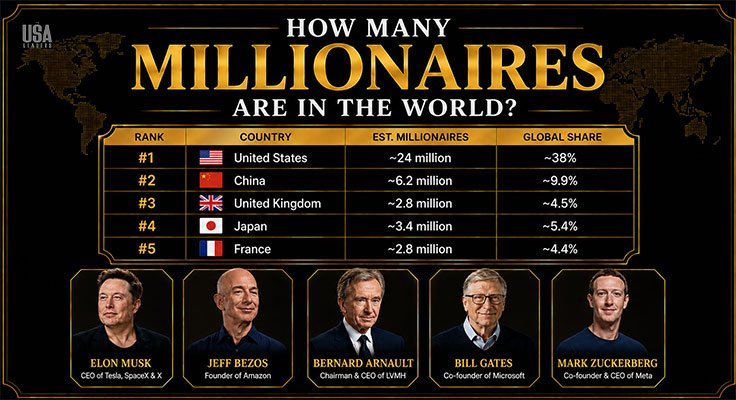
According to data from the Wikipedia list of countries by number of millionaires and the World Population Review millionaire country rankings, the top five millionaire nations are:
| Rank | Country | Est. Millionaires | Global Share |
| #1 | United States | ~24 million | ~38% |
| #2 | China | ~6.2 million | ~9.9% |
| #3 | United Kingdom | ~2.8 million | ~4.5% |
| #4 | Japan | ~3.4 million | ~5.4% |
| #5 | France | ~2.8 million | ~4.4% |
The US and China together have nearly half of all the world’s millionaires, even though they make up only about 23% of the global population.
Germany, Australia, and Canada are the next group of countries. Switzerland and Singapore have very high numbers of millionaires compared to their population, even though their total numbers are smaller.
How Many Multi-Millionaires and $100M+ Millionaires Are There?
Not all millionaires are the same. Wealth researchers divide them into different groups.
- Millionaires ($1M–$5M): This is the biggest group, often called “Everyday Millionaires” (EMILLIs) by UBS. There are over 55 million people worldwide in this category.
- Multi-millionaires ($5M–$30M): A much smaller and more exclusive group of wealthy individuals.
- $100M+ millionaires: A small group of people around the world who each have over $100 million in wealth.
- As per the 2025 Forbes list, there are 3,028 billionaires in the world with a net worth of $1 billion or more.
The ultra-wealthy group is growing the fastest. According to Capgemini’s 2026 report, the number of ultra-high-net-worth individuals grew by 9.4% in 2025, making it the fastest-growing wealth segment for the second year in a row.
Want to see what billionaire-level wealth looks like? Explore profiles of people like Mark Zuckerberg, Jensen Huang, and Larry Ellison to understand how the ultra-wealthy tier operates.
How Many Female Millionaires Are There in the World?
There is still a gender gap in wealth, but it is getting smaller. Around the world, women make up about 12–14% of millionaires, though this number can differ by region and how it is measured.
In developed countries like the US, UK, and Canada, about 18–20% of millionaires are women. This is mainly because women have better access to education, equal job opportunities, and more leadership roles in business.
Inheritance is speeding up this change. As wealth moves from baby boomers, more women are becoming rich through family inheritance. At the same time, more women are building wealth on their own through businesses, especially in tech, law, and finance.
| “The number of female millionaires in the US has been rising rapidly, especially compared to 2014, when 87% of US millionaires were men.” Fortunly Research, 2026 |
In 2025, Forbes listed 406 women among the world’s billionaires, making up about 13.4% of the total. These women show how some of the world’s most powerful females build their wealth. , check our coverage of how many billionaires are in the world.
What’s Driving Global Millionaire Growth?
In 2025, about 2 million new millionaires were created worldwide. This growth is driven by several key factors.
1. Strong Equity Markets
Global stock markets performed very strongly in 2024–2025. Rising stock prices increased the value of many investors’ portfolios, and a lot of people became millionaires for the first time. The US market led this growth, with the S&P 500 reaching record levels and creating an estimated 1,000+ new millionaires every day during the fastest growth periods.
2. Real Estate Appreciation
In most big economies, property prices have kept rising. A homeowner in a major US city who bought a home 10 years ago has likely seen their wealth double or even triple. This is the main reason many “everyday” people become millionaires.
3. Tech Sector Wealth Creation
Technology has created most new millionaires in the 21st century. From Silicon Valley to Shenzhen, tech founders, early employees, and investors have built wealth much faster than in the past, even faster than oil industry fortunes. Leaders like Larry Page and Michael Dell exemplify this tech-led path to extraordinary wealth.
4. Wealth Transfers and Inheritance
The Great Wealth Transfer, about $84 trillion moving from baby boomers to younger generations over the next 20 years, is already creating new millionaires. For many young adults, inheritance is one of the quickest ways to become a millionaire.
5. Emerging Market Growth
China, India, and Southeast Asia are creating new millionaires very quickly as their middle classes grow. In China, the number of millionaires has increased a lot, although some wealthy people are moving to other countries due to political and economic uncertainty.
Where Are Millionaires Moving?
One of the key 2025 trends is millionaire migration. According to Henley & Partners, around 142,000 millionaires moved to other countries in 2025, setting a new global record.
Top destinations include the UAE, the United States, and Singapore. These countries attract people because of low taxes, strong financial systems, and a good quality of life.
In 2024, the UK lost about 16,500 millionaires due to possible wealth tax changes and political uncertainty. China also saw around 7,800 wealthy individuals leaving the country.
Dubai in the UAE is one of the fastest-growing places for millionaires. With no income tax and excellent infrastructure, it attracts wealthy people from all over the world.
What Do Most Millionaires Have in Common?
It’s more interesting to understand the global millionaire population by looking at how they became wealthy. The data might surprise you.
- 88% of millionaires are self-made, not inherited
- 84% have a college degree or higher
- It usually takes about 32 years for a self-made millionaire to build wealth
- Common millionaire jobs in the US include business owners, engineers, accountants, lawyers, and teachers
- Only around 11% of millionaires inherited most of their wealth
- The main ways millionaires build wealth are real estate, stocks, and retirement savings accounts
In simple words, millionaires are usually not like movies show them to be. Most build wealth slowly with discipline, patience, and long-term investing like compound growth, not sudden luck or inheritance.
Conclusion
The global group of millionaires is now larger, more diverse, and spread across more countries than ever before. Whether this growth continues will depend on markets, government policies, and overall global economic stability, but the long-term trend has been rising for many years.
Which factor do you think will create the most new millionaires in the next decade—real estate, technology, or the big wealth transfer? Share your thoughts below. And if you want to explore wealth topics beyond millionaires, keep reading. Check out our detailed look at how many billionaires are in the world and the profiles of legends like Bernard Arnault.
FAQs
- How many $100 million millionaires are there in the world?
Precise data on $100M+ individuals is limited, but the ultra-high-net-worth population (those with $30M+) is estimated at roughly 510,000–520,000 globally as of 2025. Those with $100M+ represent a small fraction of that group, likely in the tens of thousands worldwide.
- How many female millionaires are there in the world?
Women make up about 12% to 18% of millionaires worldwide, depending on the region and data used. In countries like the US, UK, and Canada, the share is higher at around 18% to 20%, and it is slowly increasing over time.
- How many millionaires are in the world in 2026?
According to Capgemini’s World Wealth Report 2026, around 25.3 million people worldwide have $1 million or more in cash or easily available assets.