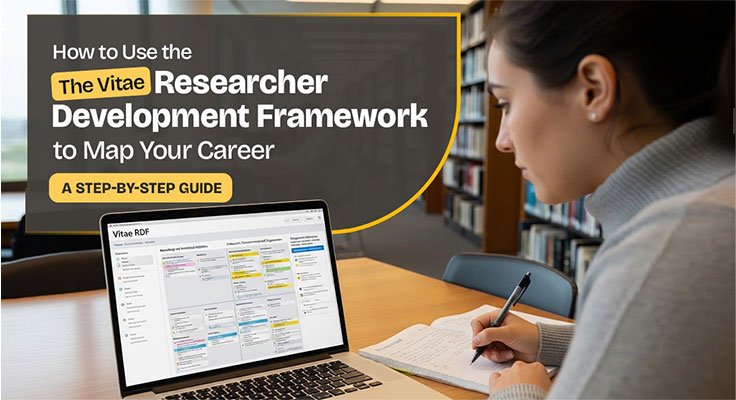
This guide explains how to use the Vitae Researcher Development Framework to plan and advance your academic and professional career. It explains simple steps to see your skills, set goals, and track your progress
Do you want to know how to plan and develop your research career? The researcher development framework (RDF) is designed to facilitate mapping researchers’ skills, identifying gaps, and defining the goals to be achieved. Moreover, it serves as a research career development framework and offers an organised method of facilitating professional development for researchers. In addition, RDF can serve as a model for researcher skills development, identifying crucial competencies and areas for enhancement.
This framework has been adopted by many universities to manage researcher development initiatives. Thus, this step-by-step guide will show you how to use the RDF to map your career, develop your skills and become more effective. At the end, you will have an effective growth roadmap, specific to your research process.
Crux Of This Article
- The Vitae Researcher Development Framework provides a structured roadmap for planning and advancing a research career.
- It helps researchers identify strengths, weaknesses, and skills gaps across key competency domains.
- The RDF emphasises four domains: knowledge, personal effectiveness, research governance, engagement and impact in research.
- Regular reflection and progress tracking allow researchers to adjust plans effectively.
- Using the RDF enhances research impact, leadership potential, and overall career success.
What is the Vitae Researcher Development Framework?
Vitae Research Skills Framework for Academics (RDF) is not just a simple tool but a resource that assists researchers in planning and developing their careers. It provides a clear outline of what skills, knowledge, and qualities are required at various phases of the research process.
The framework identifies themes like personal effectiveness, research governance, and research engagement, which give the researcher a realistic approach to evaluating their strengths and weaknesses.
The RDF is used in many institutions to guide doctoral researcher development framework activities, aligning training and career planning with individual objectives. It is a map towards continual research and development.
According to Linda Caballero, a Senior Researcher at The Academic Papers UK, a leading dissertation writing service, “The RDF helps you understand exactly what skills to focus on and how to grow step by step. It makes tricky research goals feel simple and easy to follow.”
A Step-by-Step Guide to the Vitae Researcher Development Framework.
It is worth knowing the Vitae RDF and its intended purpose before going into the practical steps. Understanding its structure and purpose will help you utilise it to the best of your abilities. In addition, it identifies areas for improvement and outlines a clear path for developing your research career.
- Study The Framework and its Domains
The researcher development framework is not just a capstone project but a reliable approach that is designed to assist researchers at any stage of their professional development. This helps them learn their skills and organise their professional journey. Knowing the four domains of the framework will help you see your strengths and weaknesses and build a roadmap to career advancement. These domains are listed here:
- Knowledge and Intellectual Abilities: This area focuses on research knowledge, critical thinking and problem solving, and helps you develop your abilities.
- Personal Effectiveness: It includes personal skills such as time management, adaptability, and self-reflection, and ensures that you can work effectively.
- Research Governance and Organisation: This includes ethics, research integrity, project management and organisational skills and makes your work standards-compliant with the research competency framework.
- Engagement, Influence, and Impact: This domain includes communication, collaboration, and knowledge and deals with professional implications of your research.
- Self-Assess Your Current Skills
The initial step in using the Vitae RDF is to evaluate your current skills. Thus, begin by reading about the researcher development framework descriptors and using the skills checklists to reflect on your capabilities. In order to track your progress, consider keeping a journal or doing structured reflection exercises.
This self-reflection helps you identify the areas where you are doing well, such as personal effectiveness, research governance, or engagement. In addition, it also highlights parts where you need to pay more attention. Through a sincere assessment of competencies, it can build a strong foundation for professional development for researchers and successfully advance their careers.
- Set Career Goals
The next step after evaluating your skills is setting up achievable career goals. Apply SMART principles: specific, measurable, achievable, relevant, and time-bound, as it helps formulate short-term and long-term goals.
Above all, connecting your objectives to the associated researcher development framework domains will keep your plans in line with the framework. In addition, you can improve personal effectiveness and make your work more engaging and impactful.
- Identify Skills Gaps
Once you have set your career goals, it’s time to identify the gaps between your current competencies and those required to reach your professional objective. Therefore, compare your self-assessment results with the skills described in the researcher development framework domains. In addition, focus on questions like:
- What improvements are necessary?
- What are the strengths and skills?
- Which gaps are influencing my research
- Plan Professional Development Activities
After identifying gaps in your skills, organise specific tasks to facilitate your development. This involves workshops, training, conferences, or mentorship programs that align with the research training and development framework.
According to Cambridge University Press (2025), 61.5% of participants in a national research mentoring network reported involvement in research training activities, such as workshops and conferences, which play a key part in professional development programs.
Thus, by making a Personal Development Plan (PDP), you can achieve your goals and expected outcomes. For instance, participate in workshops to improve research. Thus, a PDP helps keep your development organised, monitored and focused. However, it is essential to check and update it regularly so you can focus on priorities and steadily make progress in your career development as a researcher.
- Track, Reflect, and Adjust Your Development
In order to make the best out of the Vitae RDF, it is important to follow up on your progress and analyse your skills assessment on a regular basis. Look back on what you have accomplished and what problems you have encountered. In addition, see what you have learned so that you can see where you have developed and where you still have work to do.
Don’t let things like time constraints, a lack of purpose, or a lack of materials get in the way. Thus, rely on mentoring, networking, or using resources. Last but not least, act and amend consistently, integrate researcher development framework activities into your routine, and adjust your plan as your career progresses.
How the Vitae Researcher Development Framework Can Guide Your Dissertation
The Vitae Researcher Development Framework helps you see which skills you need to grow as a researcher. At the same time, planning and writing a dissertation involves many steps, such as organising ideas and following proper research methods. This is where dissertation writing services in the UK can help.
Experts guide you in structuring your chapters so your work meets academic standards. They don’t do your research for you, but they show you how to do it better and stay organised. Using these services with the RDF allows you to practise your skills while keeping your dissertation on track. It helps you stay focused, learn more, and complete your research step by step.
Conclusion
To sum up, the Vitae Researcher Development Framework (RDF) is not merely a guide but a roadmap for research career development. Thus, through the framework, self-assessment, SMART goal setting, gap identification, and targeted professional development planning, you will be able to be in control of your researcher development.
However, it is important to regularly monitor your progress, reflect on your successes, and revise your plan to ensure steady improvement and future success. Moving on, you can use the RDF regardless of your level of experience to improve your competencies and make informed career choices. Begin using the RDF to design effective, satisfying, and structured research now.
Frequently Asked Questions About Vitae Researcher Development Framework
- What is the Vitae Researcher Development Framework?
The Vitae researcher development framework (RDF) is a structured tool that helps develop a research career. It provides a concise overview of the skills, knowledge, and qualities required of researchers at different stages of their careers. The RDF addresses areas such as personal effectiveness, research governance, and engagement and impact, prompting researchers to reflect on their strengths and areas for improvement.
It plays a role in the professional development of researchers in many universities, matching training programs and career planning with individual goals. Adhering to the RDF allows researchers to create a roadmap, which will facilitate the ongoing development of their skills and career growth.
- What benefits does the researcher development framework provide?
The researcher development framework (RDF) helps the researcher define career objectives, identify skill gaps, and design professional development. In addition, it emphasises a balanced skill set by highlighting such competencies as personal effectiveness, research governance, and engagement. Moreover, this framework improves research capacity, professional development, leadership opportunities, and overall influence through mentorship, training, and reflective practice.