When a company has 20 employees, appreciation is personal by default. The founder knows people’s achievements, and recognizing them comes naturally. At 2,000 employees across different teams, locations and countries, that gets harder. Growth can make employee recognition less personal at exactly the point when companies need to become more intentional about it.
For scaling companies, December puts that ability to recognize employees to the test. Holiday gifting for employees is one of the few use cases and occasions when a growing company has to recognize everyone at once, and it is often where the cracks in an ad-hoc appreciation strategy become most visible.
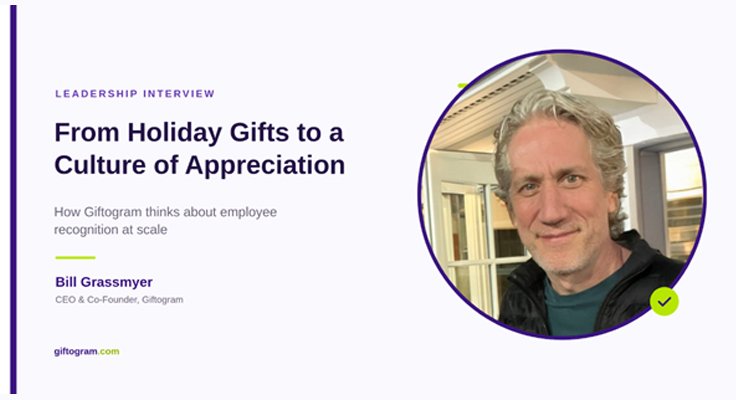
Bill Grassmyer, CEO and co-founder of Giftogram, has spent years thinking about how to build personalized recognition into corporate cultures. His company Giftogram helps organizations run employee recognition and gifting programs at scale, managing everything from reward distribution and budgets to recipient choice. But the broader challenge is a human one: how do you make sure people continue to feel seen as the company around them gets bigger?
“The issue I see most is companies assuming more budget fixes this, but it doesn’t.” Grassmyer says. “You can both 10x your headcount and 10x your recognition budget, and still find that proper employee appreciation falls through the cracks. The real solution is having a system in place that scales with your headcount, and always prioritizes personalized appreciation. Even at scale”
Why is it hard to scale employee recognition programs?
Corporate recognition programs don’t scale naturally because the fluid and personal approach that works in small teams doesn’t hold as companies grow. Gifting solutions like Giftogram standardize the reward-delivery layer, helping companies distribute rewards consistently while preserving recipient choice.
Without the right systems, recognizing thousands of employees turns a personal exercise into a logistics problem.
The burden comes from the administration: supplier approval, budgets, employee data, accurate recipient lists and rewards that work wherever employees live. Grassmyer has watched that burden pile up firsthand.
“I’ve sat with leaders who were still building their December gift list in a shared spreadsheet at 3,000 employees,” he says. “They aren’t choosing that on purpose, but it’s what happens when a process that worked at 50 people never gets rebuilt, and managing this at that scale is more than just chaotic. It can also just not work.”
What is the value of employee recognition at scale?
Recognition is also associated with measurable retention and engagement outcomes. Gallup and Workhuman tracked nearly 3,500 employees over two years and found that well-recognized employees were 45% less likely to have changed organizations. The same research found that employees receiving high-quality recognition, meeting four or five of Gallup’s criteria, were nine times as likely to be engaged as employees receiving none. Yet only 22% of employees say they get the right amount of recognition for the work they do.
That gap is the opportunity: for leaders to treat employee recognition as a consistent part of company culture rather than something handed off to HR once a year.
What should technology automate, and what should stay human?
Technology should automate the administration behind employee recognition, including recipient data, budgets, scheduling and delivery, while leaving the human part alone: why somebody is being recognized, when and what is said alongside it. Giftogram has built this operational layer into the infrastructure behind the reward, from bulk distribution and budget controls to integrations and automation.
“When we ‘automate recognition,’ people think I’m talking about AI doing everything, but that couldn’t be further from the truth,” Grassmyer says. “We’re talking about automating the admin that runs in the background, so a leader or manager’s time goes instead toward deciding how and when someone should be recognized.”
Grassmyer’s point is that infrastructure is what makes personalization possible at scale. People have different interests, families, lifestyles and financial priorities. A gift that feels thoughtful to one person can be useless to another. Grassmyer was conscious of building Giftogram around recipient choice.
The employer controls the value of the reward, but the employee decides where it goes, choosing from Giftogram’s catalog of 140,000+ national and local brands. Two people can receive the same level of recognition without receiving the same thing. At scale, personalization comes from giving employees choice rather than asking HR to predict what thousands of different people will want.
How is a culture of appreciation actually built?
A culture of appreciation is built on consistency, and the more interesting opportunity starts once the holiday program ends. The same data, budgets and infrastructure built to recognize a workforce in December can support work anniversaries, performance achievements, service milestones and spontaneous manager recognition throughout the year.
That’s where a culture of appreciation is actually built: not only around December’s gifting season, but in what employees experience the other eleven months.
“We’re trying to show that recognition programs are so much more than an annual event,” Grassmyer says. “The companies that get this right treat recognition as a scalable program that supports employee engagement and retention. But it has to be there in January as much as December. Once the technology layer is there, it’s a cultural conversation around how to use it to make employees feel appreciated, and give them a reason to stick around and continue to do great work.”
This is the distinction Grassmyer stresses: budgets, data and delivery make appreciation operationally possible, but they aren’t the end goal. The real problem he and the Giftogram team are solving is structural: building the infrastructure that lets a healthy culture of employee recognition scale with the company, instead of thinning out as it grows.
The best technology makes the machinery disappear, leaving only the part employees remember: someone noticed and appreciated them, in a way that mattered most to them.
FAQs
1. When should I start preparing for holiday gifting?
Preparation for a large holiday gifting program should begin months before the gifts arrive. For a December rollout, August or September is a sensible time to establish budgets, procurement requirements, employee data and distribution rather than leaving the operational work until November.
2. How often should employee recognition happen?
Employee recognition should happen enough that it doesn’t feel like a one-off event. A strong recognition program combines planned moments, such as work anniversaries, performance milestones and birthdays, with smaller, spontaneous moments a manager wants to acknowledge. Recognition that only appears once a year, however generous, can feel more like a company event than part of the culture.
3. How do you create a scalable employee recognition program?
Start with the basics: who should be recognized, what moments trigger recognition, how budgets are controlled and how rewards will reach employees across teams and locations. Giftogram gives companies the infrastructure to manage those programs centrally while employees choose a gift card they use somewhere that matters to them. As headcount grows, integrations and automated workflows can handle more of the administration without automating the human decision about who deserves recognition and why.