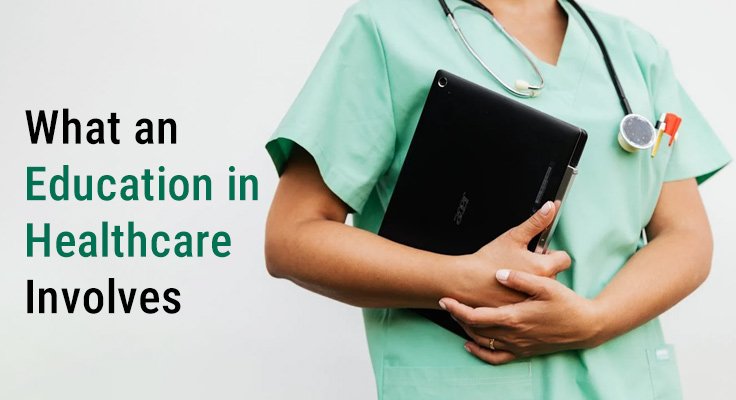
How do you actually prepare to work in a field where lives depend on your decisions? That’s the question at the heart of healthcare education, whether you’re training to draw blood, deliver a baby, run a clinic, or teach the next generation of nurses. In this blog, we will share what an education in healthcare involves, how it’s evolving, and what it demands from those who enter it.
Healthcare Education Is Built Around High Stakes
Healthcare doesn’t leave room for vague training. The risks are real, the consequences are permanent, and the standards are high for a reason. So unlike other fields, healthcare education starts early with pressure baked in. Anatomy isn’t just a list of terms—it’s the framework for understanding what goes wrong in an emergency. Pharmacology isn’t just memorizing drug names—it’s knowing what kills someone when doses are mixed up. Clinical skills aren’t theory—they’re the difference between someone walking out of a hospital or not.
Across most programs, students face a blend of classroom work, lab-based simulations, and hands-on clinical practice. There’s no skipping steps. You might study diagnostics in the morning and clean a real patient’s wound in the afternoon. It’s this mix of mental and physical work—reading, analyzing, moving, adjusting—that sets healthcare education apart.
And it’s not just for doctors and nurses. Radiology techs, EMTs, lab scientists, healthcare administrators—each path brings its own training format, but the principle stays the same: precision matters, and the margin for error is slim.
These programs move fast, often running on compressed timelines. Many are year-round with stacked terms, tight deadlines, and demanding practicals. There’s a reason drop-out rates can be high—this isn’t just about knowledge, it’s about stamina.
Within this landscape, a master of nursing education has become increasingly relevant. As demand rises for better-trained nursing staff and more structured clinical instruction, nurse educators play a growing role in shaping outcomes—not just for patients, but for the healthcare system itself. Programs offering this degree train experienced nurses to teach, assess, and lead inside nursing schools or hospital education units. These educators are the ones writing better training modules, mentoring staff, and fixing the pipeline issues that start in classrooms. The role blends clinical credibility with teaching skill, and it’s being recognized as essential—especially as healthcare systems in the U.S. scramble to close nursing shortages without lowering standards.
The Shift Toward More Realistic Training
Healthcare isn’t learned from a slideshow. Modern programs now rely heavily on simulation labs—setups that mimic real hospital rooms, complete with mannequins that breathe, sweat, bleed, and sometimes die based on student actions. It sounds intense, and it is, but it’s effective. Students get to fail in a controlled setting. They learn to handle panic, confusion, alarms going off, conflicting instructions from “patients”—without hurting anyone.
Simulation has taken on even more importance in the wake of COVID-19. Clinical site access dropped during the pandemic, so programs had to find new ways to teach high-stakes skills without direct patient contact. Now, many are keeping those simulation systems in place—not as a crutch, but as a core part of training. The labs are improving, and the realism continues to get sharper.
Virtual reality and AI-assisted diagnostics are starting to shape coursework, too. In some places, students now learn how to use digital twins of patients to test treatment decisions in real-time simulations. This isn’t theoretical anymore. It’s where the field is headed.
At the same time, healthcare education is beginning to reflect the pressure points of real clinical work. Training includes modules on burnout, ethical dilemmas, dealing with aggressive patients, and how to navigate short-staffed shifts. Programs are slowly catching up to the fact that technical skill isn’t enough—you also need grit, emotional stability, and the ability to work as part of an overstretched team.
Healthcare Training Doesn’t Stop After Graduation
One of the most misunderstood parts of healthcare education is that it doesn’t end when the degree arrives. Every license requires maintenance. Every field has ongoing training mandates. Every workplace has its own onboarding, policies, protocols, and systems to learn.
In practice, this means healthcare workers are never really “done” with school. A respiratory therapist may need to re-certify every two years. A nurse might have to take continuing education courses in cardiac care. A physician assistant could be required to log CME (Continuing Medical Education) credits across specific specialty areas.
The upside? This helps weed out stagnation. New research gets pushed into practice. Workers have to stay sharp. The downside is obvious, though: the workload never really lightens, even long after the formal program is over.
That’s one reason fields like nursing education are so crucial. Good educators don’t just pass knowledge along—they help professionals stay updated without adding useless fluff. They design learning that respects the limited time and energy of healthcare workers who are already carrying 12-hour shifts.
Who Healthcare Education Is (and Isn’t) For
It’s not for everyone. If you’re looking for a program where you can hide in the back, bluff your way through, or just go through the motions until the job shows up, this isn’t it. Healthcare programs will find your limits quickly. You will be watched, evaluated, corrected, and occasionally called out—because mistakes don’t just hurt grades. They hurt people.
But if you want a field that’s grounded in usefulness, where every day involves applying what you know under pressure, healthcare makes sense. You learn fast or you fall behind. You become efficient because you have to be. And you get used to making decisions with incomplete information while someone’s life or comfort depends on it.
The education reflects that urgency. It’s not glamorous, but it is real. And for the right people, that tradeoff is worth it every time.
Also Read – Cultural Awareness in Healthcare Education: A Career Guide