
The USA Leaders
November 17, 2026
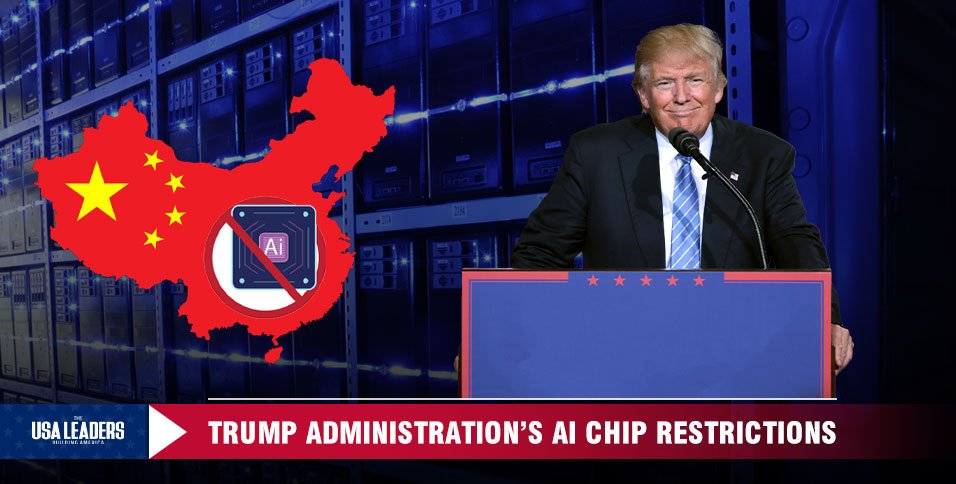
Washington, DC – The Trump administration’s AI chip restrictions now cover how Chinese companies access advanced US chips through overseas data centers. On November 16, the US introduced new rules to monitor their remote access more closely.
The AI chip restrictions build on existing rules that limit direct sales of America’s most advanced AI chips to China. It also addresses cloud computing services, which let companies rent computing power without owning the hardware.
The move could affect US tech companies, overseas data centers, and technology ties between the US and China as both countries develop AI.
What Do the Trump Administration’s AI Chip Restrictions Cover?
The Trump administration’s AI chip restrictions now cover both physical chip shipments and remote access to advanced chips through overseas data centers.
Previously, US export controls focused largely on the physical sale and shipment of advanced chips. However, AI companies could access computing power through cloud services and data centers located outside China.
According to the Associated Press report, the new requirements include:
- Overseas data centers: Facilities serving companies in China, Russia, Iran, and Cuba must identify their end users.
- Additional licensing: Certain advanced chip exports involving Indonesia, Malaysia, Singapore, Thailand, and Brazil will require additional licenses.
- Customer verification: Companies involved in supplying advanced computing technology must conduct additional checks to understand who ultimately uses their services.
The Trump administration’s AI chip restrictions apply the same rules to remote chip access and physical chip shipments.
How Do Advanced AI Chip Export Controls Affect Remote Access to AI Chips?
Advanced AI chip export controls now make it harder for restricted companies to use American chips through overseas data centers.
AI chips provide the processing power needed to train and operate advanced artificial intelligence systems. Companies use them to develop AI models, run complex calculations, and support large-scale digital services.
Remote access allows a company to use computing resources in another country without importing the physical hardware. For example, a Chinese company could rent computing power from a Southeast Asian data center that uses US-made AI chips.
Trump administration’s AI chip restrictions address these arrangements by introducing additional licensing and customer verification requirements. The Commerce Department‘s announcement says the rule applies existing chip controls to remote computing access as well.
Cloud providers and data centers will also need to monitor how customers use their computing services.
Why Is the US Updating Its Semiconductor Export Policy?
The updated US semiconductor export policy aims to maintain oversight of advanced American technology while accounting for changes in how companies access computing power.
The existing AI chip restrictions limit China’s direct access to some of America’s most advanced AI chips. However, cloud computing arrangements created another way to use processing power through overseas facilities.
The new AI chips policy addresses this gap by extending oversight to certain remote computing arrangements.
The new AI chip restrictions also follow scrutiny surrounding Nvidia chips and their possible movement through third-party technology companies. According to reports, Singapore and Malaysia are investigating the movement of related servers and chips.
For American semiconductor manufacturers, the development highlights the growing importance of export compliance, customer verification, and international supply chain management.
What Do the AI Chip Restrictions Mean for US-China AI Computing Access?
The new rules tighten China AI computing access through overseas data centers using US-made AI chips.
The changes could affect several areas:
- AI development: Chinese technology companies may have to review how they obtain computing power for training advanced AI models.
- Cloud computing: Overseas service providers may need additional licenses and stronger customer verification processes.
- Technology partnerships: Companies operating across international markets may need to reassess their data center arrangements.
For the United States, the AI chip restrictions add another layer to its approach to managing access to advanced semiconductor technology.
For China, the new AI chip policy changes the requirements surrounding access to certain American computing resources, including those hosted outside its borders.
How Could the New China AI Chip Restrictions Affect US Businesses and Consumers?
The Trump administration’s AI chip restrictions could affect chipmakers, cloud providers, data centers, and businesses that use AI technology.
For US technology companies: Chipmakers and cloud providers may need to check customers and monitor how they use their services overseas.
For data center operators: Companies in Southeast Asia and other affected markets may need to check their customers and control access to advanced chips.
For American consumers: The immediate effect on everyday technology services is expected to be limited. However, changes in AI infrastructure access could influence how technology companies plan future investments, computing capacity, and service development.
The US semiconductor export policy also highlights the growing importance of compliance and supply chain transparency in the American semiconductor industry.
How Will the AI Chip Restrictions Affect US-China AI Technology Relationship?
The next steps of the US-China AI technology relationship will depend on how companies and overseas data centers follow the new licensing and customer-checking rules.
The Commerce Department will oversee the AI chip regulation, while tech companies will need to check their overseas computing services to ensure compliance.
The Advanced AI chip export controls come as President Donald Trump visits Asia to discuss China, trade, technology, and economic ties.
Ultimately, the Trump administration’s AI chip restrictions represent a wider approach to managing access to American computing technology. As AI investment grows, the rules could change how chipmakers, cloud providers, and overseas data centers work together.
Neelmani Yadav