The USA Leaders
September 18, 2026
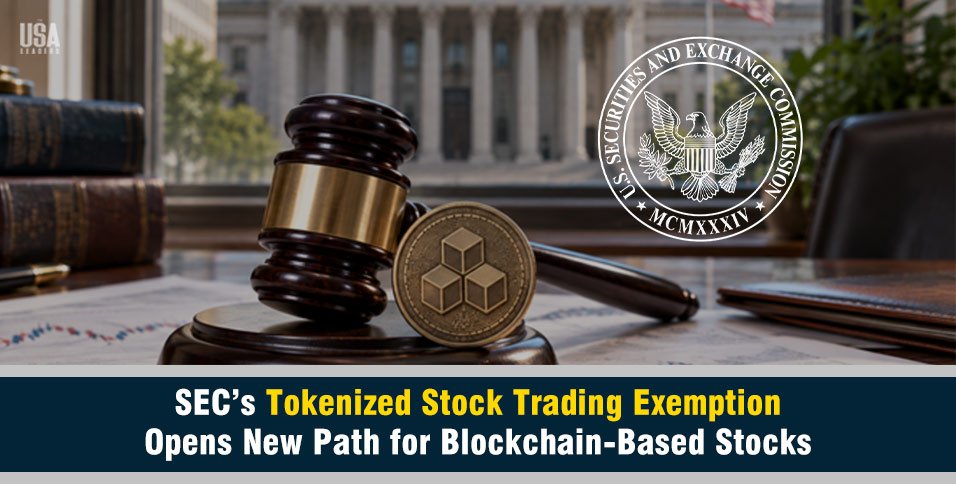
Washington, D.C. – SEC’s tokenized stock trading exemption is creating a new regulatory path for certain blockchain-based stock trading platforms in the United States. The U.S. Securities and Exchange Commission announced the temporary measure on September 17, calling it the “Innovation Exemption.”
The move allows qualifying Tokenized Securities Venues, or TSVs, to facilitate trading in certain tokenized National Market System (NMS) stocks through permissioned automated market makers and liquidity pools. The exemption is scheduled to remain in place for five years.
What Is the Tokenized Stock Trading Exemption?
In simple terms, the tokenized stock trading exemption allows certain trading venues to use blockchain-based infrastructure for trading digital versions of traditional U.S. stocks.
A tokenized stock is a digital token designed to represent an underlying share of a company. Under the SEC’s order, eligible TSVs can operate without being treated as an “exchange” under the specific conditions of the temporary exemption.
The relief is not a blanket approval for every tokenized stock or every crypto platform. It applies to qualifying venues operating within the requirements established by the SEC.
Key Details of the Innovation Exemption
| Feature | What it means |
| Duration | Five years |
| Eligible venues | Tokenized Securities Venues |
| Assets | Certain tokenized NMS stocks |
| Trading system | Permissioned AMM liquidity pools |
| Stockholder rights | Must match the equivalent traditional stock |
| Issuer notice | Issuers receive notice and an opportunity to object |
| Smart contracts | Must meet SEC conditions for transparency and auditability |
| Status | Temporary and conditional |
The SEC also requires tokenized stocks traded through a TSV to provide holders with the same rights and privileges as the equivalent traditional stock. This includes the underlying rights attached to the shares.
How Tokenized Stocks Could Fit Into U.S. Markets
The tokenized stock trading exemption gives blockchain-based market infrastructure a defined way to operate within the securities framework.
Under the order, TSVs can use permissioned AMM liquidity pools to connect eligible participants. Smart contracts used by these venues must be auditable and public, while being deployed on a public, permissionless distributed ledger.
The SEC has also placed limits on the number of stock symbols and trading volume available through the exemption. A TSV must stop trading a tokenized stock when trading in its underlying stock is stopped on the primary listing exchange.
For businesses and investors watching financial technology, this creates an interesting bridge between traditional equity markets and blockchain infrastructure.
Issuers Still Have a Role
One important part of the tokenized stock trading exemption is the role of companies whose shares are being represented by tokens.
When a tokenized NMS stock is created by an unaffiliated third party, the trading venue must provide written notice to the issuer and give it an opportunity to object before making the token available for trading.
This means the exemption does not automatically require every publicly traded company to have its shares represented through a tokenized format.
How This Builds on Earlier SEC Guidance
The latest action follows the SEC’s January 2026 statement on tokenized securities. That earlier statement explained that existing federal securities laws can apply to securities represented through tokenization.
The new Innovation Exemption therefore focuses on specific trading infrastructure rather than removing tokenized securities from the securities regulatory framework.
SEC officials have described the latest measure as a temporary way to test new approaches while the agency considers whether additional rulemaking may be appropriate.
What It Means for the Market
For the U.S. financial sector, the tokenized stock trading exemption provides a defined framework for experimenting with onchain equity trading.
Tokenization could eventually support changes in areas such as settlement, ownership records, liquidity and market infrastructure. SEC Commissioner Mark Uyeda said tokenization has the potential to modernize functions including issuance, trading, transfer and settlement.
However, the exemption itself does not guarantee 24-hour trading, fractional ownership or unrestricted retail access to tokenized stocks. Those features depend on individual platforms, products and future regulatory developments.
The Bottom Line
The tokenized stock trading exemption marks a new stage in the development of digital securities in the United States. By providing temporary, conditional relief for eligible Tokenized Securities Venues, the SEC is allowing certain tokenized NMS stocks to be traded through permissioned blockchain-based systems.
For business readers, the key point is that the SEC is testing a regulated pathway for tokenized stocks while keeping traditional shareholder rights and specific market safeguards in place. The five-year period also gives the agency time to evaluate how the model develops and whether further rules are needed.