If you’ve ever driven past a packed Chick-fil-A drive-thru at 12:15 on a random Tuesday, you’ve basically watched a case study in franchise economics play out in real time. America runs on franchises; they’re everywhere, they’re well-known, and for the right buyer, they can be genuinely lucrative businesses.
But “franchise” covers everything from a $10,000 side hustle to a $2.8 million established brand, so figuring out which ones actually make money (and for whom) takes some digging.
That’s what this list is for. We compiled the most profitable franchises in America based on public Franchise Disclosure Document (FDD) data, industry reporting, and franchisor-reported averages, looking at what it costs to open one, what the average location brings in, and roughly how long it takes to earn that investment back.
Whether you’re the type who reads FDDs for fun or you just like knowing why some brands keep printing money while most quietly close up shop, here’s the rundown.
What Are the Top 10 Franchises in the USA Right Now?
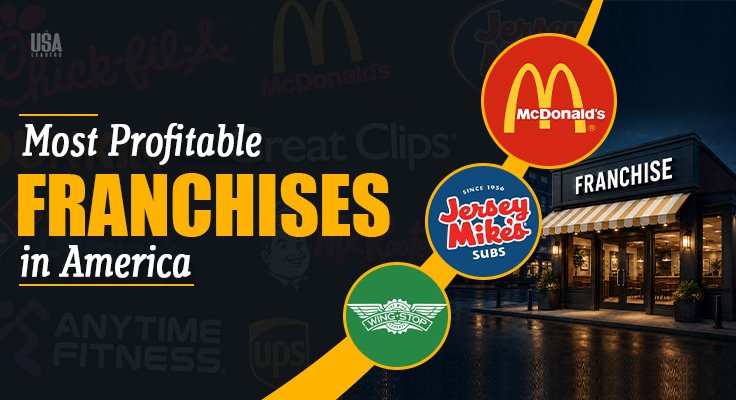
Before we get into the details, here’s the quick list of the top 10 franchises in the USA markets that consistently show up in profitability rankings:
| 1. Chick-fil-A | 6. Wingstop |
| 2. McDonald’s | 7. Mr. Rooter Plumbing |
| 3. Jersey Mike’s Subs | 8. Anytime Fitness |
| 4. Dunkin’ | 9. The UPS Store |
| 5. Domino’s | 10. Great Clips |
A quick note before we dive in: “profitable” doesn’t mean the same thing for every brand here. Some make the list because of jaw-dropping revenue they rack up in their respective locations. Others make it because of a low buy-in and a fast payback period, which is exactly what people searching for the most profitable franchise with low investment usually care about most. We’ve tried to cover both to give a broader view on the subject.
How We’re Measuring “Profitable”
A quick gut-check on terminology, because franchise marketing loves to be vague: revenue does not mean profit. When you see “average unit volume” (AUV) of $4 million, that’s gross sales, before rent, labor, food costs, royalties, and everything else that is essentially the spending a business has to make before claiming the remaining as profit.
Franchise consultants generally recommend closely monitoring Item 19 of a brand’s FDD, the section where financial performance is actually disclosed, before believing any headline number. With the ground rules established, let’s get into the case studies.
1. Chick-fil-A
Chick-fil-A is an interesting case and an outlier on this list, and it’s worth explaining why. The franchise fee is just $10,000, but that’s because Chick-fil-A owns the real estate, the building, and the equipment; you’re operating the store, not really owning the business assets.
In exchange, individual locations post some of the highest average unit volumes in the entire restaurant industry, with estimates ranging from $8.1 million to over $9 million per location. The catch: fewer than 1% of applicants get accepted, and you’re limited to one unit. It’s one of the most profitable franchises to own on a per-location basis, but it’s also one of the hardest to get into.
2. McDonald’s
McDonald’s is the classic answer to “what’s the most profitable franchise to own,” and the 2026 numbers paint a clear picture of why that is the case. Total investment runs from roughly $1.47 million to $2.8 million, but average annual revenue per US location has climbed past $4 million.
Most new owners actually buy an existing restaurant from a departing franchisee rather than build one from scratch, and payback typically lands in the 5-to-7-year range. It’s capital-intensive, but the brand recognition and operating systems are about as mainstream as franchising gets.
3. Jersey Mike’s Subs
Jersey Mike’s has been the breakout franchise story of the past few years; it topped Entrepreneur’s 2026 Franchise 500, crossed $4 billion in system sales, and went public in 2026 at a multibillion-dollar valuation.
Total investment sits between roughly $436,000 and $1.16 million, with average unit volume around $1.3 million and reported cash-on-cash returns in the ballpark of 40%.
For a sandwich shop, that’s a really strong showing, and it’s part of why Jersey Mike’s keeps landing on lists of the best franchises to own for beginners in the food-service space.
4. Dunkin’
Dunkin‘ leans on its “beverage-led” strategy, and coffee margins are one of the biggest reasons behind its success. Total investment ranges from about $437,000 to $1.8 million, with average annual sales around $1.2 million to $1.37 million per location.
Ongoing fees run close to 11% of revenue between royalties and advertising, so the math only works if the location has strong drive-thru traffic. Still, with over 8,500 US locations, Dunkin’ remains one of the more recognizable names on any list of franchises in the USA breakfast and beverage categories.
5. Domino’s
Domino’s is a good example of how a smaller footprint can still mean good returns. Total investment can start well under $200,000 for a delivery-focused location, with average unit volume estimated between $1.1 million and $1.8 million depending on the source.
The company has posted decades of consistent same-store sales growth, driven largely by its delivery technology and app-based ordering. It’s frequently cited as one of the most profitable franchises to own for people who don’t want to sink millions into a dine-in build-out.
6. Wingstop
Wingstop is one of the better-known answers when people search for the most profitable franchise with low investment. Total investment starts around $390,000, but average unit volume is roughly $1.8 million, meaning every dollar invested is generating close to $4.50 in annual revenue.
A small footprint (often under 1,800 square feet), a delivery-heavy sales mix, and limited kitchen equipment keep both build-out costs and labor overhead relatively low, which results in higher profitability.
7. Mr. Rooter Plumbing
It comes out as another outlier on this list since it’s the first entry on this list that doesn’t involve a drive-thru. Mr. Rooter is a home-services plumbing brand that is regularly cited among the highest-ROI franchises in the country, with reported returns of more than 50x on a roughly $122,000 investment.
Home-services franchises in general, such as plumbing, cleaning, and pest control, tend to post strong returns because they don’t require capital expenditures or expensive kitchen equipment, just some tools and a van, and someone who knows what they’re doing with them.
8. Anytime Fitness
Another non-fast food entry on this list, Anytime Fitness is a solid entry for anyone comparing low-investment options across industries.
Total investment runs roughly $539,000 to $905,000, with average annual revenue in the $400,000 to $450,000 range and profit margins commonly cited between 15% and 25%.
It doesn’t generate the same amount of revenue as a franchisee like McDonald’s, but the low entry cost with a 24/7 access model means it remains one of the largest fitness franchises in the country.
9. The UPS Store
If you want a steady flow of revenue instead of high returns on high investments, the UPS Store remains one of the best options.
Total investment ranges from about $216,000 to $609,000, with average annual revenue around $520,000 to $692,000 depending on the year and data source.
Net profit for a single-unit owner-operator typically lands between $60,000 and $120,000 a year, with payback periods commonly cited around 3 to 7 years.
10. Great Clips
The last entry on this list might surprise some of the readers, as probably few of you have expected a hair salon franchise to make the list with more than 4,400 locations as of August 2026.
Total investment is on the lower end at roughly $183,000 to $420,000, though individual salon revenue is more modest, averaging around $380,000 to $400,000 a year.
Great Clips owners tend to build wealth through multi-unit ownership rather than a single high-earning salon, with many franchisees eventually operating 5 to 10-plus locations.
Best Low-Investment Picks for First-Time Franchisees
If you’re specifically hunting for the most profitable franchise with low investment, a few names from this list stand out: Domino’s, Wingstop, Mr. Rooter, and Anytime Fitness all keep total investment under roughly $900,000, and several sit well under $500,000.
Home-services brands in particular tend to be some of the best franchises to own for beginners, simply because there’s no expensive real estate or kitchen build-out involved, just training, a service vehicle, and a territory.
FAQs
What is the most profitable franchise to own in the US?
By raw revenue per location, Chick-fil-A and McDonald’s top the list. But “most profitable” depends on what you’re optimizing for; home-services brands like Mr. Rooter post far higher returns relative to their (much smaller) initial investment.
Which franchise is most profitable?
There’s no single universal answer, since profitability depends on revenue, costs, and how much you had to invest upfront. Chick-fil-A tends to lead on per-location revenue, while low-investment home-services franchises often lead on percentage return.
What are the top 3 franchises?
Based on brand strength, revenue, and growth momentum in 2026, Chick-fil-A, McDonald’s, and Jersey Mike’s Subs are frequently ranked among the top 3 franchises in America.
Which franchise has the highest profit margin?
Home-services franchises like Mr. Rooter typically post the highest margins, since they avoid the heavy labor, food, and real estate costs that eat into restaurant-franchise profits.
How much does it cost to open a profitable franchise in America?
It varies enormously from around $10,000 for a Chick-fil-A operator license (with corporate owning the real estate) to nearly $2.8 million for a traditional McDonald’s. Low-investment options like Domino’s, Wingstop, and Mr. Rooter typically fall between $120,000 and $500,000.
The Bottom Line
There’s no single “best” answer to which franchise makes the most money — it really comes down to how much capital you have and what kind of return you’re chasing. If you want the biggest number on a P&L statement, the most profitable franchises in America tend to be recognizable restaurant chains like Chick-fil-A and McDonald’s. If you’d rather start smaller and scale, low-investment options in home services, fitness, and quick-service food are where a lot of first-time franchisees actually find their footing. Either way, the real work starts after you sign; actual profitability always comes down to location, management, and execution, not just the logo on the sign.
Neelmani Yadav