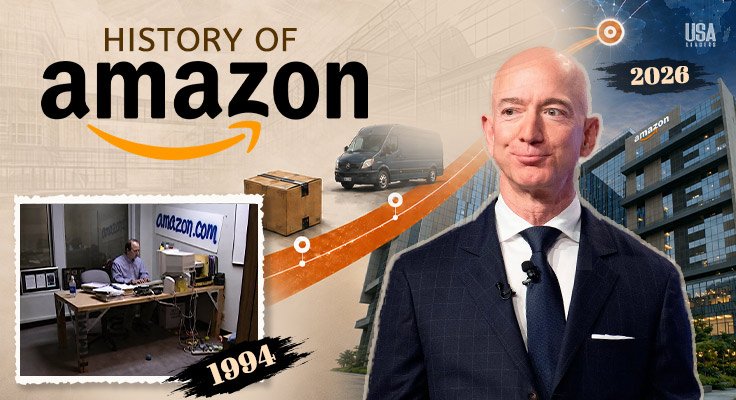
Amazon began on July 5, 1994, when Jeff Bezos started the company as an online bookstore in Bellevue, Washington. It was first called “Cadabra” but was later renamed Amazon and launched in 1995. Since then, Amazon has grown from an online bookstore into a global company offering shopping, cloud computing, and subscription services. Today, it is the world’s largest e-commerce company by revenue and reach.
What Is Amazon? A Quick Overview
Amazon is an American e-commerce and technology company based in Seattle, Washington. It sells products such as books, electronics, groceries, and medicine. Amazon also runs AWS, one of the world’s largest cloud computing services.
Amazon is publicly traded on the Nasdaq under the ticker AMZN. Andy Jassy is the CEO, while founder Jeff Bezos is the executive chairman. Amazon is the world’s largest online retailer and marketplace. The company has more than 1.5 million employees worldwide.
A few core facts define the company today:
- Founded: July 5, 1994, in Bellevue, Washington
- Founder: Jeff Bezos; current CEO: Andy Jassy
- Headquarters: Seattle, Washington
- Core businesses: online retail, a third-party marketplace, AWS cloud computing, advertising, and subscription services
- 2025 revenue: $716.9 billion, with more than 1.5 million employees worldwide
The History of Amazon: How It All Started in 1994
The history of Amazon starts with one simple idea. Jeff Bezos wanted to build “the everything store.” He left a comfortable Wall Street job in New York City and moved west to chase the fast-growing opportunity of internet retail.
Why Jeff Bezos Chose Bellevue, Washington
Bezos chose the Seattle area for several practical reasons. It had many skilled workers because of Microsoft and the University of Washington. The smaller population also meant lower sales tax costs. The area was also close to a major book warehouse in Roseburg, Oregon. Bezos also considered Portland and Boulder before choosing Bellevue.
From Cadabra to Amazon.com
Bezos first named the company Cadabra, Inc. and ran it from a converted garage. A few months later, he changed the name to Amazon because “Cadabra” sounded too much like “cadaver.” The Michigan Journal of Economics notes that Bezos chose the name Amazon partly because the Amazon River carries more water than any other river on Earth. The name matched the scale he pictured for the company.
Amazon’s Public Launch in 1995
Amazon officially launched to the public on July 16, 1995. The company had registered a year earlier, but it did not open for business until the website went live. This date answers the common question of when Amazon truly started as an online bookseller.
Amazon started by selling only books. Bezos bought books from wholesalers and publishers and shipped them from his garage to all 50 U.S. states and many countries. He focused on growing the company quickly, which Britannica says was key to Amazon’s early success.
Amazon’s Early Struggles and Road to Profit (1997–2003)
The 1997 Initial Public Offering
Amazon went public in May 1997 and raised about $54 million by selling shares at $18 each. The money helped Bezos build warehouses and grow Amazon beyond a small online bookstore.
Amazon Expands Beyond Books
In 1998, Amazon started selling music and videos. It also expanded to the UK and Germany by buying online bookstores there. In 1999, Amazon added electronics, toys, software, video games, and home products. These changes helped Amazon grow from an online bookstore into a major online retailer.
The Dot-Com Crash and Amazon’s First Profit
Like many early internet companies, Amazon lost money for years as it invested heavily in growth. Its losses peaked at about $1.4 billion in 2000 during the dot-com crash.
Amazon made its first quarterly profit in late 2001. In 2003, it had its first full year of profit, earning $35 million. This was a major turnaround from the $149 million loss it reported in 2002, according to the Michigan Journal of Economics.
Key Milestones That Built the Amazon Empire (2000s)
Opening the Marketplace to Third-Party Sellers
In 2000, Amazon allowed outside sellers to sell products on its platform. They could list new, used, and refurbished items alongside Amazon’s products. This changed Amazon’s business model. Today, third-party sellers account for about 60% of all sales on Amazon.
The Launch of Amazon Web Services (AWS)
Amazon Web Services (AWS) launched in 2002 with simple tools for developers. It grew quickly after Amazon introduced S3 in 2006 and EC2 in 2008. These services let businesses rent computing power instead of building their own data centers.
Today, AWS has nearly one-third of the global cloud market, ahead of Microsoft Azure and Google Cloud.
Amazon Prime Changes the Game
Amazon Prime launched in February 2005. It started as a $79-a-year service offering unlimited two-day shipping. Growth was slow at first, but Prime later became a key part of Amazon’s success. By the early 2020s, Prime and other Amazon subscriptions had about 200 million members worldwide.
Amazon’s Global Expansion in the 2010s
By the 2010s, Amazon had moved from proving its business model to expanding worldwide. It built fulfillment centers across the U.S., Europe, and Asia. In 2006, Amazon launched Fulfillment by Amazon (FBA), which allowed small sellers to store products in Amazon warehouses. Amazon then handled packing, shipping, and returns for them.
Kindle, Echo, and Alexa
Amazon launched the Kindle in 2007, showing that it was more than just an online bookstore. In 2014, Amazon introduced the Echo smart speaker with Alexa, its voice assistant. Today, Alexa powers more than 100 million devices worldwide.
Amazon Goes International
Amazon started as a US online bookstore but quickly expanded worldwide. By the 2010s, it had local websites in Europe, Asia, and the Americas, using local languages and currencies. In 2023, the US made up about 69% of Amazon’s sales. Germany, the UK, and Japan were its biggest international markets.
The Whole Foods Acquisition
In August 2017, Amazon bought Whole Foods Market for $13.7 billion. It was Amazon’s biggest deal at the time. The purchase gave Amazon a strong presence in physical grocery stores and helped connect its online and offline shopping.
How Does Amazon Make Money?
In 2023, Amazon’s online store sales made up about 40% of its total revenue. Third-party sellers added 24%, while Amazon Web Services (AWS) made up 16%. However, AWS generated much more operating profit because cloud services have higher profit margins than retail.
Advertising has become a major part of Amazon’s business. It now makes up about 8% of its revenue, as brands pay to show their products in search results. Amazon Prime and other subscriptions bring in steady income. This mix helps Amazon stay strong even when online shopping slows down.
Challenges Along the Way
Amazon’s growth has faced some challenges. The company has been criticized for warehouse working conditions, antitrust issues, and its environmental impact. Amazon has also made major job cuts. Between October 2025 and January 2026, it cut about 30,000 corporate jobs as it shifted its focus to AI.
Despite these challenges, Amazon keeps expanding its logistics network, cloud infrastructure, and AI partnerships. This reinforces its place as one of the most influential companies in the world.
Amazon Net Worth and Revenue Growth Over the Years
Amazon’s revenue history tells the clearest story of its growth. The company moved from years of losses to becoming one of the most valuable businesses on Earth. As of 2026, Amazon’s market value stands near $2.96 trillion, according to Britannica Money.
| Year | Annual Revenue | Net Income |
| 1997 | $148 million | -$28 million |
| 2003 | $5.26 billion | $35 million (first full-year profit) |
| 2010 | $34.2 billion | $1.15 billion |
| 2017 | $177.8 billion | $3.0 billion |
| 2021 | $469.8 billion | $33.3 billion |
| 2025 | $716.9 billion | $77.7 billion |
Amazon Today: The World’s Largest E-Commerce Marketplace
Amazon’s Leadership Today
Jeff Bezos stepped down as Amazon CEO on July 5, 2021, 27 years after founding the company. He became executive chairman, while Andy Jassy took over as CEO. Jassy still leads Amazon today. Bezos remains Amazon’s largest individual shareholder. You can also read the full breakdown of Jeff Bezos net worth.
Amazon’s AI Era: AWS, Anthropic, and OpenAI
Amazon is investing heavily in AI through AWS. It has also built a strong partnership with Anthropic. In early 2026, Amazon reportedly discussed investing up to $50 billion in OpenAI. Readers can also explore the world’s leading AI companies to understand the growing competition in the industry.
Amazon’s continued growth has also intensified its long-running rivalry with traditional retail. The comparison of Amazon vs Walmart explains how the two retail giants differ in strategy and scale today.
Amazon History Timeline at a Glance
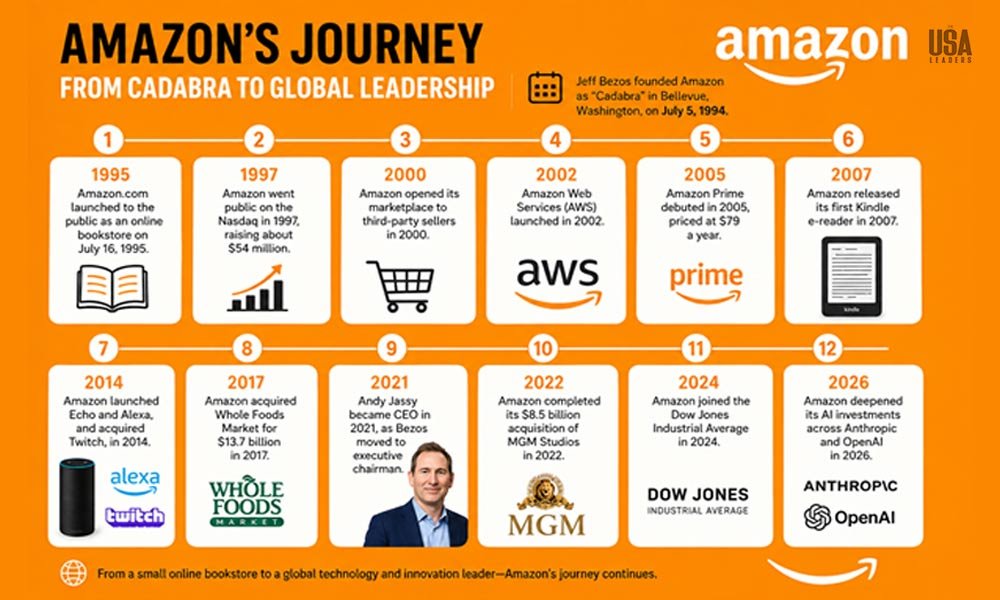
- Jeff Bezos founded Amazon as “Cadabra” in Bellevue, Washington, on July 5, 1994.
- Amazon.com launched to the public as an online bookstore on July 16, 1995.
- Amazon went public on the Nasdaq in 1997, raising about $54 million.
- Amazon opened its marketplace to third-party sellers in 2000.
- Amazon Web Services (AWS) launched in 2002.
- Amazon Prime debuted in 2005, priced at $79 a year.
- Amazon released its first Kindle e-reader in 2007.
- Amazon launched Echo and Alexa, and acquired Twitch, in 2014.
- Amazon acquired Whole Foods Market for $13.7 billion in 2017.
- Andy Jassy became CEO in 2021, as Bezos moved to executive chairman.
- Amazon completed its $8.5 billion acquisition of MGM Studios in 2022.
- Amazon joined the Dow Jones Industrial Average in 2024.
- Amazon deepened its AI investments across Anthropic and OpenAI in 2026.
Amazon Facts You Should Know
- Amazon takes its name from the Amazon River, the largest river in the world by water volume.
- Designer Turner Duckworth created Amazon’s current logo in 2000. The arrow running from A to Z shows that Amazon sells almost anything, and it also forms a smile.
- Amazon shipped its first order, a book, from Bezos’s garage in July 1995.
- Amazon Prime grew from a $79-a-year shipping plan into a subscription service with close to 200 million members worldwide.
- AWS produces a large share of Amazon’s total operating profit, even though it makes up a smaller share of total revenue.
- Amazon employs more than 1.5 million people across its warehouses, offices, and delivery network.
- Amazon owns more than 40 subsidiaries, including Whole Foods, Twitch, Ring, Zappos, and IMDb.
Lessons From Amazon’s Growth
Amazon’s rise from a small online bookstore to a global marketplace offers a few clear lessons for business owners and marketers alike:
- Long-term thinking beats short-term profit. Amazon accepted years of losses to build market share and infrastructure, a bet that paid off after 2003.
- Diversified revenue protects a business. Amazon’s move from books into cloud computing, advertising, and subscription services shielded the company from downturns in any single market.
- Customer experience builds loyalty. Fast, reliable shipping through Prime created a habit that keeps customers coming back.
- Early infrastructure investment pays off. Warehouses, fulfillment centers, and AWS data centers gave Amazon a logistics and technology edge that rivals struggled to match.
- Fast adaptation to new technology matters. Amazon moved early into cloud computing and, more recently, artificial intelligence, keeping it ahead of competitors.
Conclusion
Amazon’s story shows how a small online bookstore grew into a global company. Today, Amazon affects many parts of daily life, including shopping, delivery, cloud computing, and AI. Jeff Bezos started Amazon in Bellevue on July 5, 1994. Today, the company makes hundreds of billions of dollars and employs more than 1.5 million people worldwide.
Patience, reinvestment, and a strong focus on customers still shape how Amazon works today. As Amazon expands into AI through AWS and partnerships with Anthropic and OpenAI, its next chapter could change technology as much as it changed online shopping.
Which part of Amazon’s journey stands out most to you: the start as an online bookstore or its growth into the world’s largest e-commerce marketplace?
FAQs
- When did Jeff Bezos found Amazon?
Jeff Bezos founded Amazon on July 5, 1994, in Bellevue, Washington. The company opened to the public as an online bookstore on July 16, 1995.
- How did Amazon originally start as a business?
Amazon started as an online bookstore run out of Jeff Bezos’s garage. Books were easy to source, ship, and sell without physical stores, which made the business simple to launch.
- How much is Amazon worth today?
As of 2026, Amazon’s market value is approximately $2.96 trillion, with 2025 annual revenue of $716.9 billion, according to company filings.
- Who currently serves as Amazon’s CEO?
Andy Jassy has served as Amazon’s CEO since July 2021. Founder Jeff Bezos remains involved as executive chairman and the company’s largest individual shareholder.