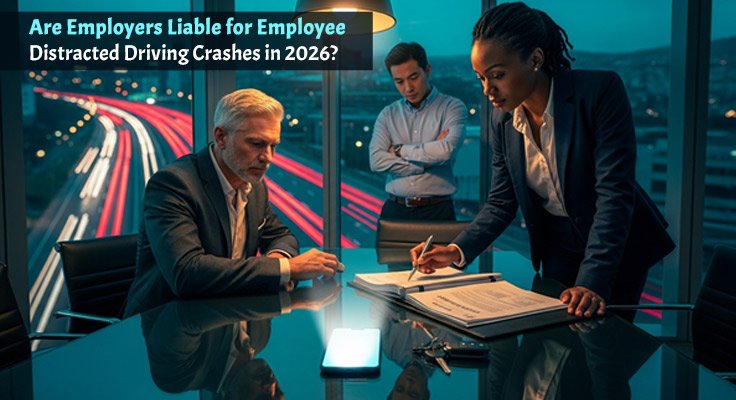
Distracted driving costs an estimated $98.2 billion in the U.S. alone in 2019. For business owners, that number should sting. Under vicarious liability law, your company can be held financially responsible when an employee causes a crash while texting a client or checking a work email from the driver’s seat.
The Growing Corporate Cost of Distracted Driving
What the Numbers Show
Federal safety data paints a grim picture. According to NHTSA, distracted driving caused 3,275 fatalities and an estimated 324,819 injuries in recent reporting periods. Think about that for a second.
Sending or reading a single text takes your eyes off the road for about five seconds. At 55 mph, that’s the equivalent of driving an entire football field blindfolded. Research shows texting while driving is even riskier than drunk driving, increasing the chance of a crash by six times.
2026 Vehicle Tech Makes It Worse
Distraction isn’t standing still; it’s evolving alongside automotive engineering. As 2026 vehicles roll out with complex multimedia systems, live-streaming features, and sprawling touch interfaces, the opportunities for a driver’s attention to wander keep multiplying.
Automakers design these features to improve the user experience, but they also pile new cognitive demands on anyone behind the wheel. For commercial operators, that translates to a riskier environment as workers navigate digital ecosystems while commanding heavy machinery.
How Vicarious Liability Puts Employers on the Hook
The legal framework around commercial driving incidents hits organizations hard. The doctrine of Respondeat Superior holds employers financially responsible for damages caused by employees working within the scope of their jobs. So if your traveling sales rep causes a crash on the way to a client meeting, or while picking up a work call, your company absorbs the liability. Not the individual driver.
Recent cases show just how steep the price tag can get. In one Missouri case, a $650,000 settlement was reached after a construction company’s driver caused permanent injuries due to distraction. Courts consistently rule that businesses must control the conduct of people operating on their behalf.
In states like Ohio, where distracted driving laws carry real teeth, holding negligent parties accountable depends on solid evidence: cell phone records, traffic camera footage, and eyewitness accounts. Because texting boosts the risk of an accident, attorneys in these jurisdictions aggressively pursue commercial claims to make sure injured parties get full compensation from liable employers. This kind of state-level enforcement is exactly why corporate accountability can’t be treated as optional.
| Liability Type | Who Is Sued | Triggering Condition | Corporate Financial Risk |
| Direct negligence | The employee | Personal texting, off the clock | Low; limited to personal insurance |
| Vicarious liability | The employer / company | Texting a client while on the clock | High; company assets and commercial policies exposed |
How Companies Can Protect Themselves
Telematics and Active Monitoring
Complex problems call for sophisticated countermeasures. Because distracted driving leaves little evidence after a crash, it creates a dangerous blind spot for corporate risk managers. So how do you close that gap?
Proactive fleets are turning to advanced telematics platforms and diagnostic models that actively monitor driver performance, flagging risky behavior before it turns into a lawsuit. These tools don’t just collect data; they help correct distracted habits in real time.
Year-Round Safety Culture
Limiting safety awareness to a single month doesn’t cut it for commercial operators. The trucking and transportation industries tackle this risk year-round through continuous training and personal coaching. But building a lasting safety culture requires clear, enforceable rules that every team member actually understands.
Here are some policies that make a real difference:
- Complete device ban: No holding or operating any mobile device while the vehicle is moving. Hands-free setups only when calls are absolutely necessary.
- Clear disciplinary action: Spelled-out consequences for violations, ranging from mandatory retraining to termination.
- Signed acknowledgments: Written proof that each employee understood and agreed to safety rules before receiving company keys.
- Pre-drive route programming: A mandatory step requiring employees to set the GPS and adjust vehicle settings before shifting out of park.
The Road Ahead for Corporate Fleet Safety
The legal and financial stakes for employers managing commercial fleets have never been higher. A single moment of employee distraction can spiral into multi-million-dollar lawsuits, ballooning insurance premiums, and lasting brand damage.
You can’t treat driver distraction as just one person’s error—it’s a business risk. Audit your policies, invest in monitoring, and enforce discipline. Protect your bottom line and keep roads safer. These goals go hand in hand.