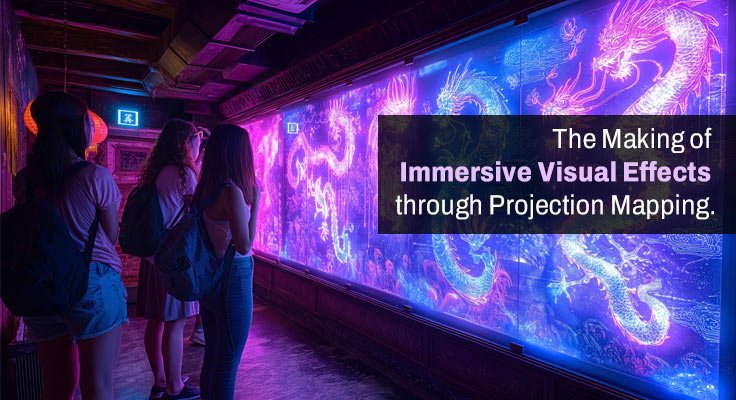
Creating immersive visuals is not only about possessing bright images or massive screens. It is the process of transforming a surface into a well-planned, dynamic, and memorable experience.
This is why projection mapping is such a handy tool in events, retail displays, exhibitions, and branded spaces. In this article, you will get to know about some of the tips on how to apply the appropriate projection mapping techniques to create immersive visuals.
Begin With the Opposite Surface.
The first step is to pick the surface you wish to change. Flat walls can appear straight, but shaped, layered, and textured walls are more attractive. The deeper the surface, the richer your ultimate display will be.
The colour, size, and placement must also be considered. Light surfaces tend to be clearer on what is happening, and dark or irregular surfaces can alter the brightness and clarity of the image.
Construct the Visual Story in Advance of the Effects.
One may lose track with animated faces, moving objects, and special effects. On the other hand, immersive visuals are only effective when they align with a story. Decide how you wish people to feel, see, or remember, first, before you do anything more.
You can apply projection mapping to something useful rather than just fun, with a good idea in mind. You may wish to display a product, a big opening scene, or a series of environments that are animated. When your visual story is understandable, you will have an impact that you intended to create.
Design to the Depth, Movement, and Scale.
The three-dimensional images add richness to the emotions and movement on the screen. This means that the content must show the shape and size of the surface, and not resemble a typical video on the screen.
The viewer becomes more involved when the visual animation is seen to flow with the structure. You may do so through overlaying animation, shadows, highlights, and transitions which correspond to the edges of the object or background. Rather than quick effects every second, employ contrast of stillness and motion to make an impression.
Fit Your Content to the Environment.
Projection mapping is not a one-sided process. A design that would appear good in a dark room may not appear as good in a bright store or an open event space. This is the reason why you need to consider the entire environment when designing.
Look at the position of people, the things they look at first and the quantity of light in the room. When your images are in line with the setting, you experience is more real rather than unrelated.
Strengthening the Experience with Audio and Timing.
An even more effective type of projection sequence is one that is accompanied by music, narration or sound effects, as the audience is led through the experience. It all has to feel interrelated. Timing is as much a matter of design.
Your animations may be chaotic in case it displays too much too fast. However, when they are too slow, they might lose the interest of the audience.
Test, Tune, and Revise, Before Going Live.
After installing the projector in the real space you have to do some calculations to get the alignment, brightness, colour balance and scale. One of the main aspects is testing. Put up your images on the ground and observe them at various angles.
Check where the picture is stretched, loses detail or is spilled over the planned surface. At this stage, the slightest alterations can make the outcome much improved and the experience feel more refined.
Make Things Simple to make Stronger Impact.
When the technology is so prolific and inventive it can be tempting to exploit all the possibilities. But the immersive visuals are most effective when your design remains focused. The viewer can be overwhelmed by many competing elements and undermine the message.
Select some of the best visual concepts, and implement them. Clarity of movement, consideration of pacing and good use of space usually outweighs all the clatter and clutter.
Make Surfaces an Experience that is not forgotten.
The immersive visuals and projection mapping are, in fact, all a matter of design, scheduling, and narration in an intelligent manner. When you begin with the correct surface, you have a clear idea and can make your visuals fit within the space in the final scene, it is much more fun. Instead of being a mere projection it becomes a part of the space.