The USA Leaders
March 11, 2026
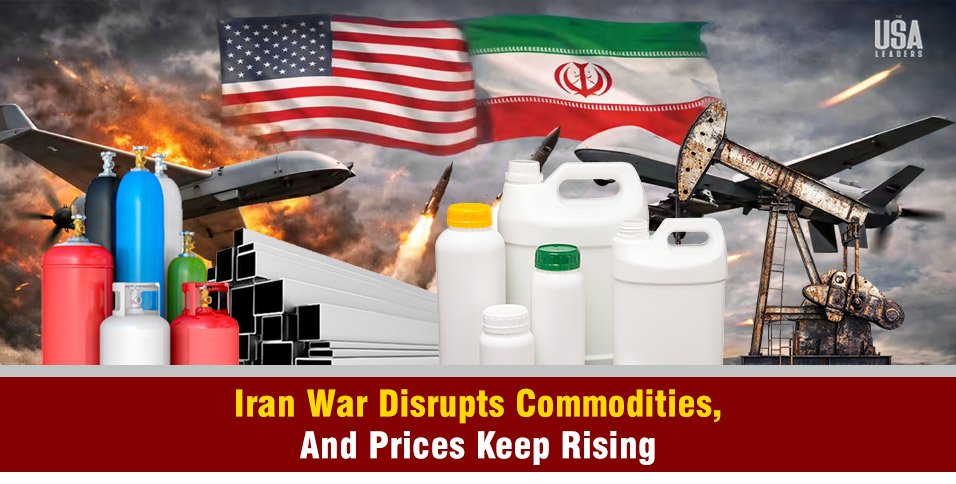
The Iran war disrupts commodities far beyond oil and gas. The conflict has begun to disrupt global commodity markets.
Prices for several commodities have already risen sharply. Urea fertilizer has jumped about 35%, while aluminum prices have increased roughly 10% in recent weeks. Traders also report tighter supplies of industrial gases such as helium.
These disruptions affect supply chains worldwide. Fertilizer shortages could raise food prices. Aluminum shortages could increase costs for vehicles and construction materials.
Shipping routes through the Strait of Hormuz now face growing risks. The channel carries about 20% of global oil shipments, according to the U.S. Energy Information Administration.
As a result, economists warn that global consumers may soon feel the pressure.
Iran War Disrupts Commodities: The Global Impact
Tensions escalated in early 2026 after military exchanges between Iran and regional rivals disrupted shipping security in the Persian Gulf.
The conflict has raised security concerns around the Strait of Hormuz, one of the world’s most important maritime corridors.
The region plays a major role in global commodity production. Therefore, disruptions quickly spread across supply chains.
Many cargo ships now face higher insurance costs. Some companies have delayed shipments. Others have rerouted vessels around longer paths.
Therefore, the cost of transporting raw materials has increased.
Analysts at the International Energy Agency say that prolonged disruption in the Gulf could tighten supply chains across multiple commodity sectors.
Key Sectors Under Pressure Beyond Oil
Several industries rely heavily on Gulf energy, shipping routes, or production facilities. As a result, disruptions in the region quickly spread into other commodity markets beyond the oil price rise.
- Fertilizers and agricultural inputs
- Industrial metals such as aluminum
- Industrial gases, including helium
- Petrochemicals and plastics
These pressures already appear in agricultural markets, where fertilizer prices have reacted quickly to the conflict.
- Fertilizers and Agricultural Inputs
Fertilizer markets show the strongest reaction.
Prices for urea fertilizer have jumped around 35% since the conflict began, according to commodity data from the Food and Agriculture Organization.
Farmers rely on urea to grow crops such as corn, wheat, and rice.
Timing makes the situation more serious. Many farmers in Asia and Africa buy fertilizers during the spring planting season.
Higher fertilizer costs often lead to reduced use. Lower fertilizer use often leads to smaller harvests. Lower yields then raise food prices.
For example, farmers in South Asia could face higher production costs for staple crops later this year.
- Aluminum and Industrial Metals
Aluminum production also faces disruption.
The Gulf region hosts several large aluminum smelters that rely on cheap natural gas.
Aluminum prices have risen about 5-7% in recent weeks as shipping disruptions worsen, with analysts projecting potential gains of 10-20% if the conflict persists.
The metal plays a critical role in many industries, including:
- Vehicle manufacturing
- Aircraft production
- Power transmission lines
- Beverage packaging
Higher aluminum costs may eventually raise prices for cars, appliances, and canned drinks.
Airplane manufacturers also depend heavily on aluminum. Supply disruptions could delay aircraft production schedules.
- Helium and Industrial Gases
Helium supply risks have also emerged.
Qatar produces roughly 30% of the global helium supply. Much of it ships through Gulf export routes.
Helium plays a critical role in MRI scanners, which require large volumes of liquid helium to cool their magnets. Supply disruptions can make maintenance and installation of imaging systems more difficult for hospitals.
Semiconductor producers also rely on helium to cool advanced chips used in artificial intelligence and 5G infrastructure.
- Petrochemicals and Plastics
Gulf countries account for around 16% of global petrochemical output.
The region produced about 156 million tons of petrochemicals in 2023, supplying global industries such as packaging, construction, and automotive manufacturing.
These materials form the base of many consumer and industrial products such as food containers, medical equipment, synthetic fibers, and electronics components.
Shipping risks around the Strait of Hormuz could slow deliveries of these materials to manufacturers in Asia and Europe.
If supply chains tighten, manufacturers may face higher costs for plastic resins and chemical feedstocks. These costs often move through supply chains into packaged goods, household products, and industrial equipment.
Shipping Disruptions Spread Across Global Trade
Shipping disruptions create another major risk.
The Strait of Hormuz connects Middle Eastern exporters with Asian and European buyers. Any threat to this route increases insurance costs and shipping delays.
Companies now search for alternative routes. However, these routes often require longer travel distances and higher fuel costs.
These detours raise transportation costs and delay deliveries. Logistics firms warn that supply chains could face weeks of delays if disruptions continue.
Market and Economic Impacts
Commodity markets have already reacted with increased volatility.
Investors now expect higher input costs across several industries, including agriculture, automotive manufacturing, aerospace, and pharmaceuticals.
Companies may raise prices to protect profit margins. This could add pressure to global inflation rates.
Central banks also monitor the situation closely. Rising commodity costs combined with slower growth could create stagflation risks in some economies.
According to analysts at the International Monetary Fund, emerging economies face the greatest risk because they depend heavily on imported fertilizers and fuel.
African and South Asian countries could see rising food costs if fertilizer shortages reduce crop yields.
At the same time, commodity exporters outside the Gulf may benefit.
Countries with large fertilizer production capacity, such as Canada and Morocco, may gain market share if Gulf exports slow.
What Happens Next
The economic impact depends largely on how long the conflict lasts.
A quick ceasefire would likely stabilize shipping routes and ease commodity prices.
However, a conflict lasting several months could force companies to restructure supply chains. Producers may seek alternative suppliers in Asia or other regions.
If tensions continue for more than six months, severe shortages could emerge in fertilizers, metals, and industrial gases.
Such disruptions would likely push global inflation higher and slow economic growth.
Outlook
The Iran war disrupts commodities across the globe, reshaping markets far beyond oil and gas. Fertilizers, aluminum, helium, and petrochemicals now face supply risks.
These materials support industries that produce food, vehicles, electronics, and healthcare equipment.
Therefore, the conflict threatens both global supply chains and household budgets.
The longer the disruption lasts, the greater the pressure on commodity markets and consumer prices worldwide.
Neha Shekhawat