The USA Leaders
March 9, 2026
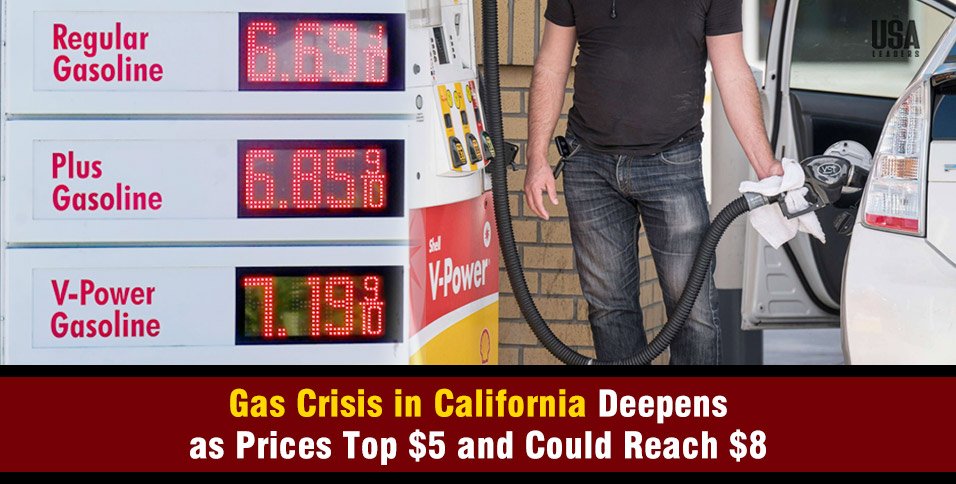
Gas prices in California have surged far above the national average, with drivers now paying about $5.16 per gallon.
This price sits nearly 50% above the national average of $3.45. Several complex factors drive this surge, including global conflict and local supply shortages.
Analysts warn that the situation may worsen throughout 2026.
Global Tensions and Crude Oil Disruptions
The primary pressure on fuel costs comes from rising crude oil prices. Conflicts in the Middle East have disrupted vital shipping routes, particularly around the Strait of Hormuz.
This narrow waterway typically handles about 20 million barrels of oil every day. Recent military actions and the blocking of tankers have significantly slowed these shipments
Furthermore, retaliatory strikes in the region have removed an additional 9 million barrels of oil per day from the global market.
Consequently, crude oil prices jumped from $66 per barrel on February 20 to $90.90 per barrel today. This sharp increase pushed national fuel averages up by 16% in a single week.
Shrinking Refinery Capacity Hits the West Coast
Beyond global markets, the state faces a critical loss of infrastructure. California is losing its ability to process fuel even as demand remains high.
Two major refineries will close by the end of April 2026. These facilities include a Phillips 66 plant in Los Angeles and a Valero plant in Benicia.
Together, these two locations represent 17% of the refining capacity in the state. Their departure will tighten an already strained supply.
Current data reveal that refining capacity has dropped from 592 million barrels per year to 488 million barrels per year.
Meanwhile, fuel demand reached 511 million barrels in 2024. This creates a 5% supply deficit.
Economists at the University of California, Davis, note that stable markets usually require a 10% surplus.
Without this cushion, gas prices in California become highly volatile. Researchers estimate that closing a single refinery can add 40 cents to the price of a gallon.
With both plants closing, some projections suggest prices could rise by an additional $1.21 per barrel later this year.
Why California Stands Alone
California remains an outlier compared to most other states. Only Washington and Hawaii report similar costs, with averages of $4.60 and $4.51, respectively.
No other state currently exceeds Gas prices in California. This price gap exists because of specific state policies and environmental regulations.
California requires a unique gasoline blend to meet standards from the California Air Resources Board.
This cleaner fuel reduces air pollution, but other states do not produce it. Therefore, California cannot easily import gasoline from neighboring states during a shortage.
High state taxes and a cap-and-trade carbon program also add to the final cost at the pump.
Future Outlook for 2026
The outlook for the rest of the year suggests further pressure on consumers. Prediction markets show a 63% chance that national gas prices will reach $4.50 by the end of March.
If that happens, the average price in California could climb to $6.73 per gallon. If national prices rise to $5.00, California drivers may see $7.48 per gallon.
Some analysts warn prices could approach $8.00 per gallon by the end of 2026. One station in Los Angeles has already listed regular gasoline at $8.21.
Policymakers now face a difficult balance between environmental goals and economic pressure. Strict regulations improve air quality, but they also reduce refinery profitability and encourage plant closures.
Unless global oil markets stabilize or refining capacity expands, California is likely to remain the most expensive fuel market in the United States.
Neha Shekhawat