The crew was three miles into the canyon when the phones went dead.
No bars. No Wi-Fi. Just wind and rock—and a job to do. Coordination became guesswork. Updates were delayed. One miscommunication? It could’ve meant real danger.
Sound familiar?
For field teams working in forests, mountains, deserts, or deep into industrial sites, off-grid communication isn’t a “nice to have.” It’s non-negotiable. And when cell service disappears, two-way radios step up.
Why Off-Grid Teams Can’t Rely on Cell Phones
Let’s be honest: smartphones are great… until they’re not.
Remote teams—whether in forestry, construction, energy, search and rescue, or environmental research—regularly operate in areas where:
● Cell towers are miles away
● Data coverage is patchy (or non-existent)
● Weather knocks out service
● Network congestion kills response time
And if you’re depending on signal bars to keep people safe and operations moving? That’s a risk your business can’t afford.
Two-Way Radios: Built for Anywhere, Every Time
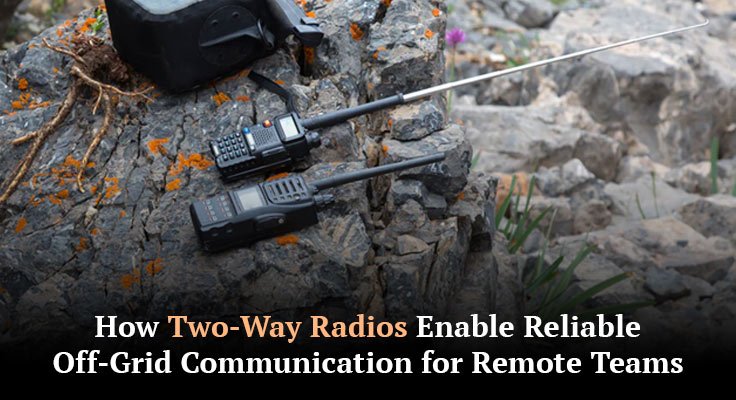
Two-way radios don’t depend on external networks. They connect directly—radio-to-radio—on pre-set frequencies or through extended range systems, making them ideal for off-grid operations.
With a simple push-to-talk function, teams can:
● Check in instantly
● Coordinate movements
● Share real-time updates
● Respond to emergencies
No spinning wheels. No “message failed.” Just dependable communication in places no phone dares to reach.
Cover More Ground—Even Without Infrastructure
One of the biggest myths about two-way radios? That they’re only useful for short-range or small sites.
Not anymore.
Modern radio systems can:
● Cover miles of rugged terrain without cellular service
● Utilize repeaters or long-range antennas to expand reach
● Offer nationwide connectivity via private networks or push-to-talk-over-cellular (PoC) models—when coverage is available
● Switch seamlessly between off-grid and connected modes
This gives remote teams the flexibility to communicate whether they’re in a canyon, on a mountain, or back at base camp.
Emergency-Ready Communication You Can Count On
Let’s talk safety. In remote settings, delayed communication can mean serious consequences. A broken ankle. A lost worker. A sudden equipment failure. You need instant communication—not a call that drops halfway through.
Two-way radios are designed for:
● One-touch emergency alerts
● Real-time location tracking (on supported models)
● Group communication—alerting everyone at once
● Hands-free options for workers operating heavy machinery
They’re rugged. Weatherproof. And engineered for tough environments where the only constant is unpredictability.
Simple to Use, Even in High-Stress Moments
When you’re in the field, simplicity matters. Walkie-talkie-style two-way radios don’t need apps, passwords, or signal bars.
Just:
● Pick a channel
● Push the button
● Speak
This ease of use is crucial during high-stakes moments when there’s no time to troubleshoot—or when gloves, wet hands, or adrenaline get in the way.
Long Battery Life, No Dependence on Power Grids
Most two-way radios are built to run all day—and then some.
● Many models last 12 to 24 hours on a single charge
● Backup batteries and charging stations keep the system running in off-grid locations
● No background apps draining the battery like smartphones
So while your phone powers down in a remote valley, your radio is still ready to transmit.
Final Thought: When You’re Off the Grid, You Still Need to Talk
Remote teams don’t get to take chances. When you’re miles from the nearest signal, buried in concrete, or high in the hills, communication becomes a lifeline.
Two-way radios offer the coverage, clarity, and confidence to stay connected—no matter how far off the map your job takes you.
Because being out of range doesn’t mean being out of reach.
Also Read: Best Practices for Managing Remote Teams Across Different Time Zones