The USA Leaders
21st January 2026
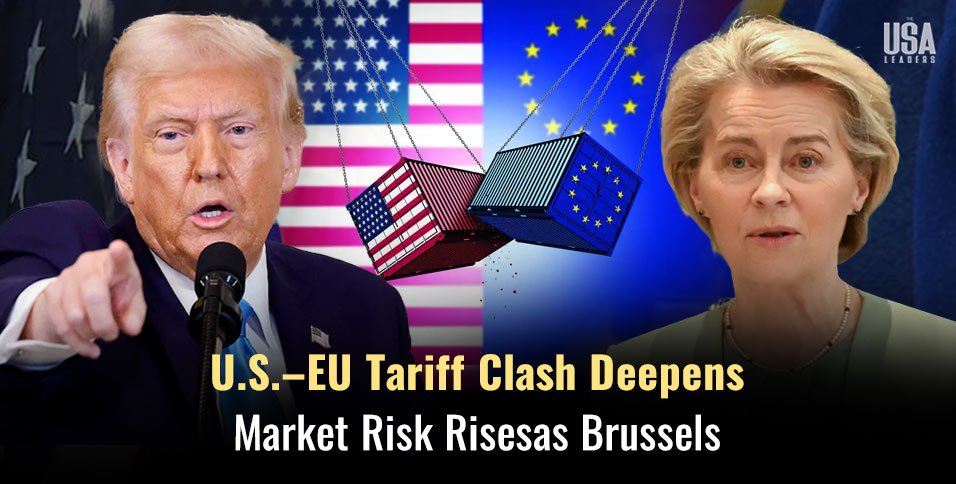
New York — Global markets are wobbling this week as European Union leaders pushed back forcefully against new U.S. tariff threats, triggering fresh concerns about transatlantic trade stability and broader market risk.
In the latest escalation of a dispute rooted in U.S. pressure over Greenland, Brussels officials described Washington’s approach as coercive, signaling readiness to retaliate and even pause longstanding trade deals if necessary.
The standoff has spiked volatility in European equities, pressured U.S. stock futures, and dampened risk sentiment across asset classes as investors recalibrate exposure to longer-term trade uncertainty.
With the U.S. preparing to impose tariffs on eight European countries starting next month — a move linked to strategic ambitions in the Arctic — the EU has responded with coordinated diplomatic and economic measures, from reinforcing Arctic security cooperation to planning counter-tariffs on U.S. products.
The tensions now extend beyond isolated levies, sparking broader concerns about a prolonged decline in global trade confidence and investment planning.
The Escalation: What Happened
President Donald Trump’s administration recently announced plans to levy an initial 10% tariff on goods from Denmark, Norway, Sweden, France, Germany, the United Kingdom, the Netherlands, and Finland beginning February 1, with the rate potentially rising to 25% by June 1 unless a controversial deal on Greenland is struck.
European Commission President Ursula von der Leyen has publicly condemned the tariff threats as strategic errors that could undermine transatlantic cooperation and long-standing trade agreements.
French Foreign Minister Jean-Noel Barrot echoed this stance, calling the use of tariffs “blackmail” and pushing to suspend the EU-U.S. trade deal signed last summer — a stark break from recent rapprochement.
Beyond rhetoric, EU ambassadors agreed to intensify their efforts to dissuade Washington and may deploy counter-tariffs targeting billions of dollars of U.S. goods if negotiations fail.
Market Reactions and Economic Signals
Financial markets have reacted sharply to the brewing dispute. European equities experienced one of their largest daily drops in two months amid the tariff uncertainty, while U.S. stock futures also traded lower as risk-off sentiment spread.
Citi downgraded its recommendation on European stocks, citing elevated risk to corporate earnings per share forecasts, particularly for auto, tech, and consumer sectors exposed to transatlantic trade flows.
Safe-haven assets, including precious metals, gained ground as investors sought refuge from equity volatility.
Analysts warn that extended tariff escalation could have broader macro effects. Capital Economics estimates a 25% tariff regime could trim output in Germany and the UK by 0.2–0.3%, with spillovers weighing on confidence and investment.
Geopolitical Undertones
The tariff confrontation is entangled with strategic interests in the Arctic region. The EU is crafting a broader package to bolster Arctic security cooperation, including high-tech equipment investments and reinforcing alliances, implicitly countering U.S. moves tied to Greenland’s future.
At the World Economic Forum, U.S. officials urged calm and discouraged retaliation, yet the rhetoric underscores deepening friction over trade policy direction and alliance cohesion.
Who Is Most Affected
Export-oriented European manufacturers and multinational companies with integrated supply chains stand at the frontline of potential tariff costs and retaliatory cycles. Financial institutions tracking European equities are already adjusting earnings outlooks downward.
U.S. multinational exporters also face heightened uncertainty as potential EU counter-measures target key goods, potentially inviting broader restrictions if tit-for-tat escalation continues.
Industry and Policy Implications
For policymakers and corporate leaders, the dispute signals that trade risks remain a material factor in global strategy and capital allocation. CFOs and risk officers may need to revisit supply chain resilience plans and hedge against tariff-induced cost inflation.
Economists note that protracted trade friction could curtail foreign direct investment as firms delay decisions in the face of policy unpredictability.
What Informed Leaders Should Watch Next
- EU counter-tariff announcements: Details on the EU’s Anti-Coercion Instrument deployment and target lists could reshape bilateral trade exposure.
- Greenland negotiations at Davos: Talks between U.S. and European leaders this week might set the tone for escalation or de-escalation.
- Macro data responses: Trade and industrial production figures over Q1 2026 will reveal real-time economic impacts of tariff disruptions.
Expert Opinion
Today’s sharp pushback from Brussels marks more than a diplomatic spat — it reflects a growing fracture in the post-war transatlantic trade order. For markets, the key risk is not merely the headline tariff percentages but the accompanying policy volatility that impairs corporate planning and investor confidence.
Sectors with high export intensity and global supply chain linkages are most vulnerable, and currency and credit markets could price in a sustained risk premium if escalation persists. Leaders should monitor the EU’s counter-tariff package and any shifts in U.S. legislative or WTO responses.
A negotiated path that preserves trade predictability, even with concessions, would be far preferable to an open-ended tit-for-tat cycle that could dent growth in both economies.