The USA Leaders
February 17, 2026
Trader Joe’s just announced seven new store locations across six states. This move signals an aggressive expansion plan as the company pushes toward opening 20 new stores in 2026.
This expansion reflects strong consumer demand and reinforces Trader Joe’s position as one of America’s fastest-growing grocery chains. The company already opened new locations in Connecticut on February 5, 2026, and New York on February 12, 2026.
Trader Joe’s new store openings typically happen within three to six months after announcing locations. This timeline allows the company to hire staff, stock inventory, and prepare store layouts.
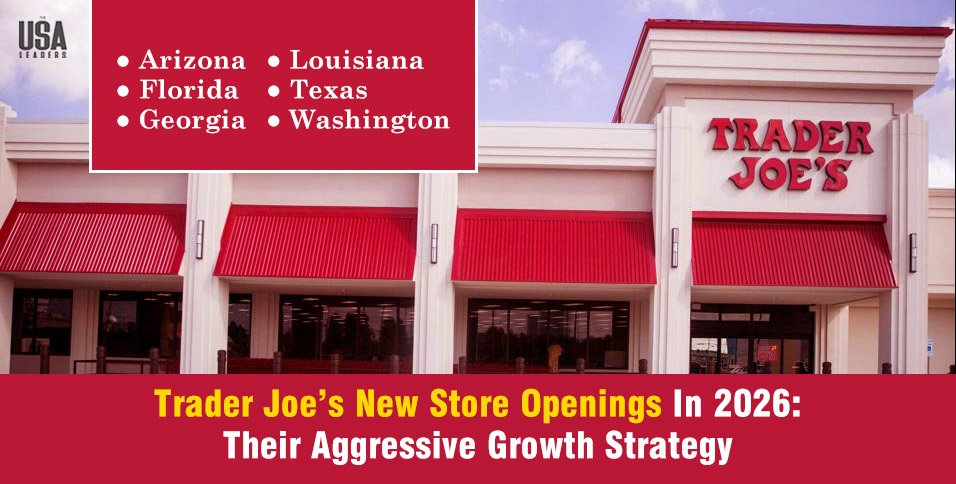
The newly announced stores will open in:
- Arizona
- Florida
- Georgia
- Louisiana
- Texas
- Washington
These locations align with population growth regions and strong retail demand.
Trader Joe’s Unique Grocery Model
Entrepreneur Joe Coulombe founded Trader Joe’s in 1967 in Pasadena. He built the company to stand apart from traditional grocery chains. Instead of selling 50,000 products, Trader Joe’s sells about 4,000 carefully selected items.
About 80% of products carry Trader Joe’s private labels. This model gives the company direct control over pricing, quality, and margins. It also creates strong customer loyalty. As of early 2026, Trader Joe’s operates more than 600 stores and employs over 50,000 people.
This curated model produces industry-leading sales performance. In 2016, Fortune estimated Trader Joe’s generated $1,750 per square foot. That figure exceeded most competitors, including Whole Foods.
Earlier, BusinessWeek reported that Trader Joe’s achieved the highest sales per square foot in the U.S. grocery industry. These metrics explain why Trader Joe’s continues to expand aggressively.
Aldi Nord Controls Trader Joe’s Behind the Scenes
Many shoppers do not realize that Aldi Nord owns Trader Joe’s. In 1979, Theo Albrecht acquired Trader Joe’s and preserved its unique business model. Aldi Nord still controls the company through the Albrecht family foundations.
This ownership structure matters because it gives Trader Joe’s long-term stability. Unlike public companies, Trader Joe’s does not face quarterly earnings pressure. This allows steady expansion and long-term planning.
The Albrecht family built one of the world’s largest retail empires through disciplined cost control and operational efficiency.
Trader Joe’s and Aldi Share Roots but Operate Separately
Trader Joe’s and Aldi share a common origin but operate independently. The Aldi brand split into two companies in 1961:
- Aldi Nord owns Trader Joe’s
- ALDI Süd operates Aldi stores in the United States
Both companies use different strategies. Aldi focuses on extremely low prices and efficiency. Trader Joe’s focuses on curated products, unique branding, and customer experience.
This separation explains why stores feel completely different despite shared ownership history.
Expansion Reflects Strong Consumer Demand and Market Opportunity
Trader Joe’s new store openings reflect broader changes in the grocery market. Several factors drive growth:
- Population growth in suburban and Sun Belt regions
- Rising demand for affordable premium food
- Strong private label economics
- High sales productivity per store
Trader Joe’s smaller store format also allows faster expansion than traditional supermarkets. The company can enter new markets quickly while maintaining profitability.
What This Expansion Means for Consumers and the Grocery Industry
Trader Joe’s expansion creates clear benefits for consumers. New stores mean:
- More access to affordable specialty foods
- Increased grocery competition
- Lower prices across local markets
- New job creation
The 2026 expansion plan confirms Trader Joe’s growth momentum. With over 600 stores and strong financial performance, Trader Joe’s continues to scale across the United States. Its private ownership, efficient model, and loyal customer base position the company for continued expansion over the next decade.
Future Outlook
Trader Joe’s new store openings plan to open 20 stores in 2026 alone. This expansion signals confidence in consumer demand and long-term growth. The company continues to expand deliberately, targeting high-growth regions and underserved markets.
Trader Joe’s does not expand solely based on size. It expands to maximize efficiency, profitability, and customer loyalty. And this strategy continues to deliver results.
Neha Shekhawat
Also Read : Pizza Hut Closing Stores in 2026: 250 Locations Affected