The USA Leaders
February 26, 2026
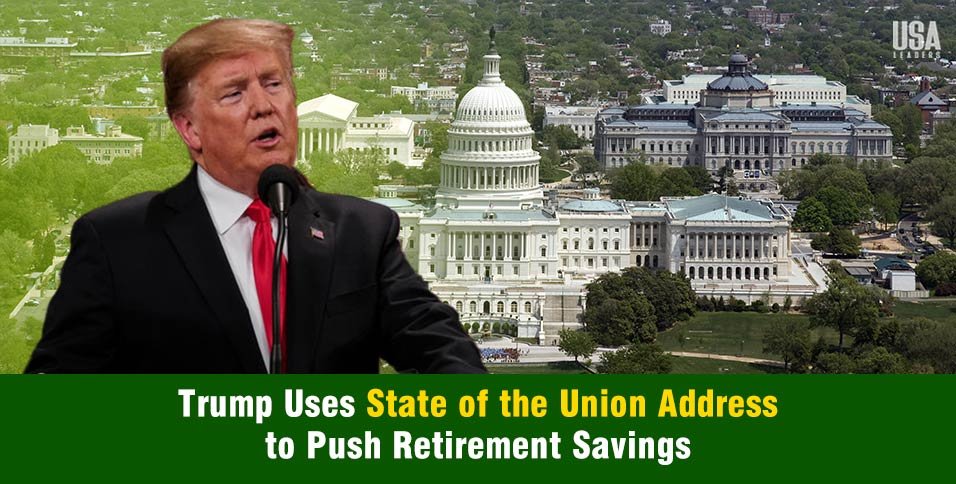
During his State of the Union address on February 24, 2026, Donald Trump announced two major financial proposals aimed at helping workers and rebuilding trust in government.
He called on Congress to create a federal retirement savings plan with matching contributions of up to $1,000 annually for workers without employer-sponsored accounts.
At the same time, he urged lawmakers to pass H.R. 7008, the Stop Insider Trading Act sponsored by GOP Representative Bryan Steil, which would prevent members of Congress from trading individual stocks.
The Viral Moment That Framed The Message
Beyond policy, Trump created a memorable political moment during the address. While discussing the stock trading ban, Trump took a direct swipe at former House Speaker Nancy Pelosi.
“As we ensure that all Americans can profit from a rising stock market, let’s also ensure that members of Congress cannot corruptly profit from using insider information,” Trump said. “Did Nancy Pelosi stand up, if she’s here? Doubt it. Pass the Stop Insider Trading Act without delay.”
The moment quickly spread across social media and news coverage, reinforcing his broader message that financial ethics reform must apply to long-serving lawmakers.
Why These Proposals Matter
Retirement insecurity remains widespread. According to the Federal Reserve, about 47% of private-sector workers lack access to employer-sponsored retirement plans.
At the same time, public frustration over congressional stock trading continues to grow. A February 2026 poll from YouGov found that 74% of Americans support banning lawmakers from trading individual stocks.
Trump framed both issues as systemic failures requiring direct federal intervention.
The Retirement Savings Plan: “Trump Accounts”
The administration’s proposal introduces federally supported retirement accounts known as “Trump Accounts.” According to Reuters reporting on February 24, 2026, the program would match individual contributions up to $1,000 annually for workers without access to employer-sponsored retirement programs such as 401(k)s.
Unlike traditional employer-linked plans, these accounts would remain fully portable. Workers could keep the same account regardless of job changes, removing one of the most common barriers to long-term savings.
Fast Facts: Trump Accounts
| Feature | Details |
| Annual Match | Government matches up to $1,000 per year |
| Target Group | Workers without employer retirement plans |
| Portability | Fully portable between jobs |
| Investment Options | Limited to S&P 500 index funds |
| Fee Cap | Maximum 0.10% annually |
| Child Benefit | $1,000 seed deposit for eligible newborns born 2025-2028 |
Baby Seed Money and Long-Term Wealth Building
The initiative also includes a one-time$1,000 government deposit for every U.S. citizen child born between 2025 and 2028. The Treasury Department will manage these accounts.
To maintain low fees and reduce risk, the program restricts investments to broad market index funds tied to theS&P 500. For those looking to diversify further, these top investment planning tips offer a roadmap for navigating current market volatility.
Closing the Retirement Gap
Financial leaders have warned about growing retirement risks. In his 2024 annual letter titled “Time to Rethink Retirement,” Larry Fink, CEO of BlackRock, called the decreasing ability to retire in a financially sound way one of the biggest economic challenges of the mid-21st century.
He noted that securing a retirement is “a much harder proposition than it was 30 years ago. And it’ll be a much harder proposition 30 years from now.” As the landscape shifts, understanding the role of wealth preservation through non-qualified annuities and other long-term vehicles becomes essential for those nearing retirement age.
Trump argued that the matching program would increase participation rates and reduce dependence on Social Security over time.
However, the proposal carries a high fiscal cost. Budget analysts estimate the annual price tag could reach $50 billion to $60 billion, setting up major funding debates in Congress.
The Insider Trading Crackdown: How H.R. 7008 Changes Current Law
Trump endorsed H.R. 7008, the Stop Insider Trading Act, which would prohibit Members of Congress, their spouses, and dependent children from purchasing individual stocks from publicly traded companies.
The proposal requires lawmakers to publicly announce their intent to sell covered investments at least seven days before the sale. Violators would face penalties of $2,000 or 10% of the transaction value, whichever is greater, plus any net gains from the trade.
Comparison: Current Law vs. Proposed Reform
| Feature | Current STOCK Act | Proposed H.R. 7008 |
| Individual Stock Trading | Allowed | Banned |
| Family Coverage | Limited | Includes spouses and dependents |
| Disclosure Timing | After trade completion | Public notice required before sale |
| Investment Options | No restrictions | Blind trusts or index funds are required |
| Penalties | Minor administrative fines | $2,000 or 10% of trade value |
Public Trust and Bipartisan Support
Public support for congressional trading restrictions remains strong. According to recent polling,
- 86% of Americans support banning Members of Congress from trading individual stocks
- 87% of Republicans support the ban
- 88% of Democrats support the ban
- 81% of Independents support the ban
These figures come from a national survey conducted by the University of Maryland’s Program for Public Consultation.
Ethics experts say stricter rules on congressional stock trading would directly address conflicts of interest. Lawmakers often gain access to nonpublic economic, regulatory, and corporate information through hearings, classified briefings, and legislative negotiations.
This access creates opportunities for financial gain that ordinary investors do not have. The current STOCK Act already bans insider trading and requires disclosure of transactions within 45 days. However, critics argue the law still allows lawmakers to profit from market movements linked to their official duties.
Trump endorsed H.R. 7008 and urged Congress to pass the legislation quickly, and stated that lawmakers must not profit from insider information while serving in office.
Political Contradictions And Legislative Hurdles
- Ethics Message Faces Scrutiny: Critics quickly pointed to Trump’s past pardons of political allies convicted of financial crimes. NBC News analysis found that more than half of Trump’s pardons went to wealthy criminals convicted of white-collar crimes such as money laundering and fraud. This creates a contradiction with his current push for stricter financial ethics rules.
Democratic lawmakers, including Representative Joe Morelle, also criticized H.R. 7008 as incomplete because it does not require immediate divestment of existing stock holdings. These criticisms highlight political tensions that could complicate legislative approval.
- Budget and Legislative Barriers: The retirement proposal faces fiscal scrutiny due to its estimated $50 billion to $60 billion annual cost. Budget debates over funding options are expected in Congress during the coming months.
Meanwhile, H.R. 7008 has already been approved by the House Administration Committee and now advances to consideration by the full House. The bill’s passage will determine whether the proposal becomes law.
What Happens Next
The State of the Union address has set clear policy priorities for the Trump administration. Key developments to watch include:
- H.R. 7008’s House Floor Vote: After being reported out of the House Administration Committee in early February 2026, the Stop Insider Trading Act now moves toward a full House vote.
- Congressional Debate on Retirement Funding: The Trump Accounts proposal will face budget scrutiny, with lawmakers needing to determine how to fund the estimated annual cost without increasing the deficit.
- Treasury Implementation of Trump Accounts: The administration will begin rollout of the retirement savings program, with details on eligibility and account creation forthcoming.
- Legislative Timeline: Both proposals face significant hurdles before becoming law, with committee votes and floor action expected in the coming months.
Together, these proposals aim to expand retirement access and strengthen financial ethics rules. Their success or failure will shape both long-term retirement security and public trust in government financial oversight.
Neha Shekhawat