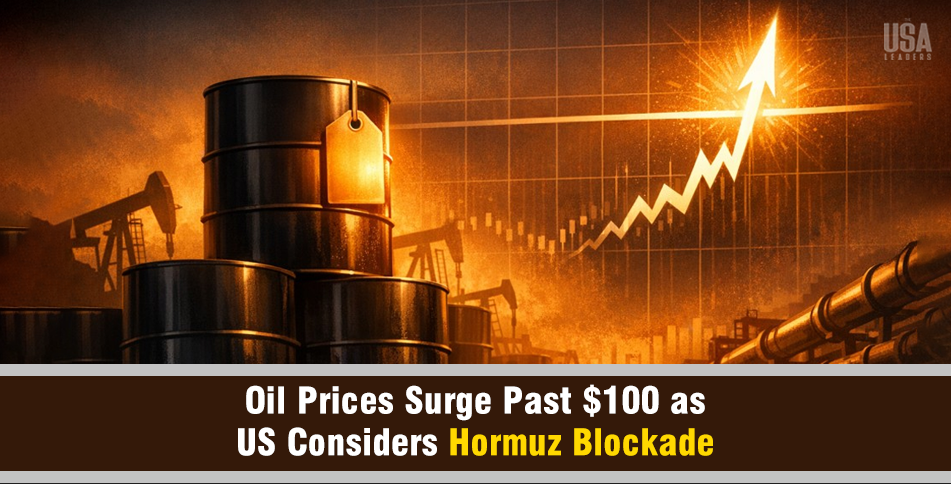
Oil prices surged above $100 per barrel after the United States signaled a potential blockade of Iranian ports near the Strait of Hormuz, raising fears of a major global supply disruption.
Global oil markets rallied sharply after the United States outlined plans to impose a blockade on Iranian ports near the strategically vital Strait of Hormuz. The announcement triggered an immediate surge in crude prices, with benchmark oil contracts crossing the $100-per-barrel mark amid growing fears of supply disruption.
This development marks one of the most significant geopolitical escalations in recent months and highlights how sensitive energy markets remain to tensions in the Middle East.
Strait of Hormuz — The World’s Most Critical Oil Chokepoint
The Strait of Hormuz remains the most important transit route for global oil shipments, with nearly one-fifth of the world’s crude supply passing through this narrow corridor daily.
Due to its strategic importance:
- Even minor disruptions can trigger major price swings
- Shipping routes become highly vulnerable during conflicts
- Insurance and freight costs rise sharply
Any attempt to restrict access directly or indirectly can send immediate shockwaves across global energy markets.
Market Reaction: Immediate Spike in Oil and Gas Prices
Following the announcement by Donald Trump, oil markets reacted within hours.
Key Developments:
- Brent crude surged past $100 per barrel
- US benchmark crude recorded sharp intraday gains
- European gas prices jumped amid energy security concerns
The rally reflects both real supply fears and speculative trading driven by geopolitical uncertainty.
US Policy Shift and Strategic Pressure on Iran
The proposed blockade is part of a broader US strategy aimed at tightening economic pressure on Iran by restricting its oil exports.
This shift signals a more aggressive geopolitical stance, with potential consequences including:
- Increased military presence in the region
- Heightened geopolitical tensions
- Risk of retaliatory actions from Iran
Iran has previously warned that any attempt to block its exports could disrupt traffic in the Strait of Hormuz, raising the risk of a wider regional conflict.
Oil Market Dynamics: Fear Premium Driving Prices
Current price movements are largely driven by what analysts describe as a “geopolitical risk premium.”
This means:
- Prices are rising based on the anticipated disruption
- Actual supply remains unchanged for now
- Markets are reacting more to uncertainty than confirmed shortages
Such conditions typically lead to:
- Increased volatility
- Rapid price swings
- Short-term speculative trading
Global Economic and Political Repercussions
The potential blockade has raised concerns among major economies, particularly those heavily dependent on energy imports.
Key Risks:
- Supply chain disruptions
- Increased reliance on strategic reserves
- Strained diplomatic relations
Countries across Asia and Europe are especially vulnerable due to their reliance on Middle Eastern oil supplies.
What Could Happen Next in Oil Markets?
The direction of oil prices will depend on how tensions around the Strait of Hormuz evolve.
Escalation
- Full blockade enforcement
- Oil prices could rise above $110–$120
Limited Action
- Partial or symbolic enforcement
- Prices remain high but stable
De-escalation
- Diplomatic resolution
- Oil prices may decline
Market Outlook:
Oil markets will stay highly sensitive to geopolitical developments, with volatility likely to continue in the short term.
Conclusion
The surge in oil prices following the US proposal to blockade Iranian ports near the Strait of Hormuz highlights the fragile balance of the global energy system. Even the possibility of disruption in this critical chokepoint is enough to trigger sharp market reactions, reinforcing the powerful link between geopolitics and economic stability.
As tensions between the United States and Iran continue to unfold, uncertainty is expected to dominate global markets. Investors, policymakers, and businesses will remain highly sensitive to any developments, as even minor escalations could push prices higher.
In the coming weeks, the direction of oil markets will depend largely on geopolitical decisions. Whether the situation escalates into a prolonged supply crisis or stabilizes through diplomatic efforts will play a crucial role in shaping global economic conditions in 2026.
Tejas Jadhav