The USA Leaders
February 24, 2026
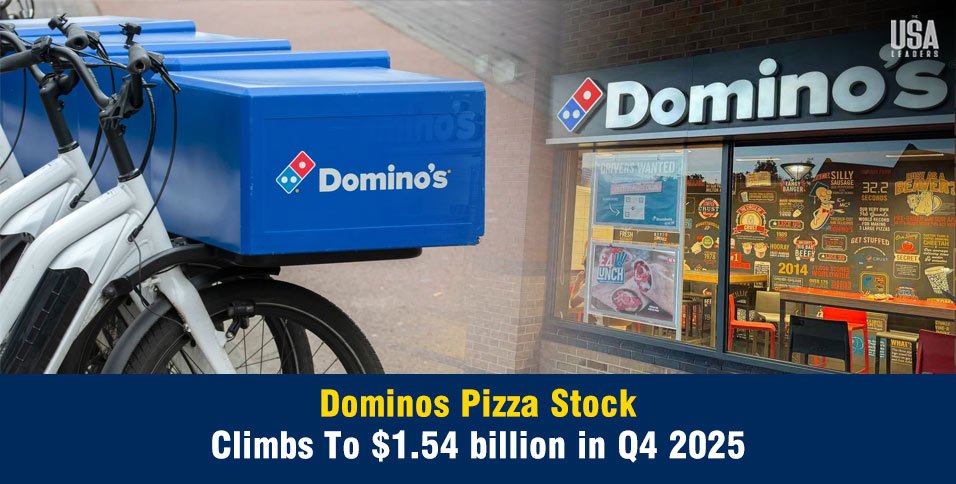
Dominos Pizza stock rose after the company reported stronger sales and sharply higher cash flow, giving investors confidence that its core business remains healthy even as delivery competition increases.
Revenue reached $1.54 billion in the fourth quarter, up 6.4% from a year earlier. Profit came in at $5.35 per share, up 9.4%. The company also raised its quarterly dividend by 15% to $1.99 per share, marking its 14th straight year of dividend growth.
The stock gained 4.65% after the announcement. Before earnings, shares had fallen about 20% over the past year and traded near their 52-week low of $370.70.
The results confirm strong execution. But investors still question whether Domino’s can maintain growth as the delivery business changes.
Growth Comes from More Orders, Not Higher Prices
| 3.7% | 6.5% | 37.3M | $166K |
| U.S. same-store sales growth | Carryout same-store sales growth | Active loyalty members | Avg. annual profit per franchise store |
| Up from 2.9% a year earlier | Total carryout revenue: $4.4B | Up 20% since 2023 | 11th straight year of U.S. market share gains |
Domino’s growth came from more customers placing orders, not from raising prices. U.S. same-store sales increased 3.7%, up from 2.9% a year earlier. That means existing stores generated more business without relying on price hikes.
Carryout led the growth. Same-store carryout sales rose 6.5%. Total carryout revenue reached $4.4 billion for the year. Carryout matters because it produces higher profit margins than delivery.
Domino’s loyalty program also strengthened customer retention. Active members reached 37.3 million, up 20% since 2023.
Loyalty programs increase repeat purchases and give companies direct access to customer data.
Franchise stores remained highly profitable. Average annual profit reached about $166,000 per store. Domino’s also gained market share in the United States for the 11th straight year.
Delivery Platforms: Growth Opportunity vs. Long-Term Risk
Domino’s expanded its presence on third-party delivery platforms such as DoorDash and Uber Eats. Management estimates these platforms could generate up to $1 billion in additional annual sales. These partnerships increase reach but also introduce new risks.
| Impact Area | Benefit to Domino’s | Risk to Domino’s |
| Customer growth | Reaches new customers who may not order directly | Platforms control customer relationships and data |
| Revenue | Adds incremental sales volume | Platform fees reduce profit margins |
| Market reach | Expands presence without opening new stores | Customers compare prices easily across competitors |
| Delivery performance | Helped support modest delivery sales growth in Q4 | Weakens Domino’s traditional delivery advantage |
| Wall Street outlook | Supports near-term revenue growth | TD Cowen expects only 2.5% U.S. same-store sales growth, below the company’s forecast of 3% |
Delivery platforms support short-term sales growth but create uncertainty about long-term profit strength. This tension remains one reason Dominos Pizza stock still trades below its historical valuation.
International Growth Slows, but Expansion Continues
International same-store sales rose 0.7%, down from 2.7% the previous year. Weak performance from a major franchise partner contributed to the slowdown.
Even so, Domino’s achieved its 32nd consecutive year of international same-store sales growth.
The company plans to open about 800 new international stores in 2026. China and India will drive much of this expansion. These markets offer large growth potential but also carry higher business risk.
Cash Flow Strength Supports Dividends and Buybacks
Free cash flow reached$671.5 million in 2025, supporting dividends and share repurchases, according to the company’s earnings release. Free cash flow represents the cash a company generates after paying operating and capital expenses.
Investors watch this closely because it funds dividends, debt payments, and share buybacks. Domino’s used this cash to return money to shareholders.
The company repurchased $354.7 million in shares during the year and increased its dividend.
Domino’s also carries about $5 billion in total debt. This increases financial risk if interest rates rise or sales slow. However, current cash flow provides strong coverage.
Competitors Are Losing Ground
Competitors continue to struggle. Papa John’s reported sharply lower profits.Pizza Hut is closing 250 underperforming stores.
These closures create opportunities for Domino’s to capture more customers. Domino’s operates more than 22,000 stores globally. Its scale, technology, and supply chain give it a major advantage.
Valuation Shows Skepticism but Also Opportunity
Dominos Pizza stock currently trades at about 19 times what analysts expect the company to earn next year. That is well below its five-year average of about 27 times earnings.
This lower valuation reflects investor concerns about:
- Delivery competition from third-party platforms
- Slower international growth
- Rising costs and debt levels
A lower valuation can signal risk. It can also create an opportunity if the company continues growing.
Outlook for 2026
Domino’s expects steady growth next year. Management forecasts:
- Global sales growth of about 6%
- U.S. same-store sales growth of about 3%
- International same-store sales growth of 1% to 2%
- Operating profit growth of about 8%
The company plans to open hundreds of new stores worldwide.
Investor Takeaway
Dominos Pizza stock reflects two competing realities. The business continues to generate strong cash flow, gain market share, and grow customer orders. These strengths support dividends and long-term growth.
At the same time, delivery competition and debt levels create uncertainty. The current stock price reflects that tension.
Investors who believe Domino’s can continue expanding its customer base may see upside potential. Others may wait for clearer evidence that delivery competition will not weaken long-term profits.
Neha Shekhawat
Also Read : Amazon vs Walmart: A New Era in the Retail Wars