The USA Leaders
December 11, 2025
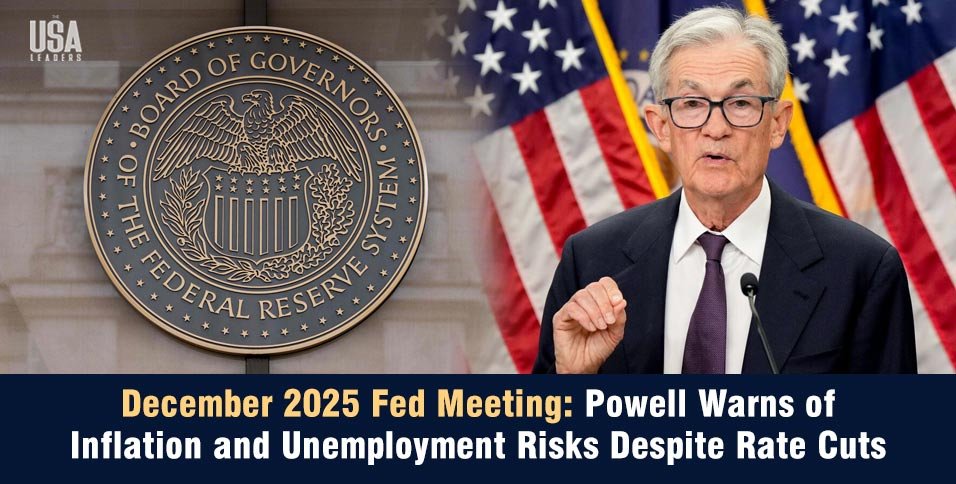
Washington, DC– The December 2025 Fed Meeting delivered one of the most closely watched policy decisions of the year, as the Federal Reserve cut interest rates for the third consecutive time. The central bank lowered the benchmark range to 3.50%–3.75%. At the same time, it warns that the economy still faces significant risks tied to inflation, rising unemployment and blames them on tariffs.
During the meeting, Federal Reserve Chair Jerome Powell emphasised that inflation remains “somewhat elevated,” and much of it stems from tariff-related price increases rather than excess demand.
Powell noted that the recent growth in inflation was “largely driven by the new tariffs,” which have increased import prices and added pressure on households and businesses.
This December 2025 Fed Meeting signalled a careful balance between lowering interest rates to support a softening economy, while acknowledging that the path forward is still uncertain.
Why Did the December 2025 Fed Meeting Cut Rates Again
According to economic data, there was slower job growth and growing concerns in the labour market. The central bank sees increasing risks that unemployment could rise in the coming months. A rate cut in the December 2025 Fed Meeting was intended to provide some relief, as the interest rate cut could support spending and investment.
Powell clarified that interest rates are not on a preset path. He stated that, the central bank is “well positioned to wait and see how the economy evolves,”. This means the future decisions will depend strictly on economic data. While inflation has moderated from earlier highs, it has not eased enough to give the Fed full confidence.
This position explains why the December 2025 Fed Meeting delivered an interest rate cut, but avoided signalling any long-term commitment to continued easing.
The rate cut does not mean the economy is weakening sharply. Instead, the Federal Reserve is trying to keep financial conditions stable as both businesses and households adjust to global trade disruptions and cooling demand.
Tariffs Driving Inflation: Jerome Powell
One of the most striking points from the December 2025 Fed Meeting was Powell directly acknowledging that Trump’s tariff decision is a major contributor to inflation.
As reported by Reuters, Powell stated, “Import prices have risen significantly because of the new tariffs,” and this has added to the inflation overshoot seen in recent months.
Multiple analysts have noted similar effects earlier in the year. The renewed tariffs have fueled global uncertainty and pushed up costs for U.S. companies and consumers. These tariff-driven pressures act differently from typical inflation sources, as they raise prices even when demand is not strong.
The Fed is carefully navigating the situation and signalling flexibility rather than a fixed strategy.
Risks of Both Inflation and Unemployment
Powell highlighted a rare dual threat at the December 2025 Fed Meeting:
- Inflation is still too high, especially on imported goods affected by tariffs.
- Unemployment risks are rising, with job creation slowing and some industries reporting weaker hiring.
This makes policymaking more complicated than in a typical slowdown or a typical inflation cycle.
Powell emphasised that the central bank cannot ignore either side of the economy. He explained that “risks remain on both sides,” referring to the need to protect workers from job losses while still bringing inflation closer to the Fed’s 2% goal.
This caution was reflected in the committee’s projections, indicating that the Fed does not plan a long easing cycle unless conditions worsen.
December 2025 Fed Meeting For Households and Businesses
Key Point:
1. Borrowing costs may drop slightly. Lower interest rates can make loans cheaper, particularly for homebuyers and small businesses.
2. Inflation may stay elevated on imported goods. Tariff-related price increases, especially for electronics, machinery, and some consumer goods, may continue into 2026 unless trade policies change.
3. Employment conditions may weaken. Powell’s comments suggest that the labour market is no longer as strong as earlier in the year.
4. The Fed is not committing to further cuts, as the meeting emphasised flexibility, not a long-term easing cycle.
A Delicate Balancing Act Going Into 2026
The December 2025 Fed Meeting reinforced that the U.S. economy is at a delicate moment. Inflation is cooling slowly but inconsistently. Unemployment is no longer at historic lows. And tariff-driven cost pressures continue to shape economic outcomes.
The Federal Reserve is trying to steady the economy without overstimulating it, and Powell made clear that policy will adjust as new data arrives. Investors, businesses, and consumers will be watching inflation, job numbers, and global trade developments closely in early 2026.
For now, the Federal Reserve remains alert to the risks posed by inflation and unemployment, but the road ahead is far from settled.