There is a particular kind of expertise that cannot be taught in a classroom or simulated in a training module. It accumulates slowly, through years of watching people move through spaces, of listening carefully to what a client says and even more carefully to what they do not say, of learning the difference between a room that merely functions and a room that truly resonates.
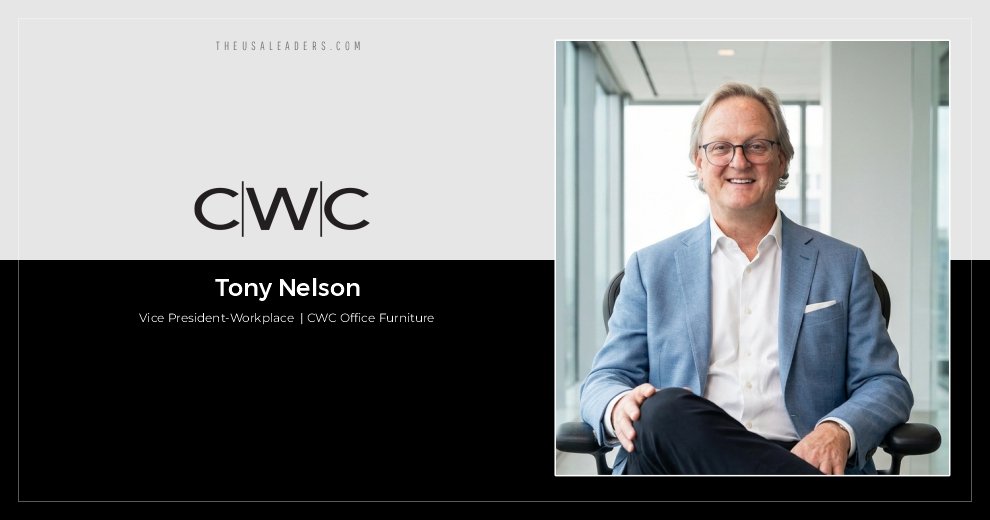
Tony Nelson has been accumulating that kind of expertise for 31 years.
As Vice President of Workplace at CWC in Atlanta, Georgia, Tony brings more than three decades of experience in the contract furniture industry. Throughout his career, he developed corporate workplace projects and drove business growth through strategic sales leadership. Before joining CWC, Tony spent 5 1/2 years at Global Furniture Group, where he served as Southeast Regional Manager, then SR VP of Sales for the US, leading the sales team and sales initiatives. His career has been shaped not by a single path, but by a depth of experience, with each role building on the last and strengthening the expertise he brings to every client relationship.
His portfolio spans major corporate headquarters, higher education institutions, hospitality projects, and leading architecture and design firms throughout Atlanta and beyond, including landmark work for UPS, Equifax, Georgia Tech, The Ritz-Carlton, and several of the region’s most influential commercial organizations.
The list is substantial. What he holds onto, however, is not the scale of those projects but the consistency of the approach that made them possible.
A Beginning Built from the Ground Up
Before the world headquarters and the million-dollar deals, there was a warehouse.
Tony’s entry into the industry began practically, working in warehousing and logistics before moving into sales. Straight out of high school, he took a job at an office furniture and office supply dealer, starting in warehousing and logistics. The ambition was always to become a furniture seller for a Steelcase dealer, but Tony understood that you build toward something rather than leap into it.
He moved into supply sales first. Furniture sales followed. Then came the defining chapter: his first boss, John Harris, purchased and began rebuilding a Knoll dealership and brought Tony into that effort. It was the proving ground he needed.
His first million-dollar deal came with Delta Air Lines. What followed was even more formative. The United Parcel Service World Headquarters project arrived at a scale and complexity that demanded everything he had. Tony describes it with the precision of someone who knows exactly what shaped him: “That became my personal ‘master’s level program’ in workplace design, strategy, and the contract furniture industry.”
That foundation, earned through execution rather than theory, has guided his work with clients across Georgia, the country, and around the world ever since.
A Company That Survived the Depression
CWC Office Furniture was founded in 1929, which is to say it was founded in the same year the American economy collapsed. That is not a detail to pass over lightly.
The company began in office supplies, furniture, machines, and related services, oriented from the start around a mission that was at once simple and demanding: put the customer first, represent stable and forward-thinking manufacturers, and build relationships with the people who shape the built environment, including architects, interior designers, facility managers, and commercial real estate professionals.
Over the decades, CWC steadily established itself as one of Atlanta’s leading workplace solutions providers, building long-standing relationships throughout Georgia’s commercial and design communities. Nearly 100 years later, that orientation has not wavered.
“The mission has always been to take great care of customers and relationships at every level of Atlanta and throughout the state of Georgia,” he says.
The products have transformed, the demands of the market have multiplied, and the tools of the industry have evolved considerably. But the commitment to service, talent, and relationship-building has remained the company’s constant, its true north through every disruption and every season of change.
What Employee Ownership Actually Looks Like
In 2018, CWC became employee-owned, and Tony is careful to explain what that means beyond the organizational chart.
It is not simply a financial arrangement. It is a cultural one. Every person at CWC has a personal stake in the outcome of every project and every client relationship. That stake shows up not in press releases but in phone calls returned promptly, in problems addressed before they become crises, in clients who sense, without being fully able to name it, that the people working on their space genuinely care about the result.
CWC reinforces this culture with infrastructure. The company maintains its own labor workforce, its own fleet of vehicles, and a showroom accessible to the market, all supported by strategic partnerships with manufacturers and representatives who assist in every aspect of project and workplace development. When CWC commits to a timeline or a standard of delivery, it holds the means to honor that commitment from the inside out.
“Since becoming employee-owned in 2018, that accountability has grown even stronger,” he says. “Every employee-owner has a personal stake in the outcome, and clients feel that difference in communication, responsiveness, and follow-through.”
That is not a small thing in an industry where the distance between a promise and its fulfillment is precisely where trust is either built or broken.
More Than Furniture: The Full Scope of What CWC Does
There is a reductive version of what CWC does, and Tony gently but consistently resists it.
The company’s core services include design services for furniture and architectural products, delivery, installation, warehousing, asset management, workplace strategy, and long-term service support. The work unfolds in close collaboration with designers, facility team members, organizational leadership, and project managers. It requires, above all else, effective listening, genuine accountability, and what he calls exemplary service.
“Furniture is only part of the equation,” he says. “What sets CWC apart is how it manages details, anticipates challenges, and supports clients beyond installation.”
That word “beyond” carries real weight in his vocabulary. A workspace is not a completed project. It is a living environment that evolves as the organization inside it evolves. CWC’s relationship with its clients is built to accommodate that ongoing reality, and every team member is empowered to make decisions that serve the client rather than wait for authorization that might arrive too late.
That sense of ownership, he makes clear, extends to every touchpoint.
Built for Change, by Design
Across 31 years in this industry, Tony has watched the workplace transform in ways that would have been difficult to predict at the outset. He does not appear troubled by this. If anything, he finds the pace of change clarifying.
“CWC exists because of change,” he says simply.
The forces reshaping the modern workplace, including shifting workstyles, evolving space constraints, growth and contraction cycles, attract-and-retain imperatives, collaboration design, employee engagement, and brand representation, are precisely the conditions that CWC is structured to navigate. As a MillerKnoll-aligned dealer, the company brings both product range and strategic perspective to the challenge, working to meet a client’s financial investment goals while also helping them absorb the market’s inevitable disruptions.
He frames the stakes with characteristic directness. Furniture and workplaces, he says, are “significant tools employers, education entities and businesses provide to serve their clients, communities and employees.” That framing transforms what might appear to be a commercial transaction into something closer to stewardship.
Technology in the Service of Space
The modern workplace is not simply a physical arrangement of surfaces and seating. It is an integrated environment, and Tony approaches it with both precision and creative instinct.
Audiovisual systems, communication technology, biophilia, access to natural light, clean air, visibility, and connectivity are all part of the planning conversation at CWC today. He describes these not as optional enhancements but as foundational components of a workspace that truly serves the people inside it. CWC works to stay ahead of or closely aligned with the providers of these innovations, “always learning how we mutually support businesses, their leaders, their goals, and their missions.”
Technology has also transformed how clients experience the design process itself. Real-time visualization, product tracking, and project coordination tools now allow clients to see their options clearly, make decisions with speed and confidence, and manage the complexity of a large commercial undertaking without being overwhelmed by it.
The projects themselves have only grown more complex, but the tools available to navigate them have become significantly more capable.
Earning Trust the Unglamorous Way
CWC hosts annual appreciation luncheons for its vendor and manufacturer representative partners, a tradition that reflects the company’s understanding of how the commercial interiors ecosystem actually functions. No firm succeeds in isolation. CWC also supports its relationships through continuing education programs, referral arrangements, internships, and actively promoting customers to one another for mutual growth and resource alignment.
But Tony is clear-eyed about where trust is actually built. It is not at a luncheon, however warmly attended. It is in the quiet, sustained discipline of honoring your commitments, at every level of the organization, across every interaction.
Integrity, honesty, acceptance, and trust are not aspirational language at CWC. They are, as he describes it, actively monitored and promoted across all actions, all locations, and all team members.
The standard, he acknowledges, is not complicated. Maintaining it consistently and at scale is where the real work lies.
Resilience Measured in People, Not Projects
CWC’s nearly 100-year history includes the Great Depression, multiple recessions, a global pandemic, and the ordinary and extraordinary turbulence of a century in business. Tony speaks about those periods without drama, focusing on the response rather than the difficulty.
The company’s leaders work to tackle issues directly and hold one another accountable. That approach does not make difficulty disappear, but it prevents it from deepening. What has allowed CWC to move through each disruption, he says, is a sustained commitment to its people, its customers, and its values, alongside a genuine willingness to keep evolving.
The alumni of industry professionals that CWC has developed over the decades, now leading roles throughout Atlanta, Georgia, and the broader contract furniture industry, are for him the truest measure of the company’s resilience.
“A great measure of our resilience is not only the projects we have completed, but the leaders and successful team members developed throughout the life of CWC.”
CWC has held the position of leading dealership in Atlanta and the state of Georgia for a significant portion of its nearly century-long lifespan. Its client list spans corporations and businesses of every size, type, and market, alongside some of Atlanta’s most accomplished architecture and design firms. What Tony returns to consistently is not simply the scale of the work, but the continuity of the relationships that remain long after the installations are complete.
The Workplace of 2026 and What Comes After
Tony does not make predictions in the abstract. He makes them in particular.
Workplace design, he believes, will continue to evolve alongside artificial intelligence, new technology, hybrid and remote work strategies, furniture innovation, and architectural walls. Spaces will increasingly be designed to serve multiple and overlapping purposes: work, play, learning, and healing. Every category of the market, from corporate to education to healthcare, uses the tools that CWC provides to help people perform their roles, serve their families, serve their communities, and drive business forward.
CWC is preparing for that future by investing in adaptable solutions, technology, service, and partnerships that equip clients to navigate change with clarity and confidence, rather than be caught off-guard by it. The question driving that preparation is not about product or trend. It is about purpose: what do people need from their physical environment in order to connect, to perform, and to belong?
For Tony, that question remains at the center of every workplace conversation.
The Philosophy Behind the Leader
When Tony talks about balance in a fast-paced industry built on deadlines and client expectations, he does not reach for the expected answers. He says, plainly, that he loves going to work.
He means something specific by that. He means the daily engagement with his immediate team, with clients, with influencers, designers, project managers, customers, and business agents. He means the work of driving projects forward, fulfilling needs, and finding what he calls, without any trace of irony, “magic” in the workplace. Honest evaluation of deadlines and milestones, he adds, is what keeps everyone focused and driven to succeed.
His advice for future leaders follows the same logic that has guided his own career. Empower your team through trust, respect, and open communication. Be genuinely involved as you develop people, projects, and relationships. Acknowledge successes and, more importantly, acknowledge the people behind them. Remain open-minded and accepting of diverse thoughts, beliefs, and differences, and demonstrate integrity, faith, and honesty both inside the organization and outside it.
He ends with a reminder that workplace design is ultimately about people. The workplace should be inspiring and engaging because, as he sees it, we spend a great deal of our lives inside these environments. They deserve to reflect the energy, connection, and purpose of the people within them.
After 31 years, Tony Nelson still means every word of it. And the evidence, measured in projects completed, people developed, and a company approaching its centennial, suggests he has been right all along.
Quotes
“Trust is really earned after the project is complete. It comes from doing what you say you will do, communicating honestly, and remaining available long after installation.”
“The future is not simply about where people work. It is about creating spaces that support connection, culture, performance, and flexibility for whatever comes next.”
Also Read – Visionary Leaders Transforming Workplace Design, Commercial Spaces & Business Growth in 2026