The earth possesses an invisible memory. It remembers the hands that have turned it, the seeds it has swallowed, and the harvests it has yielded or denied. For centuries, the relationship between marginalized communities and the American soil has been fraught with profound tension. It is a story of systemic agricultural exclusion, redlined neighborhoods, and concrete landscapes where fresh food is a rare luxury. Yet, if you walk into the lush sanctuaries of certain urban church lots today, you will witness a quiet but radical reclaiming of that very earth. This is not merely gardening. This is a theological statement.
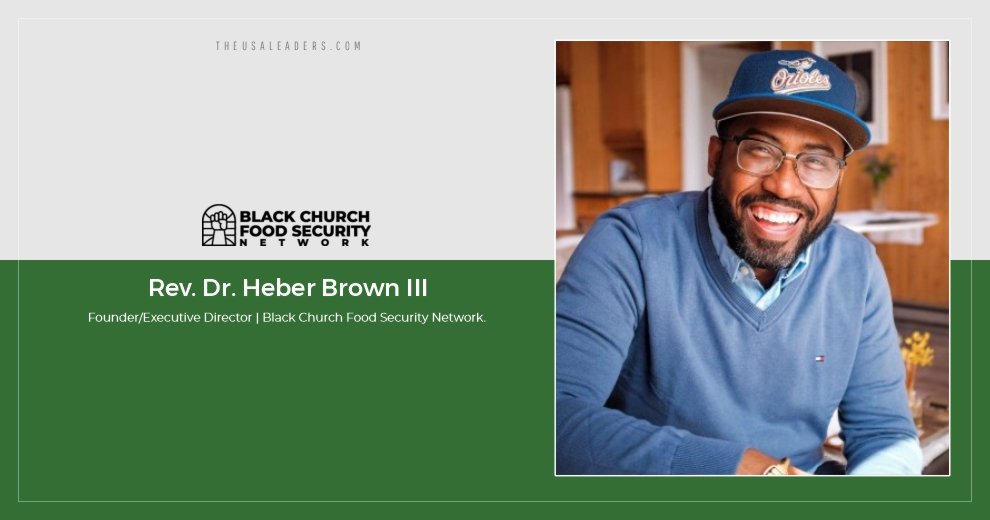
At the center of this movement stands Rev. Dr. Heber Brown III. He is a man who understands that a tomato plant growing in the shadow of a steeple is never just a tomato plant; it is a declaration of sovereignty. In 2026, he stands at the helm of a national movement, proving that spiritual power requires practical earthly infrastructure.
“I help congregations and grassroots organizations turn bold vision into structured, sustainable impact,” Dr. Brown explains. As a faith-rooted strategist, community builder, and organizational leader, he works precisely where food justice, nonprofit innovation, and liberation theologies collide.
Imagine a typical Sunday morning. The choir’s voices rise into the rafters, carrying centuries of hope and sorrow. Yet, when the service ends, the congregation walks out into a neighborhood where finding a fresh, crisp apple is harder than finding a corner liquor store. This stark contrast is what ignited a fire in Dr. Brown. He looked at the sprawling, often manicured lawns of church properties and saw an untapped agricultural revolution. He realized that the same institutions that fed the soul were perfectly positioned to literally feed the body.
A Pastoral Awakening in Baltimore
His journey toward this intersection of faith and food did not begin in a garden. Between 2005 and 2008, he served as the Manager of Public Policy for the Maryland Mentoring Partnership, learning the intricate dance of advocacy and civic organizing. But it was in the pulpit where his deepest calling took root.
From June 2008 until May 2022, a span of exactly fourteen years, Dr. Brown served as the Senior Pastor of Pleasant Hope Baptist Church in Baltimore, Maryland. In this role, he witnessed firsthand the devastating impacts of food apartheid on his congregation. He saw parishioners struggling with diet-related illnesses, unable to access fresh, life-giving produce in their own neighborhoods. Instead of offering hollow platitudes, he mobilized his church.
Under his leadership, the congregation experienced steady growth, national recognition, and a demonstrated commitment to community service. He led the church in acquiring an additional property for community outreach and successfully secured $250,000 in state funding to renovate the building. He also spearheaded the establishment of a Community Development Corporation, firmly planting the church’s nonprofit arm in the gritty reality of neighborhood revitalization.
Cultivating the Mind and the Earth
During his pastoral tenure, he realized that true freedom requires education that transcends standard curricula. From January 2014 to December 2020, a period of seven years, he served as the Founder and Executive Director of Orita’s Cross Freedom School. This African-centered youth educational program, a project of Fusion Partnerships, was meticulously designed to teach critical thinking, self-sufficiency, and cultural pride. It was a bold step in inspiring the next generation of societal change-makers.
However, the most sweeping transformation was yet to come. In April 2015, Dr. Brown founded the Black Church Food Security Network. Now in its eleventh year and seventh month of operation, he continues to serve full-time as its Executive Director. The organization’s premise is breathtakingly elegant in its simplicity. They partner with local congregations to establish gardens and farms on church-owned land, while connecting Black farmers with Black churches to inspire mutual support and self-sufficiency. As the Founding Executive Director, he leads the organization’s visioning, strategic direction, staff management, fundraising, and partnerships.
Through this network, he is engineering community organizing campaigns rooted in justice, guided by strategy, and driven by the sacred. His multifaceted approach ranges from launching CSA programs through the network to launching a multi-channel holistic health company, and even promoting Black businesses through social impact investing. He specializes in connecting the ethereal nature of belief with the very tangible reality of soil and commerce.
A Nationwide Harvest
To understand Dr. Brown is to understand that he does not merely practice theology. He cultivates it. He has taken this radical philosophy into the halls of academia. His academic work is not confined to dusty library shelves; it is lived out in the dirt and the sun. In February 2018, he served as a contract Adjunct Professor at the Wake Forest University School of Divinity in the Greensboro, Winston-Salem, and High Point area.
There, he led students in an exploration of the historically overlooked connections between food sovereignty and Black churches. He presented modern practices of Christian leadership within the context of urban food security issues, beginning with the context of the Black Freedom Struggle of the twentieth century.
A year later, in January 2019, he took his teachings to the Memphis metropolitan area, serving as a contract Adjunct Professor at the Memphis Theological Seminary. He taught a doctoral course titled ‘Higher Ground: A Theopraxis of Land & Food.’ The Doctor of Ministry in Land, Food, and Faith Formation program critically explores the intersections of ministry with care for the land. Drawing upon biblical study, this course attends to both God’s gracious gift of the land and human responsibilities to care for it, addressing just access to food in both rural and urban settings.
Today, he is blessed to serve on the board of several highly impactful organizations, including Bread For The World and Future Harvest. As 2026 unfolds, the literary and theological worlds eagerly anticipate his forthcoming book, entitled ‘Nothing More Sacred: Radical Stories Of Black Church Faith, Food and Freedom.’ Through every seed planted and every sermon preached, Dr. Brown continues to prove that salvation is not just a heavenly promise. It is something that can be grown right here, in the soil of the community.
Also Read – Leaders Shaping Faith-Driven Impact & Community Transformation in 2026