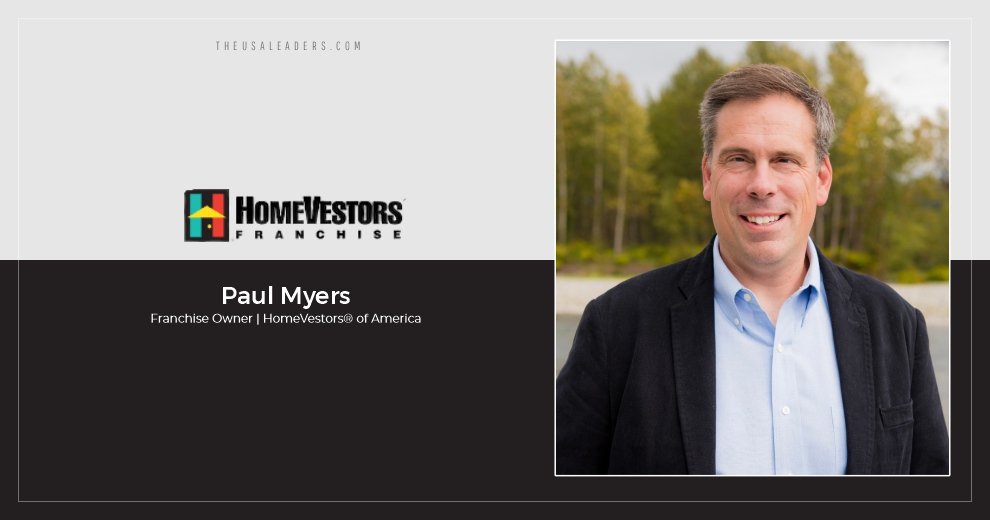
There is a particular way of looking at a house that only comes from knowing what lies beneath it. Most people see the paint, the curb appeal, the way the light hits the kitchen window. Paul Myers sees the soil. He sees the load-bearing walls, the foundation settling into the earth, the invisible web of plumbing and wiring that keeps the structure alive. He grew up in Issaquah, Washington, the son of a single mother who taught him the value of doing things right the first time. He was the kid taking apart cars and tools just to understand their mechanics.
Later, he studied Geological Sciences at the University of Washington, a path that led him to spend over 15 years at Mayes Testing Engineers. There, he inspected thousands of job sites, from foundation pours to massive commercial projects, learning the unforgiving language of structural failure and success.
Today, Paul is the HomeVestors® of America franchise owner at Real Rock, LLC, famously known as the “We Buy Ugly Houses®.” But to describe him simply as a real estate investor is to miss the point entirely. He is a craftsman of second chances. He is aLicensed Washington Real Estate Broker with over 23 years of experience, a man who combines the technical precision of an engineer with the deep empathy of a neighbor. He operates in a world of distressed properties, inherited burdens, and difficult life transitions, offering a solution that is as much about human relief as it is about real estate transactions. He is a leader who believes that the true value of a house is not just in its market price, but in its ability to be a home again.
The Science of the “Ugly”
To understand Paul, you have to understand that he does not view an “ugly” house as a failure. He views it as a data point in a human life.
In 2002, Paul and his wife, Tanice, bought their first rental property, a small house in Lake Stevens. It was meant to be an investment. It became an obsession. Paul realized that his background in construction materials testing and engineering gave him a superpower. Where others saw a terrifying money pit, Paul saw a solvable equation. He knew how to evaluate a house without emotion but with extreme precision. He knew how to avoid the surprises that sink the uninitiated.
“Real estate became more than a business for me,” Paul says, reflecting on those early years. “It became a craft.”
But as he and Tanice expanded their portfolio, moving into fix-and-flip projects and renovations across multiple markets, they began to notice a gap. The real estate market is designed for the shiny and the new. It is designed for the homeowner who has the time to declutter, the money to stage, and the patience to wait for a more traditional buyer using conventional funding from banks.
It is not designed for the person who has just inherited a hoarder’s house from a deceased parent. It is not designed for the couple going through a contentious divorce who needs to liquidate assets yesterday. It is not designed for the elderly person whose home has deferred maintenance that would terrify a traditional buyer.
“Tanice and I kept meeting sellers who weren’t just overwhelmed by a property,” Paul observes. “They were overwhelmed by life.”
This was the origin of Real Rock LLC. In 2018, they decided to scale their impact. They joined the HomeVestors® of America network: the “We Buy Ugly Houses®” people. It was a strategic decision, certainly; the franchise provided a marketing engine and national credibility. But more than that, it was a value decision.
Paul saw that the “Ugly House” model wasn’t about exploiting a lack of options. It was about creating an option where none existed. It was about realizing that for some people, the house is not an asset. It is an anchor. And they need someone to cut the chain.
The Mechanics of Relief
The traditional real estate transaction is a theater production. You have the set design (staging), the marketing campaign (listing), the audience (showings), and the critics (inspectors and appraisers).
Paul operates in a different reality. The HomeVestors® of America model is built on speed and certainty. There are no open houses. There is no waiting for a bank underwriter to approve a loan. There is just Paul, or one of his team members, walking through a property, looking past the debris or the dated wallpaper, and making a cash offer based on the true condition of the home.
“Traditional real estate is focused on maximizing exposure,” Paul explains. “HomeVestors® of America is focused on maximizing solutions.”
This distinction is critical. The people Paul serves are often in the midst of a transition they did not choose. They are dealing with death, debt, or disease. They do not have the emotional bandwidth to negotiate repairs. They need to know that on a specific date, the problem will be solved, and the money will be in their hands.
Paul recounts sitting at kitchen tables with sellers who are embarrassed by the state of their home. They are apologetic. They are afraid of judgment. In these moments, Paul doesn’t act like a salesman. He acts like the engineer he is. He explains the numbers. He walks them through the repair costs, the structural concerns, and the market value. He treats the house as a physical object that needs work, separating the condition of the drywall from the character of the owner.
“What ultimately builds trust is a combination of clarity and compassion,” Paul says. “We show up without judgment.”
By removing the judgment, Paul removes the shame. And by removing the shame, he allows the homeowner to make a decision based on logic rather than fear.
The Mentor in the Field
If the sellers are one group of people Paul serves, the other group is the next generation of entrepreneurs. As a Development Agent, Paul is responsible for the success of HomeVestors® of America franchises across a massive swath of the American West.
It is a role that requires a shift from doing the work to teaching the work. New franchisees often come into the system with a dream but no blueprint. They might be escaping the corporate grind or looking for financial independence, but they rarely know how to estimate the cost of a new roof or how to talk to a seller who is crying in their living room.
Paul bridges that gap. He takes them into the field. He teaches them the geology of the business.
“My job is to bridge that gap,” Paul says. “I’ve been in the trenches for years, and I’m able to pass on the lessons learned.”
He is not a distant corporate overseer. He and Tanice host training sessions, organize field days, and foster a community where competitors become collaborators. They have built an ecosystem where a franchise owner in Idaho can learn from a mistake made in Utah.
This mentorship is rooted in the same philosophy as his construction work: do it right the first time. Paul teaches his franchisees that this business can be emotional, and that is okay. But he also teaches them that empathy must be paired with professionalism. “You cannot help someone if your business fails. You have to be profitable to be helpful.”
“When our franchisees win,” Paul says, “the communities they serve win too.”
The Myth of the Shark
There is a persistent myth about real estate investors, specifically those who make cash offers. The myth says they are sharks. It says they are predatory, circling the water, waiting for someone to bleed so they can strike.
Paul is aware of this perception. He confronts it the same way he confronts a structural issue in a basement: with transparency.
The misconception is that the investor is trying to “get a deal” at the seller’s expense. The reality, Paul argues, is that the seller and the investor are solving different variables. The seller needs speed, convenience, and a lack of contingencies. The investor needs a margin to cover the massive risk of renovating a distressed property.
“When I sit with a seller,” Paul says, “I walk them through the numbers the same way I would explain a project to a construction team.”
He shows them the cost of the foundation repair. He shows them the price of the lumber. He demystifies the offer. When people see the math, the “shark” narrative dissolves. They realize that the offer isn’t arbitrary. It is the cost of revitalizing a home that the traditional market has rejected.
Furthermore, Paul pushes back against the idea that investors don’t care.
“In our business, empathy isn’t an accessory,” he says firmly. “It’s an operating principle.”
He has learned that leadership in this space means slowing down. It means listening to the story behind the house. A house that hasn’t been painted in thirty years is often a house owned by someone who has been struggling for thirty years. To ignore that human element is to miss the entire point of the transaction.
The Crucible of Leadership
Leadership is easy when the sun is shining and the project is under budget. But Paul knows that the true test of a leader happens when the walls, literally or metaphorically, start to crumble.
He shares a story about a particular home purchase that tested every fiber of his patience and integrity. The seller was going through a horrific chapter in life. The house was a disaster of deferred maintenance. Paul’s team bought it, expecting a standard renovation.
But as they peeled back the layers, the house fought back. Hidden issues emerged. Structural failures. Mechanical nightmares. The budget evaporated. The timeline stretched. The crew was exhausted.
The easy financial decision would have been to cut corners. To patch over the problems. To do the minimum required to get it sold.
“But that wasn’t an option for me,” Paul says. “A family was going to live in that home.”
This is where the kid who took apart tools in Issaquah stepped in. He didn’t panic. He reassessed. He gathered his team and communicated the new reality. They rebuilt systems that no buyer would ever see. They fixed things they didn’t break. They took the financial hit to ensure the product was safe.
“Leadership isn’t loud,” Paul reflects. “It’s steady.”
It is the willingness to take responsibility for the outcome, even when the outcome is painful. It is the understanding that your reputation is the only asset that truly matters, and it is built in the moments when no one is watching.
The Architecture of Support
No one renovates a house alone, and certainly, no one builds a multi-state business alone. Paul is quick to deflect credit to the ecosystem he has built.
He speaks with reverence about his construction crews: the roofers, plumbers, and electricians who understand that “good enough” is not in the vocabulary of Real Rock LLC. He speaks of the title companies and attorneys who navigate the legal labyrinths of inherited properties.
But the most critical partner is sitting right beside him. Tanice is not just his wife; she is the co-architect of their vision. While Paul is in the field, dealing with the tangible reality of lumber and concrete, Tanice is driving the brand. She is the storyteller. She is the community builder.
While HomeVestors has been a powerful foundation for their success, their brand Road Warrior Investors (RWI) plays a big role in how they reach everyday Americans. It is the “people-first brand” they built to educate, inspire, and connect with sellers, investors, and new franchisees through media and education.
“It’s a true partnership,” Paul says.
Together, they have created a business that allows them to live a life that looks nothing like the typical grind of a high-powered CEO. They do not believe in a perfect “work-life balance,” a term Paul finds somewhat artificial. Instead, they believe in priorities.
“If Tanice or our daughter Amelia needs me, I stop what I’m doing,” Paul says.
He works hard, but he works on his terms. He and Tanice travel constantly, exploring the backroads, finding quiet spots in the mountains or near the water. The Pacific Northwest runs through Paul’s veins; he is happiest when he is outdoors, fishing, or tinkering with a mechanical project. These moments are not escapes from his work; they are the fuel for it. They remind him that life is broader than real estate.
The Finished Project
When Paul looks back at what he has built, he doesn’t count the houses. He counts the relief.
He sees the faces of the people who were able to move on from a tragic situation because he provided a solution. He sees the franchise owners who have quit their soul-crushing corporate jobs to build a legacy for their own families. He sees the neighborhoods that are safer because a derelict house was turned into a home.
“I look at the people we’ve helped,” Paul says.
His vision for the future is to keep doing exactly this, but better. He wants to take on the projects others are too afraid to touch. He wants to train the next generation of investors to operate with the same code of ethics that guides him. He wants to prove that you can be profitable and principled at the same time.
There is a wisdom in Paul Myers that feels earned, like the calluses on a carpenter’s hands. It is the wisdom of a man who knows that you don’t have to be perfect to start. You just have to be willing to do the work.
“You don’t have to have everything figured out to take the next step,” he concludes.
Paul and Tanice Myers continue to lead the charge in shaping the future of off-market real estate investing. Through their RWI platform and as Development Agents for HomeVestors, they support aspiring investors, speak at national events, and help families solve complex property situations.
Learn more at RoadWarriorInvestors.com or follow them on LinkedIn, or YouTube @roadwarriorinvestors.
Quotes
“You don’t have to have everything figured out to take the next step.”
“If you focus on leaving every situation better than you found it—whether that’s a house, a seller, or a business partnership—you’ll be surprised how far that approach will take you.”
Also Read: The 10 Most Influential Real Estate Leaders of 2026