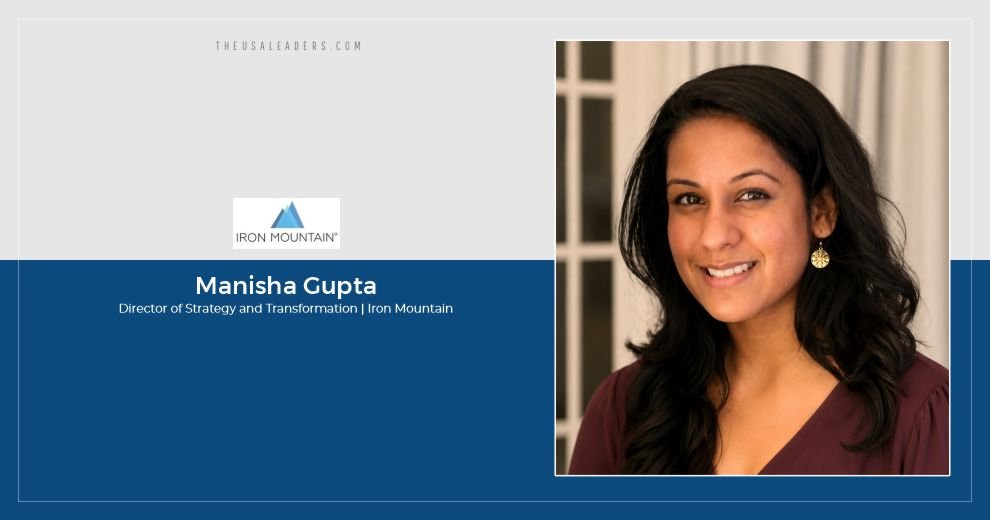
There is a particular kind of leader who never chases the spotlight, who instead spends her career in the columns and footnotes of financial statements, learning exactly where a company’s money leaks and exactly how to stop it. Manisha Gupta is that kind of leader. Today, she serves as Director of Strategy and Transformation at Iron Mountain, based in Herndon, Virginia, following a promotion from her previous leadership role in Enterprise Finance. Her career has been built at the intersection of financial discipline, operational understanding, and business transformation.
Her bio describes her plainly, without embellishment: an award-winning, growth-focused leader with comprehensive experience directing all aspects of functional and operational financial management. It is the kind of sentence that undersells, on purpose, just how much groundwork sits behind it.
Six Years Inside Iron Mountain’s Transformation Engine
Manisha’s time at Iron Mountain now totals more than six years. She joined the company in March 2020, initially contributing to technology transformation initiatives within the Global Technology Organization, where her work included ideation, financial due diligence, and assessing organizational impact.
She later moved into Enterprise Finance leadership, spending approximately three years in that area before her promotion to Director of Strategy and Transformation. Her progression reflects a widening mandate: from evaluating the financial and organizational implications of transformation initiatives to helping lead transformation at the enterprise level.
That evolution makes her current role a natural continuation of the work that came before it. She brings financial rigor to transformation, using the discipline of finance and operations to help organizations turn strategic priorities into measurable business change.
Eight Years Learning the Business From the Ground Up
Before Iron Mountain, Manisha spent eight years in Finance and Operations at Field Data Technology, based in Fairfax, Virginia, from April 2012 to March 2020. It was the longest single stretch of her career, and it built the operational fluency that would later define her strategy work: understanding not just what a spreadsheet says, but what actually happens on the ground to produce the numbers inside it. Public records also identify her as a contact for Field Data Technology in Fairfax, Virginia.
A Foundation Forged in Audit
Manisha’s earliest professional years were spent inside the discipline that, more than any other, teaches a person to distrust assumptions and demand evidence. From February 2009 to April 2012, three years and three months, she worked on the Corporate Audit Staff at The Nielsen Company in New York, moving through the roles of Audit Associate, Audit Manager, and finally Senior Audit Manager.
Before Nielsen, she spent seven months as a Financial Analyst at GE Healthcare, from August 2008 to February 2009, and before that, two years and one month in General Electric’s Financial Management Program (FMP) within its Healthcare division, from August 2006 to August 2008, the kind of rigorous, rotational training ground that has produced generations of finance leaders across corporate America.
Her career therefore followed a deliberate progression: finance training at GE, increasingly senior audit responsibilities at Nielsen, hands-on finance and operations leadership at Field Data Technology, and progressively broader transformation responsibilities at Iron Mountain.
What the Resume Doesn’t Say Out Loud
Read end to end, Manisha’s career traces a single, coherent argument: that financial discipline, learned in the exacting language of audit and sharpened inside a General Electric training program, becomes something far more valuable once it is turned toward strategy. Her stated areas of focus, strategic guidance, financial management, process improvement, reporting and KPI creation, and budgeting and forecasting, read less like a list of skills and more like a description of the actual machinery she has spent nearly two decades building and repairing, one company at a time.
What makes the arc particularly relevant now is the expansion from financial and operational leadership into enterprise transformation. She is no longer simply examining how organizations perform; her current mandate places her closer to the work of changing how they perform.
It is a career with very little noise in it. No headline acquisitions, no public reinventions, just nearly two decades of steadily building the financial, operational, and transformation expertise needed to understand how organizations work and how they can work better. At GE, Nielsen, Field Data Technology, and Iron Mountain, the pattern has remained consistent: learn the numbers, understand the operation, identify what needs to change, and build the discipline required to make that change stick.
Also Read – Trailblazing Women Leaders Driving Business Outcomes in 2026