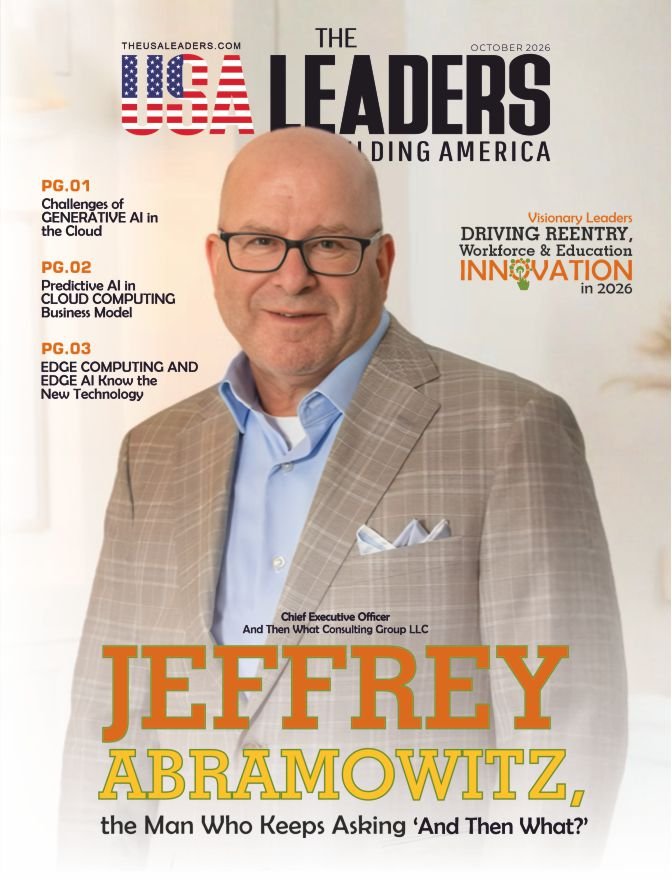

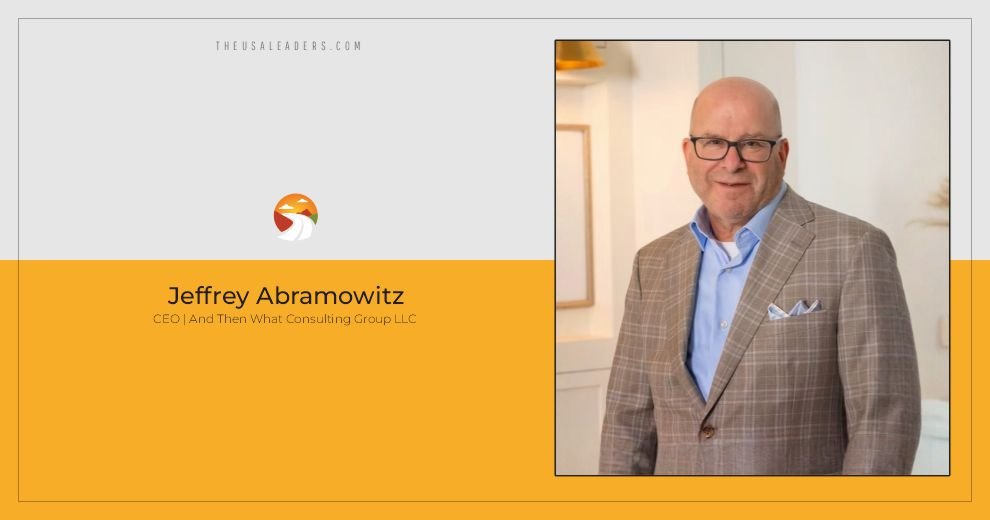
A courtroom teaches a person to argue for outcomes. It rarely teaches what happens after the verdict is read and the gavel comes down and everyone goes home. That gap, the long silence after a decision has been made, turns out to be the place where Jeffrey Abramowitz has spent the better part of two decades working. Today he is the Chief Executive Officer of And Then What Consulting Group LLC and President of the And Then What Foundation, roles he assumed in August 2026. Before that, for more than three years, he ran the Petey Greene Program, a multi-state tutoring program serving people who are currently or formerly incarcerated. He has also served since January 2024 as CEO of the Puttkammer Center for Educational Justice & Equity in Princeton, New Jersey, a center focused on educational justice, research, pilot programming, and evaluation.
None of that, however, is where his story begins. It begins with a trial attorney who thought he understood justice, and then discovered, the hard way, that he did not.
The Lawyer Who Went to Prison
For more than twenty years, Jeffrey practiced as a civil trial lawyer, the kind of career built on precedent and argument, on believing that justice was primarily achieved through the courtroom. Then poor choices led to a federal indictment, and he was sentenced to five years in federal prison. It is the sort of biographical detail that could sink a career or bury a man’s sense of purpose entirely. Instead, it became the hinge on which everything else in his professional life would turn.
“My own experiences with adversity and incarceration transformed my understanding of justice, education, and human potential,” he says. “Rather than allowing those experiences to define me, they became the foundation for a new purpose.”
After his release, Jeffrey did not return to litigation. He became the Director of Student Services & Workforce Development at Community Learning Center, an adult literacy, Title II agency serving Philadelphians who were undereducated, unemployed, or underemployed, a role he held from October 2015 to October 2017. It was, in retrospect, the first brick laid in a body of work that would eventually span workforce development, adult education, corrections, and nonprofit leadership, and that would teach him, as he puts it, that education is one of the most effective tools for reducing recidivism, strengthening families, and building stronger communities.
A Career Built Brick by Brick
What followed reads less like a résumé and more like a series of experiments in the same question, asked over and over in different rooms. In September 2017, he founded the National Workforce Opportunity Network, LLC, a fully integrated workforce development and career placement agency for people facing barriers to employment, a venture he led for nine months before the next opportunity called. In 2018, he became President of the Looking Forward Community Engagement Partnership and began hosting the Looking Forward Show, a television and radio program on PhillyCAM’s WPPM 106.5 FM. That same year, he founded the Global Affiliate Resource Center, born out of the same instinct: that reentry work needed public storytelling as much as it needed case management.
Then came his work at JEVS Human Services, where he served as Executive Director of Reentry Services from August 2018 to November 2021 and Executive Director of Justice Partnerships from December 2021 to December 2022. It was during this stretch, moving between direct service and systems-level partnership building, that Jeffrey began to notice a pattern he could not unsee. Shortly after taking his position at JEVS, Jeff was summoned by the Coalition on Adult Basic Education (COABE) to launch the Prison Literacy Committee across the country and has remained on their Board of Directors, currently serving as Director of Strategic Initiatives.
The Gap Nobody Was Naming
“Throughout my career I noticed that organizations often excelled at helping people earn a credential, secure employment, or complete supervision, but rarely connected those milestones into a long-term pathway toward success,” he explains. People were being asked to overcome systemic barriers without an integrated support system behind them. A credential without a job offer. A job without stable housing. Housing without health care. Each achievement standing alone, disconnected from the next.
That observation is not an abstraction for Jeffrey. It is the philosophy that now defines his work: every educational achievement should naturally lead to the next opportunity. Education, workforce development, housing, health care, financial stability, and community engagement, he insists, cannot operate in isolation. Success requires an ecosystem.
It is this conviction that eventually gave rise to And Then What Consulting Group, the organization he now leads, which helps other organizations design systems connecting education, workforce development, and justice into seamless pathways rather than disconnected checkpoints and challenges individuals to never stop asking the question, “And Then What?”
Leading the Petey Greene Program
Before founding his own consulting practice, Jeffrey spent more than three years as CEO of the Petey Greene Program, beginning in December 2022 and concluding in July 2026. Founded in 2008, the organization supports the academic goals of incarcerated and formerly incarcerated people through high-quality tutoring and other educational programs, while educating volunteers and the public about the issues surrounding incarceration and reentry. Its namesake, Petey Greene, was himself formerly incarcerated in the 1960s before becoming a community activist and media personality in Washington, D.C., dedicating his life to advocacy for racial and social justice. The program that carries his name continues that legacy, providing and advocating for high-quality education for justice-impacted individuals.
What sets the Petey Greene Program apart, in Jeffrey’s telling, is not simply the scale of its tutoring network but the relationships underneath it. “One of the program’s greatest strengths has been its ability to build relationships between volunteers, correctional institutions, colleges, and community organizations,” he says. Rather than treating education as a stand-alone service, the organization has consistently prioritized human connection and individualized, long-term support. As CEO, his task was to strengthen that mission further, expanding partnerships, increasing organizational capacity, and pushing forward conversations around educational equity within correctional settings.
Since January 2024, Jeffrey has also served as CEO of the Puttkammer Center for Educational Justice & Equity in Princeton, New Jersey. The Center focuses on research, pilot programming, evaluation, and educational justice, building on the work and expertise developed through the Petey Greene Program. The Center functions as a catalyst, he notes, promoting access to quality education behind and beyond bars.
Correcting the Record
Ask Jeffrey what people get wrong about his field, and he does not hesitate. “One of the biggest misconceptions is that reentry is simply about helping someone find a job,” he says. Employment matters, certainly, but successful reentry is really about creating stability across multiple areas of life at once.
The second misconception runs deeper, and it is one he pushes back on with visible conviction: that justice-impacted individuals lack motivation. In his experience, it is often the reverse. “Many possess extraordinary resilience, determination, and creativity,” he says. What they are missing is rarely willpower. It is opportunities, supportive networks, and systems designed to recognize their potential. Changing that perception, he believes, takes a combination of education, storytelling, and data, the kind of evidence that lets employers, policymakers, and communities witness measurable outcomes alongside the individual stories behind them.
Innovation as a Discipline, Not a Buzzword
Jeffrey speaks about technology the way an engineer speaks about tools, with respect but without romance. Artificial intelligence and data analytics, he says, offer real opportunities to personalize learning, improve case management, and better understand what is actually working inside a program. But he is wary of innovation adopted for its own sake.
“Innovation should simplify systems rather than complicate them,” he says, adding that every new strategy his organizations pursue has to answer a single question: does it improve outcomes for the people they serve? It is a discipline he applies through measurable performance indicators, continuous evaluation, and partnerships built to scale what already works, while cutting away complexity that does not serve the mission.
Growing Leaders From Lived Experience
Ask Jeffrey how he builds organizations that last, and the conversation turns, almost immediately, to people rather than process. “I believe lived experience is a leadership asset, not a limitation,” he says. Some of the strongest leaders he has worked alongside carried personal histories of extraordinary hardship, histories that, rather than disqualifying them, forged the resilience, empathy, and perseverance that make for exceptional leadership.
Building organizations around that belief requires more than good intentions. It requires cultures of trust, accountability, and professional development, he says, along with mentorship, real opportunities for advancement, and the freedom to innovate inside clear expectations around performance. “When people are empowered to contribute authentically, organizations become stronger, more diverse, and more effective.”
This philosophy extends to how he assembles teams generally. The strongest teams, in his view, begin with a shared sense of purpose, since technical skill only carries an organization so far if people do not understand why the work matters. He hires for strengths, extends trust early, and tries to build environments where innovation is welcomed rather than feared. High-performing organizations, he says, set clear goals, use data to guide decisions, commit to continuous learning, and stay willing to adapt. But the deepest reward, he admits, is something less measurable than any of that. “My greatest professional satisfaction comes from watching people discover talents they did not know they possessed and then seeing them lead others.”
When Leadership Is Tested
Not every chapter of Jeffrey’s career has been about steady growth. He has led organizations through periods of significant change, transitions that tested both his resilience and his leadership philosophy in equal measure. “During times of uncertainty, leaders cannot simply provide answers; they must provide stability, transparency, and hope,” he says.
What he learned in those stretches surprised him a little. Listening, he found, often mattered more than speaking. Bringing people together around a shared mission, communicating honestly even when the news was hard, and staying anchored to long-term goals helped guide his organizations through uncertain periods while preserving something harder to rebuild than a budget line: the trust of staff and stakeholders.
Measuring What Matters
When Jeffrey talks about achievement, organizational metrics come up, but they are not where he starts. “Success is seeing individuals complete educational programs they once believed impossible, obtain meaningful employment, reunite with families, and become leaders within their own communities,” he says. That is the scoreboard that matters most to him.
Beyond individual outcomes, he counts among his proudest contributions the role he has played in advancing national conversations around correctional education, workforce development, digital equity, and systems innovation, work carried out through leadership roles, board service, conference presentations, and collaborative initiatives across the country. It is a body of civic contribution that runs well beyond any single job title: he currently serves as Secretary and Board Member of the Coalition on Basic Adult Education, having previously chaired its Prison Literacy Committee, chaired its State Advocates for Adult Education Fellowship Program, and now serves as Director of Strategic Initiatives. He chaired the Philadelphia Reentry Coalition, sat on the Pennsylvania Reentry Council as chairman of its Employment Committee, and served on advisory boards for Community Forgiveness & Restoration. Nationally, Jeff serves on the Board of the Small Business Mentoring Initiative and National Workforce Readiness Council and hosts the Looking Forward Radio/Television Show and the COABE Behind Every Employer Podcast.
What Comes Next
Jeffrey’s next chapter is already underway. Through And Then What Consulting Group, he intends to build a national catalyst for systems innovation, one that pushes education providers, employers, correctional systems, nonprofits, and government agencies to work together with real intention, so that educational milestones lead to meaningful opportunities and longer-term pathways to success.
“The question ‘And Then What?’ challenges organizations to think beyond immediate outcomes and design complete pathways toward long-term success,” he says. Ultimately, his hope is bigger than any one program or partnership. “I hope to help reshape how America prepares individuals not simply for release, but for lifelong success.”
Away From the Work
For all the intensity of his professional life, Jeffrey is careful to protect the parts of it that have nothing to do with a title. Balance, he says, comes from staying connected to the people and activities that offer perspective, namely his family, along with cycling, distance running, reading, writing, and following emerging technologies that might one day improve education and workforce development. Those pursuits, he says, keep him curious, energized, and continually learning, qualities he believes every leader should hold onto.
The Question He Wants Every Leader to Ask
If Jeffrey has a single piece of wisdom he hopes readers carry away from his story, it is not a strategy or a framework. It is a habit of mind. “I would encourage every leader to ask one simple question: ‘And then what?’” he says. Whatever success is achieved today, he believes, should be used to build opportunity for tomorrow, whether the work is educating students, leading organizations, developing employees, or serving communities.
“Leadership is ultimately measured not by what we accomplish ourselves, but by the opportunities we create for others.”
It is a fitting note for a man whose own life took a detour through federal prison and came out the other side building pathways for people who might otherwise be written off. Jeffrey Abramowitz did not simply survive his own reckoning. He built a career, and now a consulting group and a foundation, out of refusing to let anyone else’s story end at the moment of judgment either.
Quotes
“People should never be defined by the worst day of their lives, but by the opportunities they are given to build what comes next.”
“Every educational milestone should lead to meaningful opportunity, not just release, but lifelong success.”
Also Read – Visionary Leaders Driving Reentry, Workforce & Education Innovation in 2026