The USA Leaders
February 25, 2026
The global technology race has entered a decisive decade. Artificial intelligence, semiconductors, and space systems now determine which nations lead and which fall behind.
STEM, science, technology, engineering, and mathematics, powers every breakthrough. They shape economic strength and national security.
China already produces nearly twice as many STEM graduates as the United States each year. America cannot afford to fall behind.
Yet it continues to overlook one of its most powerful competitive advantages. The United States uses only part of its available talent. Women make up half of the college-educated workforce, but they hold only about one-third of STEM jobs.
This gap does not just limit individual careers. It reduces the innovation capacity, slows technological progress, and weakens America’s global position.
America cannot win the global technology race while leaving talent unused. Women in STEM represent one of the largest untapped economic and competitive advantages in the United States.
Closing this gap should not be a social goal, but a national economic priority.
America’s Competitive Edge Depends on Women in STEM
The United States leads global innovation. Yet women remain underrepresented in STEM. This gap creates a direct economic risk.
National Science Foundation data from 2023 shows women make up 35% of the STEM workforce. In critical sectors, the numbers drop further:
- 15% of engineers
- 26% of computing professionals
- 24% of physical scientists
These roles drive artificial intelligence, defense, biotechnology, and space leadership.
Global competitors invest heavily in STEM talent. America cannot maintain leadership while using only part of its workforce.
McKinsey & Company confirms that companies with strong gender diversity outperform competitors financially.
Innovation improves when companies use the full talent pool. America’s global position depends on closing this gap.
Progress Over 25 Years
The United States has made measurable progress in bringing more women into STEM over the past 25 years.
More women now enter technical careers, earn STEM degrees, and lead major innovation efforts. This growth strengthens America’s talent base and innovation capacity.
However, progress remains uneven across critical fields. Some sectors show strong gains, while others, especially emerging areas like artificial intelligence, continue to lag. The data reveals both meaningful advancement and a clear opportunity to accelerate further.
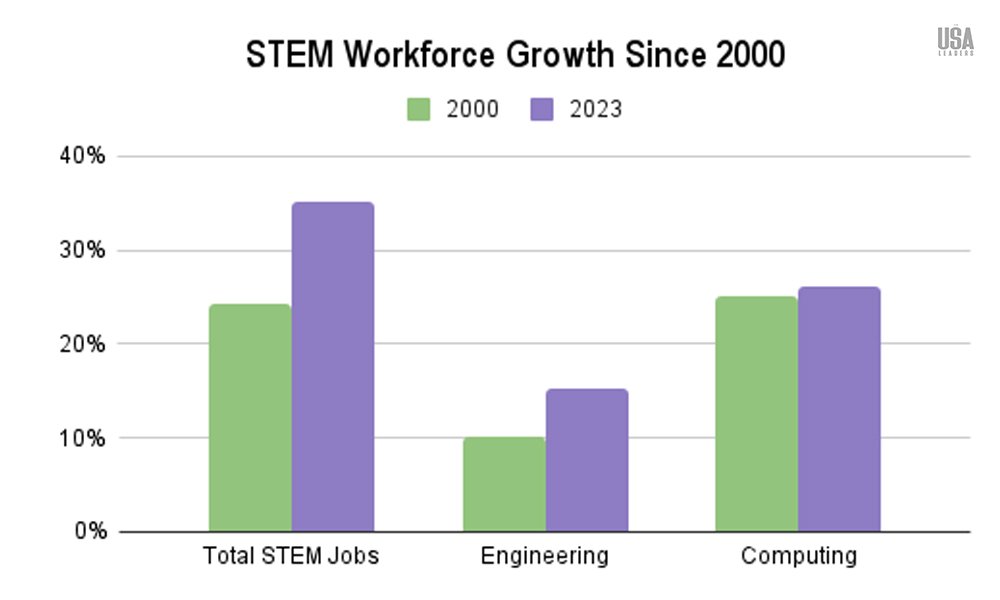
| Field | 2000 | 2023 | Growth |
| Total STEM Jobs | 24% | 35% | +46% |
| Engineering | 10% | 15% | +50% |
| Computing | 25% | 26% | +4% |
This progress reflects millions of women entering STEM careers. That represents a 46% increase in total female STEM representation over 25 years.
- Education Pipeline Shows Stronger Momentum
Women now earn:
- 57% of biological science degrees
- 50% of chemistry degrees
- 42% of math degrees
These numbers show that the talent pipeline exists. The challenge lies in retention and advancement.
Women represent only about 22% of the AI workforce. AI will define economic leadership for decades. America cannot afford to repeat past gaps in this critical field.
Problem Deep-Dive: Barriers That Still Limit Growth
Despite strong entry rates and measurable progress, the STEM pipeline continues to narrow as careers advance.
Women enter education and early roles in meaningful numbers, but representation declines steadily at each career stage.
This pattern reveals a structural retention problem rather than a talent shortage. Understanding where and why women exit STEM careers is critical to protecting America’s long-term innovation capacity.
100% Education Entry
(Women in STEM degree programs)
↓
78% Entry-Level Jobs
(22% exit or switch fields)
↓
52% Mid-Career (5-10 yrs)
(26% leave for other fields)
↓
28% Leadership (15+ yrs)
(72% gap in leadership)
Women lose 72% of their representation in education until they reach the point of leadership.
- Career Timeline
The gender gap in STEM does not appear overnight. It develops gradually across each career stage. Women begin with strong representation in education, but barriers increase during entry-level, mid-career, and leadership phases.
Each transition point introduces new risks that reduce retention and slow advancement. The career timeline shows exactly where talent loss accelerates and where intervention delivers the greatest impact.
- 0-2 Years: Education Phase (Ages 18-22)
Status: High participation
Emerging Barriers: Stereotype threat, male-dominated classroom, and limited female mentorship
- 2-5 Years: Entry-Level Phase (Ages 22-27)
Status: Pipeline loss begins (22% exit)
Key Barriers: Limited high-visibility projects, lack of sponsorship, workplace isolation
- 5-10 Years: Mid-Career Phase (Ages 27-32)
Status: Major attrition (26% additional exit)
Key Barriers: Family planning pressures, promotion gaps, caring responsibilities
- 10-15 Years: Senior Phase (Ages 32-37)
Status: Leadership gap widens (28% reach senior roles)
Key Barriers: Executive pipeline deficit, networking gaps, board representation
Barriers compound exponentially. A single obstacle at the entry level becomes three obstacles by mid-career. The consequence is irreversible: women who leave STEM careers rarely come back.
Delayed intervention means permanent loss of talent. The difference between ‘staying’ and ‘gone for good’ often comes down to whether support arrived in year two or year seven.”
Institutional Solutions That Deliver Measurable Results
- Corporate Investment Produces Results
Intel invested $300 million in diversity and inclusion programs. The company achieved full workforce diversity goals ahead of schedule.
Microsoft implemented structured mentorship and leadership programs. These programs improved retention and promotion outcomes. Companies that invest see measurable returns.
- Federal Programs Strengthen National Talent Supply
The National Aeronautics and Space Administration funds STEM education programs that support girls and women. These initiatives expand the national talent pipeline. Government investment supports long-term competitiveness.
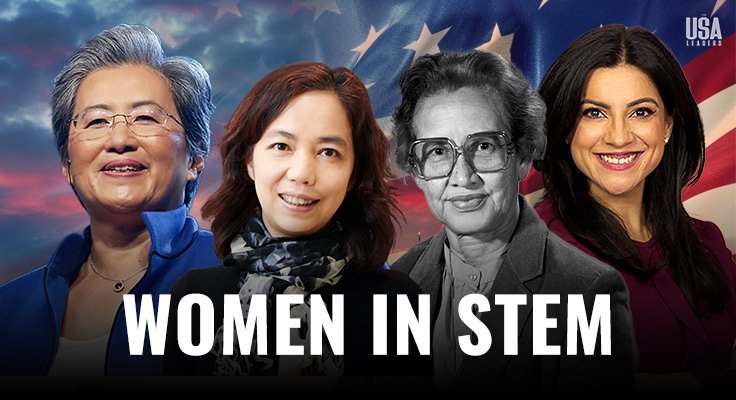
Success Stories: Women Driving America’s Innovation Economy
- Katherine Johnson Helped America Win the Space Race
Katherine Johnson calculated orbital trajectories for early space missions. Her work helped America achieve global leadership in space. And her success proves that women strengthen national competitiveness.
- Lisa Su Revived a Critical Semiconductor Company
Lisa Su transformed Advanced Micro Devices into a global semiconductor leader. AMD now competes directly with larger rivals in AI and computing chips. Her leadership strengthens America’s semiconductor independence.
- Fei-Fei Li Helped Build Modern Artificial Intelligence
Fei-Fei Li created ImageNet, a dataset that accelerated AI development worldwide.
Her work powers modern machine learning systems. AI leadership defines global economic power.
- Reshma Saujani Built America’s Future Talent Pipeline
Reshma Saujani founded Girls Who Code. Her organization trained hundreds of thousands of girls in computer science. This pipeline strengthens America’s future workforce.
What Works: Proven Solutions That Accelerate Progress
Research and corporate data identify clear solutions:
- Mentorship programs increase promotion rates
- Sponsorship programs accelerate leadership advancement
- Paid parental leave improves retention
- Clear promotion criteria improve fairness
- Leadership accountability drives measurable results
Companies that implement these changes strengthen their capacity for innovation. These programs deliver economic returns.
Final Takeaway: America’s Innovation Future Depends on Women
America has made real progress over the past 25 years. More women now enter STEM careers, lead major technology companies, and programs support advancement.
But the global technology race accelerates. Artificial intelligence, semiconductors, and space technology will define economic leadership.
America cannot compete globally while leaving talent unused. Companies, universities, and policymakers must invest now.
Women in STEM do not represent a social goal alone. They represent America’s competitive advantage.
FAQs:
- How much has female STEM participation improved in 25 years?
Female STEM participation increased from 24% in 2000 to 35% in 2023. This represents major progress, but gaps remain in leadership and emerging tech.
- Why does America need more women in STEM?
America needs STEM talent to compete globally in AI, defense, biotech, and space. Using the full workforce strengthens innovation and economic growth. Gender diversity creates a competitive advantage.
- Which STEM fields show the largest gender gaps?
Engineering, artificial intelligence, and computer science show the largest gaps. These fields define future economic leadership.
- Are women entering STEM education in large numbers?
Yes. Women earn strong shares of STEM degrees, especially in biological sciences, math, and chemistry. Retention and advancement remain the main challenges.
- Can companies benefit financially from hiring more women in STEM?
Yes. Diverse companies outperform competitors financially and innovate faster. Gender diversity strengthens business performance.
Neha Shekhawat