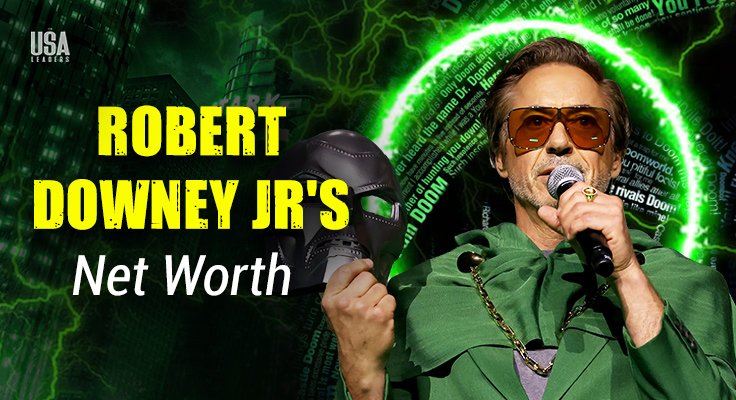
Robert Downey Jr.’s net worth is estimated at $300 million as of 2026, making him one of the wealthiest actors in Hollywood history.
Born on April 4, 1965, in Manhattan, New York, Downey built a career that spans acting, production, venture capital, and consumer brand ownership. He is best known as Tony Stark in the Marvel Cinematic Universe, a role he held from 2008 to 2019 and which generated an estimated $500 million to $600 million in gross career earnings.
Beyond the MCU, he produces films and television through Team Downey, manages climate technology investments through the FootPrint Coalition, co-founded Happy Coffee with entrepreneur Craig Dubitsky, and serves on the board of the cybersecurity firm Aura.
This article explains that RDJ’s $300 million net worth represents his post-tax liquid wealth rather than his total gross earnings.
Robert Downey Jr. Net Worth at a Glance
| Attribute | Details |
| Net Worth (2026) | $300 Million |
| Estimated Annual Income | $30 Million to $50 Million (active years) |
| Profession | Actor, Producer, Venture Capitalist, Entrepreneur |
| Date of Birth | April 4, 1965 |
| Nationality | American |
| Known For | Iron Man / Tony Stark (MCU), Sherlock Holmes, Oppenheimer |
| Primary Income Sources | MCU Earnings, Team Downey, FootPrint Coalition, Endorsements, Real Estate |
| Primary Companies | Team Downey, FootPrint Coalition, Downey Ventures |
| Years Active | 1970 to Present |
Note: Celebrity Net Worth, Forbes, and Parade. Gross earnings figures represent pre-tax, pre-fee income. Liquid net worth is materially lower due to taxation, representation fees, and illiquid venture capital holdings.
Robert Downey Jr Early Life and Career
Robert John Downey Jr. was born into a filmmaking family. His father, Robert Downey Sr., was an independent filmmaker, and his mother, Elsie Ann, was an actress. He made his screen debut at age five in his father’s film Pound (1970). Growing up in New York and later Los Angeles, he was exposed to the entertainment industry from childhood. Later, he briefly attended Santa Monica College but left to pursue acting full-time.
RDJ’s early career gained momentum in the 1980s through a series of Brat Pack ensemble films, including Weird Science (1985) and Less Than Zero (1987), the latter establishing his ability to carry a dramatic role. His Academy Award nomination for Chaplin (1992) confirmed his status as a serious dramatic actor and raised his quoting fee significantly. However, a period of well-documented struggles with addiction between 1996 and 2001, including multiple arrests and time in rehabilitation, rendered him uninsurable by major studios, effectively stalling his career and income for several years.
RDJ’s return to studio filmmaking was made possible in 2003 when actor Mel Gibson personally guaranteed his insurance bond for The Singing Detective, absorbing the financial risk that studios were unwilling to take. This allowed Downey to rebuild his track record before his career-defining casting in Iron Man five years later.
Career Milestones That Built Robert Downey Jr.’s Fortune
The MCU: From $500,000 to $75 Million Per Film
When Marvel Studios cast Downey as Tony Stark in Iron Man (2008), the studio paid a base salary of just $500,000 due to the lingering insurance risk from his personal history. The film grossed $585 million globally and launched the MCU. Downey’s subsequent contract renegotiations produced some of the largest acting paydays in cinema history — a pattern shared across Marvel’s highest-paid actors. For The Avengers (2012), he negotiated first-dollar gross backend participation, which ultimately yielded $50 million.
That model escalated through Iron Man 3 ($75 million), Avengers: Infinity War ($75 million), and Avengers: Endgame ($75 million). His most efficient single payday was Spider-Man: Homecoming (2017), where he earned approximately $15 million for three days of filming..
Salary Breakdown: MCU Films
| Film | Release Year | Estimated Earnings |
| Iron Man | 2008 | $500,000 (base salary; insurance-restricted) |
| Iron Man 2 | 2010 | ~$50 Million (salary + backend) |
| The Avengers | 2012 | ~$50 Million (first-dollar gross participation) |
| Iron Man 3 | 2013 | ~$75 Million (salary + backend) |
| Avengers: Age of Ultron | 2015 | $50 Million to $80 Million |
| Captain America: Civil War | 2016 | ~$40 Million |
| Spider-Man: Homecoming | 2017 | ~$15 Million (3 days of filming) |
| Avengers: Infinity War | 2018 | ~$75 Million |
| Avengers: Endgame | 2019 | ~$75 Million (salary + backend) |
| Total Estimated MCU Gross Earnings | $500 Million to $600 Million |
Non-MCU Films: Consistent A-List Fees
Outside the Marvel ecosystem, Downey commanded standard A-list fees for commercial studio projects and accepted strategic pay cuts for prestige work. His salary for Dolittle (2020) was $20 million upfront despite the film’s poor performance. Oppenheimer (2023) accepted just $4 million upfront to work with director Christopher Nolan, relying on backend points that became significant following the film’s $952 million global box office run.
That Oscar-winning performance for Best Supporting Actor reset his commercial scope for all future projects.
| Film | Year | Estimated Salary |
| Chaplin | 1992 | $1 Million |
| Sherlock Holmes | 2009 | $9 Million |
| Due Date | 2010 | $12 Million |
| Sherlock Holmes: A Game of Shadows | 2011 | $15 Million |
| The Judge | 2014 | $10 Million |
| Dolittle | 2020 | $20 Million |
| Oppenheimer | 2023 | $4 Million (upfront) + backend points |
The Doctor Doom Contract (2026)
At San Diego Comic-Con 2024, Marvel Studios and Kevin Feige announced Downey’s return to the MCU as Victor von Doom in Avengers: Doomsday and Avengers: Secret Wars, with the Russo Brothers directing. The baseline contract is reported at $100 million, structured with performance escalators at the $750 million and $1 billion global box office thresholds. Downey’s representation at WME stipulated that the deal was contingent on the Russo Brothers’ hiring, for which AGBO negotiated an $80 million directorial fee. This contract represents the largest single deal of his career and guarantees a significant future influx of liquid capital.
Building Team Downey
In 2010, Downey and his wife, Susan co-founded Team Downey, transitioning from acting fees to production revenue — a diversification strategy also seen among the highest-paid television personalities who have built business empires beyond their primary careers. Team Downey initially operated under a first-look deal with Warner Bros. before pivoting to premium streaming partnerships with Netflix, HBO, Amazon, and MGM Studios. Productions include The Judge (2014), Dolittle (2020), Sweet Tooth (Netflix), The Sympathizer (HBO), Perry Mason, and the upcoming limited series Weather Girl, produced with A24 for Netflix.
Team Downey operates as a standalone revenue generator, collecting executive producer fees, overhead coverage, and backend streaming performance bonuses independent of Downey’s acting schedule.
Brand Endorsements: From Cash Deals to Equity
Downey’s endorsement strategy evolved over the course of his MCU career. In 2013, he signed a two-year, $12 million contract with HTC for global smartphone campaigns. A multi-million dollar campaign followed with OnePlus in 2019. He also served as the voice of Mr. Peanut for Kraft Foods and appeared in campaigns for Audi and Nissan.
Since 2022, the strategy has shifted entirely toward equity-based partnerships. He joined the board of directors at Aura, the AI-driven cybersecurity firm, giving him equity participation in the company’s valuation growth rather than a flat promotional fee. His Happy Coffee co-founding stake operates on the same model: direct-to-consumer digital revenue supplemented by retail distribution through Target, CVS, and Kroger, building enterprise value he owns rather than endorsement income he collects.
Robert Downey Jr.’s Business Ventures
- FootPrint Coalition
Founded in 2019 alongside co-investors Jonathan Schulhof and Steve Levin, with Rachel Kropa as Scientific Liaison, the FootPrint Coalition is a hybrid venture capital and media firm focused on climate and environmental technology
The firm currently manages an estimated $500 million in assets under management. Its investment thesis spans six sectors: food and agriculture technology, materials and industrial tech, energy and transportation, advanced environmental solutions, consumer products, and media.
Portfolio companies include Prolific Machines (cellular agriculture), Chunk Foods (plant-based meat), Aspiration (sustainable banking), Ynsect (insect protein, with a reported $240 million investment), and Commonwealth Fusion Systems (clean fusion energy).
The firm leverages Downey’s audience of over 100 million social media followers to reduce customer acquisition costs for portfolio companies, directly increasing their valuation.
- Downey Ventures
Downey Ventures is the early-stage technology investment arm that operates alongside Team Downey. Its most significant exit was an early stake in Maker Studios, acquired by The Walt Disney Company for $500 million. Additional holdings include Red 6 AR (augmented reality military training, $70 million investment), Motif FoodWorks (plant-based food science), 1Password, and Cloud Paper.
- Happy Coffee
In 2024, Downey co-founded Happy Coffee with Craig Dubitsky, the entrepreneur behind EOS lip balm and Hello Products. The brand targets the $28 billion US coffee market with a philanthropy-integrated model: 100% of sales from specific microlots are directed to the Mental Health Coalition, with NAMI (National Alliance on Mental Illness) as a primary charitable partner.
In 2025, the brand executed a cross-promotional collaboration with Tom Holland’s non-alcoholic beer brand Bero, creating a lifestyle beverage partnership marketed as an “AM to PM” consumer narrative. By 2026, Happy Coffee expanded its retail presence to over 70,000 outlets, utilizing NetSuite’s AI enterprise resource planning software to manage supply chain operations.
The rapid scaling of Happy Coffee from a direct-to-consumer launch in 2024 to over 70,000 retail outlets by 2026 has created a significant CPG equity asset on Downey’s balance sheet. As a co-founder equity holder, every increase in enterprise value directly increases Downey’s personal net worth.
Robert Downey Jr. Real Estate and Luxury Assets
Downey’s real estate portfolio is valued between $40 million and $50 million, concentrated in Southern California and the Hamptons. Unlike his venture capital holdings, these properties serve dual purposes as both wealth preservation assets and functional production infrastructure.
| Property | Acquired | Purchase Price | Notable Features |
| Malibu Equestrian Compound | 2009 | $13.44 Million | 7 acres, private zoo, solar/wind power |
| East Hampton Windmill Cottage | 2016 | $10.5 Million | 7 beds, 50-ft pool, 4-acre East Coast anchor |
| Santa Monica Residence | 2012 | $4.0 Million | Strategic proximity to LA production hubs |
| Venice Eco-House (Team Downey HQ) | N/A | $3.8 Million | Sustainable architecture, dual-use as production office |
| Portfolio Total (Est.) | $40M to $50M | Concentrated in Southern California and the Hamptons |
Robert Downey Jr’s watch collection includes a Greubel Forsey GMT Tourbillon ($605,000) and several Rolex GMT-Master II variants. Furthermore, his car collection features an Acura NSX Concept ($9 million) and a custom Mustang. These can be considered as lifestyle assets.
Robert Downey Jr. Net Worth Growth Timeline (2020 to 2026)
| Year | Est. Net Worth | Primary Catalyst |
| 2020 | $270 Million | Final Endgame backend bonuses + $20M Dolittle upfront salary |
| 2021 | $275 Million | Team Downey streaming deals; Sweet Tooth success on Netflix |
| 2022 | $280 Million | Real estate portfolio appreciation; FootPrint Coalition expansion |
| 2023 | $285 Million | Aura board compensation; Oppenheimer backend box office points |
| 2024 | $290 Million | Happy Coffee launch; Academy Award raises quoting fee |
| 2025 | $295 Million | Happy Coffee retail expansion (70,000+ outlets); The Sympathizer on HBO |
| 2026 | $300 Million | Doctor Doom contract announced; Avengers: Doomsday filming underway |
Net Worth Comparison of Robert Downey Jr. vs. Other MCU Actors
| Actor | Est. Net Worth | Primary MCU Role | Est. MCU Earnings |
| Robert Downey Jr. | $300 Million | Iron Man / Doctor Doom | $500M to $600M (gross) |
| Scarlett Johansson | $165 Million | Black Widow | ~$150M (gross) |
| Chris Hemsworth | $130 Million | Thor | ~$100M+ (gross) |
| Chris Evans | $110 Million | Captain America | ~$90M+ (gross) |
| Tom Holland | $18 Million | Spider-Man | Growing |
Key Takeaways
- Gross earnings vs. liquid net worth
Robert Downey Jr.’s $500 million to $600 million in MCU gross earnings translates to a $300 million net worth after California state taxes (13.3%), federal taxes (37%), WME agency fees (10%), and attorney and business manager fees (5% each). Understanding this attrition is essential to interpreting any Hollywood wealth figure.
- Equity ownership over endorsements
RDJ’s shift from cash-for-likeness deals (HTC, OnePlus) to board-level equity partnerships (Aura) and co-founder stakes (Happy Coffee) represents a fundamental change in how he generates wealth from his personal brand.
- Production as a parallel income engine
Team Downey generates revenue independent of his acting schedule through executive producer fees, overhead deals, and streaming bonuses. This decouples his annual income from his on-screen activity.
- Illiquid venture capital is a future wealth event
The FootPrint Coalition’s $500 million AUM and Downey Ventures’ portfolio of technology startups represent substantial future value that does not appear in current net worth estimates. These equity positions could significantly increase his liquid net worth over the next five to seven years.
The $100 million baseline deal, combined with box office escalators, ensures that Robert Downey Jr.’s net worth will increase materially between 2026 and 2028 as Avengers: Doomsday and Secret Wars deliver their payouts.
Conclusion
Robert Downey Jr.’s $300 million net worth is the result of a career trajectory that turned a single MCU casting decision into a multi-decade wealth architecture. His $500 million to $600 million in gross Marvel earnings did not translate directly into $600 million in net wealth. Taxes, agency fees, and the deliberate redirection of liquid capital into illiquid venture investments reduced the figure to its current level. But that reduction was strategic. The FootPrint Coalition, Downey Ventures, and Happy Coffee represent a portfolio of future wealth events, not current losses.
What separates Downey’s financial profile from most of his peers is ownership. He owns a production company equity through Team Downey. He owns climate technology equity through the FootPrint Coalition. He owns consumer brand equity through Happy Coffee. And with the Doctor Doom contract, he re-enters the highest-paying franchise in film history with significantly more leverage than he had in 2008, when he accepted $500,000 because no one else would cover his insurance.
FAQs
- What’s Driving Robert Downey Jr.’s Wealth in 2026?
Robert Downey Jr.’s wealth in 2026 is driven by his Doctor Doom Marvel contract, Happy Coffee’s retail expansion, Team Downey’s growing streaming projects, and the rising value of his FootPrint Coalition investments.
Also Read: How Did Kevin Hart’s Net Worth Reach $450 Million?