Product teams rarely struggle because they have nothing to say. More often, the challenge appears when a strong internal story never becomes a strong external one. Companies may understand product value clearly, know their differentiators, and hold a sharp view of market position, yet still fail to express that value in a way that feels immediate, visual, and easy to absorb. That gap becomes most visible during launches, brand campaigns, and other moments when market attention matters most.
That is where Wan 2.7 Video API starts to matter. For developers, workflow teams, and product organizations, the value is not simply access to video generation. Stronger upside comes from moving product narratives, launch concepts, and brand materials into usable visual form earlier, faster, and with more room for iteration.
Product Stories Often Lose Force Between Strategy and Expression
Inside a company, the product story may already be clear. Teams know the user problem, the product advantage, and the market position. Outside the company, that same story often becomes flatter. Messaging turns abstract. Visuals arrive late. Communication fragments across channels.
Such disconnect is not always a strategy problem. In many cases, the real issue is production pressure. When visual expression takes too long to create, teams settle for whatever can be shipped first instead of what would explain the product best.
Internal Clarity Does Not Automatically Become External Understanding
Product stories that make perfect sense in a deck or internal brief may still fail to land with customers, partners, or the broader market.
Brand Communication Often Breaks Under Production Pressure
Communication weakens when teams cannot translate ideas into assets at the pace required by launches and campaigns.
Wan 2.7 Video API Changes What an Early Draft Can Become
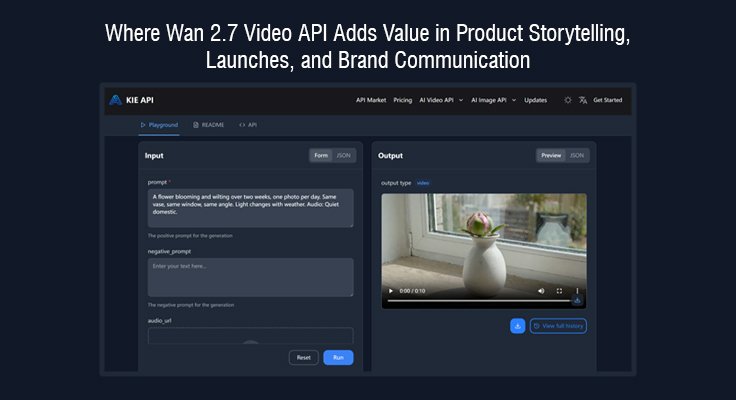
Major change begins when a first visual draft no longer depends on a long production cycle. That is where Wan 2.7 Text-to-Video API becomes especially useful. Product language, campaign concepts, or launch messaging can move beyond slideware and static planning into something teams can actually see, compare, and refine.
Early visibility changes decision-making. Teams can judge whether a message feels clear, whether visual direction supports the product story, and whether communication carries enough force before the launch window closes.
Wan 2.7 Text-to-Video API Helps Product Stories Move Beyond Slideware
Concepts that once stayed trapped in scripts, internal docs, and presentation slides can move into a visual draft much earlier in the workflow.
Wan 2.7 AI Video Adds More Value When Teams Need to Test Direction Early
Earlier visibility usually improves judgment. Teams can decide what deserves more investment and what should be revised before reaching the market.
Launch Pressure Increases When Every Asset Starts From Zero
Modern launches rarely depend on a single announcement. Landing pages, social clips, update posts, internal enablement, customer education, partner communication, and sales support all need coordinated assets. That means teams need more than one format and more than one visual layer.
That is where Wan 2.7 Image to Video API becomes practical. Product screenshots, campaign visuals, UI assets, brand imagery, and launch materials already exist in many workflows. Turning those assets into motion-ready communication often makes more sense than building every piece from scratch.
Modern Launches Need More Than One Story Format
Launch communication now depends on repetition across multiple channels, each carrying different pacing, expectations, and visual demands.
Wan 2.7 Image to Video API Helps Existing Assets Carry More of the Launch Load
When teams already have visual building blocks, extending them into motion can strengthen launch communication without resetting the entire production process.
Brand Communication Gains More Value When Visual Direction Stays Cohesive
Brand communication becomes more effective when audiences see not just repetition, but recognizable repetition. Consistency across channels builds trust, clarity, and memory. That is why visual alignment matters just as much as production speed.
Within that context, Wan 2.7 Reference To Video API matters because it supports workflows where direction matters. Teams do not simply want output. Teams want output that still feels connected to brand language, pacing, and visual identity already in place.
Wan 2.7 Reference To Video API Supports More Consistent Brand Direction
Reference-driven workflows make it easier to keep communication aligned across launch assets, campaign materials, and broader brand storytelling.
Repetition Builds Recognition When the Output Still Feels Cohesive
Recognition grows when teams can publish across channels without making the brand feel visually scattered.
Revision Matters More Than One Perfect First Pass
Strong business communication almost never appears fully formed on the first try. Product stories improve through review, comparison, feedback, and revision. Launch messaging gets sharper when teams can see what is working and adjust what is not. Brand expression matures through iteration, not instant perfection.
That is why Wan 2.7 Edit Video API deserves attention. Edit-oriented workflows are often a better fit for real business operations than one-pass generation logic. Teams rarely need a final answer immediately. More often, teams need a faster route toward a better next version.
Better Messaging Usually Comes Through Revision
Communication improves when teams can test, revise, and tighten what they are trying to say.
Edit Workflows Fit Teams That Treat Communication as an Ongoing System
Product, brand, and launch teams all benefit when refinement is built into the workflow instead of treated as a separate burden.
Speed Creates Value Only When It Supports Judgment
Faster output is not valuable by itself. Speed matters when it helps teams make better decisions, maintain momentum, and support clearer expression. That is where a broader Wan video API or Wan AI API conversation becomes more useful for leadership teams. The goal is not speed for its own sake. The goal is to improve how fast a company can move from idea to credible communication.
Same distinction matters when evaluating an Alibaba Wan 2.7 Video API path or broader Wan 2.7 AI Video Generator capabilities. Real business value does not come from producing more video alone. Real business value comes from using faster production to communicate product value more clearly across launches, brand moments, and market-facing touchpoints.
Wan 2.7 Video API in Modern Business Communication
The most useful interpretation of Wan 2.7 Video API starts with workflow advantage. For developers, launch operators, and communication teams, that means creating a faster path from internal strategy to visible expression. In a business environment where product storytelling, launch execution, and brand communication all move under tighter timelines, that kind of speed is not just operationally helpful. More importantly, such speed can change how confidently a company shows up in the market.