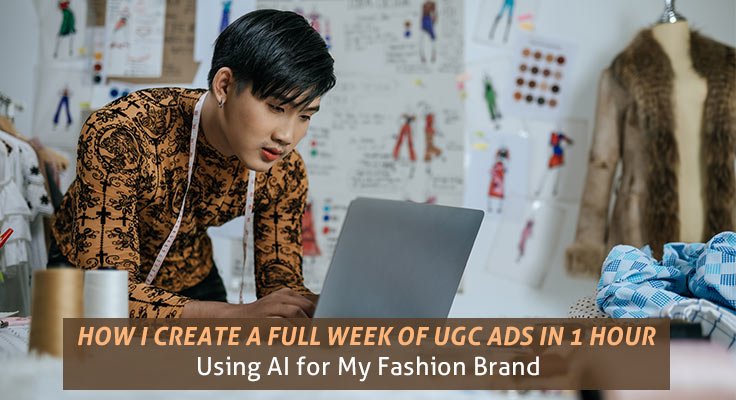
Gone are the days of spending multiple days crafting only a handful of brand videos. As a fashion brand marketer, I now wrap up an entire week’s UGC ad production in roughly one hour, even for fast-paced apparel labels.
Previously, I’d sink endless hours into brainstorming concepts, drafting scripts, on-location filming and post-production just to roll out a small set of usable clips. AI completely flipped my workflow.
Instead of generating content one clip at a time, I now build weekly content batches upfront. Every batch explores distinct storytelling angles centered around the brand’s core products.
This streamlined framework sustains steady posting cadence, saves me from creative burnout, and cuts dependence on costly freelance content creators.
Why AI changed how I produce UGC ads
Most e-commerce brands I see struggle with the same thing: content production cannot keep up with platform demand. You might have a good product, but if you cannot consistently show it in different formats, performance drops fast.
Traditional UGC production is slow because it depends on creators, reshoots, and editing cycles that take days.
With AI, I can now separate ideas from execution. I don’t wait for shoots or creators anymore. I generate multiple angles of the same product story in one sitting and then turn them into videos immediately. That speed matters because ad fatigue happens quickly, especially in fashion where visuals dominate buying decisions.
Another big shift is testing. Instead of betting on one “perfect” ad, I can now test many variations of hooks, visuals, and CTAs within a single week. That means I learn faster what actually works for my audience instead of guessing.
Why AI is becoming essential for e-commerce UGC ads
The main reason more brands are moving toward AI is not hype, it is efficiency. A single winning ad used to cost time, money, and coordination. Now, the bottleneck is creativity, not production.
AI helps solve three major problems in e-commerce marketing:
- Content volume is hard to maintain manually
- Creative testing cycles are too slow
- Scaling across TikTok, Instagram, and X requires constant adaptation
When I run campaigns, I need different versions of the same idea. TikTok needs fast hooks, Instagram needs cleaner visuals, and X performs better with direct messaging. AI lets me generate all of these variations without restarting from scratch each time.
The real advantage is iteration speed. If one angle performs well, I can expand it into ten more variations in under an hour.
Tools I use to create UGC ads with AI
My setup is not complicated. I focus on tools that reduce steps rather than adding complexity. The key is having everything connected in one place instead of switching between five different apps.
I usually rely on:
- Script generation using ChatGPT for hooks and storytelling angles
- Visual generation using an ai image generator to create product and lifestyle scenes
- Video creation using AI video generator for turning static visuals into motion
- Short-form ad assembly tools for subtitles, cuts, and pacing
- Distribution tools for scheduling posts across platforms
One of the platforms I use often is Loova, which combines multiple AI models and tools in one place. It helps me move from idea to finished ad without constantly exporting and importing files. I can generate scripts, images, and videos in the same system, which is what makes the one-hour production window possible.
How I build a full week of UGC ads in one session
When I sit down to create a week of content, I don’t think in individual videos. I think in angles. Each angle represents a different emotional or practical trigger that can sell the same product in a different way.
I usually break the session into five parts.
Generating seven video ideas and scripts
I start by generating seven distinct concepts using LLMs like ChatGPT, Claude and Gemini for the week. Each one is tied to a different purpose, such as problem awareness, social proof, or lifestyle positioning. I also write short scripts for each video, usually 15–25 seconds long.
For example, if I’m promoting a summer dress collection, the angles might look like this:
- Monday focuses on a “before vs after outfit problem”
- Tuesday highlights product details and fabric feel
- Wednesday uses a testimonial-style narrative
- Thursday shows behind-the-scenes design inspiration
- Friday uses a trending format adapted to the product
- Saturday focuses on lifestyle use cases
- Sunday pushes a limited-time offer or CTA
The goal is not creativity for its own sake. It is structured variation that helps me test what converts.
Creating visuals for each concept
Once I have scripts, I move into visuals. This is where an ai image generator becomes useful. I generate product-focused and lifestyle-based images for each idea so that every video has a strong visual foundation.
I usually keep prompts consistent so the brand feels cohesive across the week. For fashion, I focus on lighting, outfit context, and real-life scenarios rather than overly polished studio looks.
A typical set of images includes:
- Model wearing the product in different environments
- Close-up texture shots of fabric
- Lifestyle scenes like walking, shopping, or café moments
- Simple product flat lays for clarity
These images act as the base layer for video creation.
Turning images into videos
After visuals are ready, I convert them into motion using image to video AI tools. This step is what makes the content feel like UGC instead of static ads.
I usually apply subtle motion effects like camera zoom, natural movement, or light transitions. The goal is not to make it look cinematic, but to make it feel like real user-generated content.
For some ads, I also test text to video AI when I want to go from script directly to short video variations. This is useful for hook testing, especially when I want multiple intros without rebuilding visuals.
Editing and assembling the ads
Once I have video clips, I assemble them into final ads. This is where pacing matters more than anything else. Most winning UGC ads grab attention in the first three seconds, so I always start with a strong hook.
I also add captions, CTA overlays, and quick cuts to maintain retention. I avoid over-editing because too much polish often reduces performance for UGC-style content.
The key things I focus on here are:
- Hook clarity in the first 3 seconds
- Subtitle readability for silent viewing
- Fast pacing without confusing transitions
- One clear message per video
Publishing across platforms
Finally, I distribute the content across TikTok, Instagram Reels, and X. Each platform gets slightly different formatting even though the core video stays the same.
TikTok focuses on hooks and retention, Instagram focuses on aesthetics and storytelling, and X works best with direct, concise messaging.
I usually schedule all seven videos in advance so I can observe performance without manual posting pressure.
A real weekly example of UGC ad content
Monday — Problem awareness hook video
On Monday, I focus on a clear problem that my audience already feels but may not have named. For a fashion brand, this is usually something like “I have nothing to wear even though my closet is full.” The video is built around that frustration and quickly introduces the product as a simple fix. I keep the hook strong in the first few seconds, then show how the outfit solves the specific styling issue without over-explaining anything.
Tuesday — Product detail and fabric focus
On Tuesday, I slow things down and let the product speak. This video is about texture, fit, and small details that are hard to communicate in photos. I usually zoom into fabric movement, stitching, and how the outfit looks in natural light. The goal is to make people feel the product quality without needing a physical try-on, so the visuals carry most of the message.
Wednesday — Social proof style video
Wednesday is where I simulate a customer reaction or review-style narrative. I frame it like someone discovering the product and being surprised by how it fits or feels. This type of video works well because it reduces hesitation and builds trust quickly. I keep the tone casual and unpolished so it feels more like a real user experience rather than an ad.
Thursday — Behind the design story
On Thursday, I shift the angle to storytelling. Instead of focusing on selling directly, I show how the product might have been designed or what inspired it. This could be a mood board style visual or a narrative about the aesthetic direction. It helps the audience connect emotionally with the brand and gives context that makes the product feel more intentional.
Friday — Trend-based short-form adaptation
Friday is where I experiment with trends. I take a format that is already performing well on TikTok or Instagram and adapt it to my product. The pacing is usually faster, with stronger edits and more attention-grabbing hooks. The goal here is reach and discovery, not deep explanation, so I prioritize entertainment value over detail.
Saturday — Lifestyle integration video
On Saturday, I show the product in a real-life context. This is less about the item itself and more about how it fits into a daily routine, like going out, meeting friends, or a casual weekend moment. The idea is to make the product feel natural and wearable in different situations, not just something seen in a controlled setup.
Sunday — Conversion-focused offer video
Sunday is the most direct sales-focused video of the week. I highlight urgency, limited availability, or a special offer depending on the campaign. The messaging is clear and simple, with a strong call to action. At this point in the week, I assume the audience has already seen the product multiple times, so this video is designed to push decision-making rather than introduction.
What I learn after publishing
Once the content is live, I focus on performance signals rather than vanity metrics. I track what actually matters for growth and conversion.
The key things I look at are:
- Watch time and drop-off points
- Click-through rate from video to product page
- Engagement patterns per hook type
- Cost per acquisition if running ads
The interesting part is that AI-generated content makes iteration much faster. If a hook performs well on Tuesday, I can generate five new variations of it the same day and test them immediately.
Over time, this creates a feedback loop where my content gets sharper every week without increasing production time.
Final thoughts
Creating a week of UGC ads in one hour is not about replacing creativity, it is about removing friction. I still decide the angles, messaging, and positioning, but I no longer spend time on repetitive production work.
The biggest shift for me is thinking in systems instead of individual videos. Once I have a repeatable structure, AI becomes the execution layer that scales it.
Tools like Loova make this possible because they combine multiple steps like ai image generator, image to video AI, and text to video AI in one place. That integration is what turns a long content process into something I can finish in under an hour.
For e-commerce brands, especially in fast fashion, this approach is becoming less of an advantage and more of a baseline expectation. The brands that win are the ones that can test more ideas, faster, without increasing workload.
FAQ
Can AI really create effective UGC ads for fashion brands?
Yes, as long as the strategy and messaging are clear. AI handles production, but the creative direction still decides performance.
What is the best type of UGC ad for TikTok and Instagram?
Short, hook-driven videos with clear visual storytelling tend to perform best, especially when the product is shown within the first few seconds.
How long does it take to create UGC ads using AI?
With a streamlined setup, I can generate scripts, visuals, and videos for an entire week in about one hour.
Do AI-generated ads perform as well as real influencer content?
In many cases, yes, especially for testing and scaling. Performance depends more on concept quality than production method.
How many ad variations should I test each week?
I usually test at least seven variations per product angle, then expand winners into more versions.
Is AI replacing UGC creators?
No, but it is changing the role. Creators are still valuable, but AI is becoming the default tool for scaling content production efficiently.