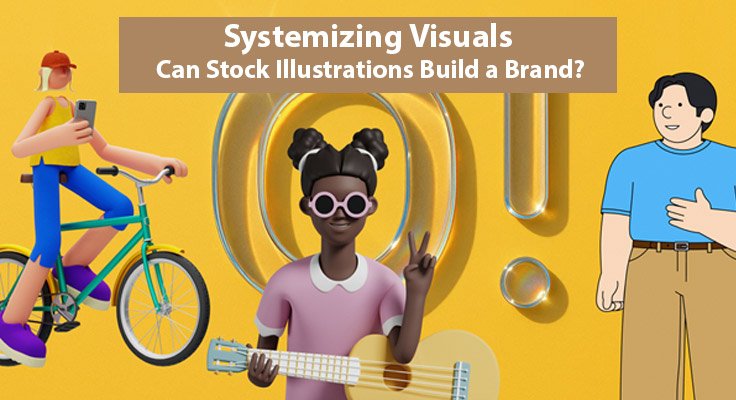
Designers face a binary choice: hire an illustrator for a custom brand language or raid stock repositories for generic assets. Option A burns budget and time. Option B creates a “Frankenstein” visual identity where the landing page clashes with the product interface.
Ouch, the illustration arm of Icons8, occupies the middle ground. It isn’t a bucket of random vector files. Instead, it operates as a collection of design systems. With over 100 styles and thousands of assets, the platform poses a solution to the consistency problem. By treating stock illustrations as libraries rather than standalone images, it suggests you don’t always need a dedicated illustrator to maintain a unified visual language.
The Architecture of Consistency
Most stock sites fail on depth. You find a perfect hero image for a homepage, but when you need a matching graphic for a 404 error, login screen, or newsletter footer, the well runs dry.
Ouch fixes this by organizing assets into massive style families. Choose a style like “Surrealism” or “Business 3D,” and you aren’t getting five images. You access a library covering the entire user experience flow. This includes specific UI states-success, failure, empty carts, waiting screens-alongside broader conceptual metaphors.
Teams can build a “brand system” using off-the-shelf parts. A startup might adopt the “Shiny” style for their entire app. That ensures the onboarding flow matches the marketing emails sent three weeks later.
Scenario: The B2B SaaS Pivot
Picture a small team building a project management tool for remote developers. They need to pivot from “scrappy startup” to “enterprise-ready” but can’t afford a six-week agency rebranding.
The lead designer selects the “Sway” style on Ouch. It features clean lines and corporate-friendly proportions. They don’t just download a few banners. They systematically replace every empty state in the application.
When a user has zero tasks, they see a “Sway” illustration of a relaxed person. When the server times out, a matching illustration of a tangled wire appears.
Because the library includes 28,000+ business and 23,000+ technology illustrations, the designer finds specific metaphors for “cloud syncing,” “team collaboration,” and “security encryption.” They never leave the style family. The result looks like it had a dedicated illustrator, despite being assembled from a repository.
Beyond Static PNGs: 3D and Animation
Static vectors work for print, but modern web design demands motion. Ouch includes a significant collection of 3D styles (44 distinct looks) and animated formats.
For developers and motion designers, format flexibility matters. You aren’t stuck with heavy GIFs. The platform supports Lottie (JSON) and Rive formats. These allow for crisp, scalable animations that don’t kill page load speeds. Video editors can grab MOV files, while 3D generalists can download FBX models for deep customization in Blender or Cinema 4D.
Scenario: The Interactive Agency Project
Take an agency designer tasked with a fintech landing page. The client wants “delight” but provided zero assets.
The designer browses the 3D section and finds a vibrant, clay-morphic style. Rendering scenes from scratch would take days. Instead, they download the FBX models. This lets them rotate objects to match the specific camera angle of the website layout.
For the mobile view, they use Lottie animations. An animated wallet icon triggers when the user scrolls to the pricing section. Since the 3D models and animations come from the same source library, the lighting and texture remain consistent across 2D web elements and 3D hero assets.
The “Real World” Workflow
Let’s look at the daily routine of Dom, a Content Manager at a mid-sized logistics company.
Dom writes three blog posts a week and manages the newsletter. He needs visuals that aren’t stock photos of people shaking hands. He has the Pichon desktop app installed, which syncs with the Ouch library.
- Search: Dom opens Pichon. He filters by his company’s chosen style ID to keep branding tight.
- Selection: He needs a visual for a section about shipping delays. He searches “waiting” and finds a character checking a watch.
- Contextual editing: The character wears red, but the brand color is blue. Dom drags the vector into the integrated Mega Creator tool. He clicks the shirt, selects the company hex code, and the asset updates.
- Export: He drags the finished PNG directly from the tool into his email marketing platform.
The whole process takes four minutes. Later, he needs a specific anxiety clipart to represent supply chain stress in a presentation. He repeats the process, finding an image that matches the previous “waiting” illustration perfectly.
Customization vs. “As-Is”
Mega Creator bridges the gap between stock and custom. Often, a stock illustration is 90% right but contains a misfit element-like a laptop when you need a tablet, or a plant obscuring text.
Since Ouch assets are often built as layered vector objects rather than flattened images, you can deconstruct them. Swap a character’s head. Remove a background element. Combine a dog from one scene with a park bench from another. This composability transforms the library from a gallery of finished art into a kit of parts.
Comparison with Alternatives
Freepik
Freepik is the volume king. They have millions of generic vectors. But inconsistency is the price you pay. Content comes from thousands of contributors, making a cohesive brand system nearly impossible. You might find a great style for one icon, but the artist hasn’t created the rest of the set.
Undraw
Undraw is a staple for open-source projects. It’s free and clean. But it suffers from ubiquity. The “Corporate Memphis” style is so recognizable that using it makes a project look like a template. Ouch offers more stylistic variety, helping brands avoid looking like everyone else.
Custom Illustration
Hiring a freelancer is the gold standard. You get exactly what you want, and you own the IP exclusively. The trade-off is cost and speed. Ouch serves as the pragmatic alternative when you need 80% of the quality for 1% of the price and zero wait time.
Limitations and When to Avoid
Ouch isn’t a magic bullet for every scenario.
Exclusive Rights
You cannot buy exclusive rights to these images. Your competitor could technically use the exact same illustration style. If owning the visual IP is critical to your business strategy, hire an illustrator.
Hyper-Specific Niches
“Business” and “Tech” are well-covered. Highly specialized industries-like specific surgical procedures or complex industrial machinery diagrams-may not find accurate representations.
Free Tier Restrictions
The free tier is generous but requires link attribution and is limited to PNG. If you need scalable SVGs for responsive web design or large format print, you must upgrade to a paid plan.
Practical Tips for Success
- Stick to One Style: The biggest mistake is mixing styles. Filter by style first, then search for your keyword.
- Use the Desktop App: Pichon lets you drag and drop directly into Figma, Photoshop, or PowerPoint. This saves time compared to the download-upload cycle.
- Recolor for Ownership: Never use default colors. Even a subtle shift to your brand’s palette makes the illustration look bespoke rather than borrowed.
Conclusion
Can an off-the-shelf library support a brand system? Yes, provided the library is built with that intent. Ouch distinguishes itself by focusing on the depth of styles rather than just the breadth of topics. For startups, agencies, and content teams, it offers a way to scale visual storytelling without the logistical weight of freelance contracts. It won’t replace the nuance of a custom artist for every use case, but for the day-to-day demands of digital product design, it is a formidable tool.
Also Read: Gold Stocks List – Discover the Best Gold Stocks List in India!