Technologies rarely start as essential. Most begin at the edges of daily life, introduced as optional upgrades, convenience features, or niche tools for people willing to try something new. Over time, though, some of them stop feeling optional. They become expected, not because of a single breakthrough moment, but because they gradually fit more naturally into how the home actually functions.
That pattern has already played out across much of the modern house. Features once seen as extra now feel standard because they solve recurring friction well enough that people stop wanting to manage without them. What matters is not only whether the technology works. It is whether it becomes normal.
Smart outdoor cleaning is beginning to move through that same process. It is not entering the home all at once. It is being absorbed step by step, as expectations around outdoor spaces shift and maintenance routines become harder to separate from everyday life.
From Optional Upgrade to Everyday Expectation
Very few household technologies arrive as necessities. At first, they are often treated as enhancements, products people may admire without feeling they truly need. But that status does not stay fixed. Once a tool proves useful in repeated, ordinary situations, its role begins to change.
This is how adoption usually works inside the home. A product enters as something optional, becomes convenient enough to justify repeated use, and then slowly shifts into something people begin to depend on without consciously planning to. The transition is rarely dramatic. In most cases, it is subtle enough that people only notice it after the category already feels established.
Technologies rarely start as essential—they become essential over time. What changes is not just the product itself, but the surrounding expectation of what the home should handle more easily.
The Familiar Path from New Category to Daily Habit
Household adoption tends to follow a recognizable sequence. It does not usually move from novelty to necessity in a single leap. It moves through stages of familiarity and repeated use until the category feels ordinary.
Typical Adoption Path
Optional upgrade
Convenience tool
Routine dependency
Expected standard
The shift happens gradually, not through a single decision. A household may first try a technology because it sounds useful. Then it becomes part of one routine. Then it becomes something that quietly supports daily life. Eventually, it is no longer treated as an add-on at all. It is simply part of how the home works.
That is why normalization matters more than novelty. A category becomes important not when it first appears, but when people stop thinking of it as unusual.
Outdoor Spaces Have Taken Longer to Catch Up
Indoor spaces have moved through this process faster than outdoor ones. That is partly because interior routines were easier to automate first. The home’s interior offered clearer boundaries, more stable conditions, and earlier opportunities for connected systems to become part of everyday life.
Outdoor spaces, by contrast, have often remained more manual. Even as families spent more time using patios, backyards, and pool areas, the systems supporting those spaces stayed more fragmented. Demand existed, but adoption moved more slowly.
Outdoor spaces have been slower to adopt automation despite similar demand. That lag is important because it suggests the issue was never relevance alone. It was timing, environment, and the gradual pace at which new categories become integrated into the broader household system.
Backyards Now Function More Like Extensions of the House
One of the biggest shifts has been how outdoor spaces are used. In many households, these areas are no longer treated as occasional-use zones. They function more like everyday extensions of the home, supporting regular routines rather than special events alone.
That change matters because repeated use creates repeated expectations. A space that is part of everyday life is expected to stay more consistently ready. Once that happens, the threshold for what feels manageable begins to change. Maintenance that once seemed acceptable as an occasional task becomes more visible when it keeps returning inside a frequently used environment.
Outdoor spaces are no longer occasional—they are continuous-use environments. That shift helps explain why smart outdoor maintenance categories are becoming more relevant now than they may have seemed before.
Pool Cleaning Is One of the First Outdoor Routines to Shift
The point where a new category begins fitting into the home is usually the point where recurring need becomes too visible to ignore. Outdoor cleaning, especially in spaces with repeated maintenance patterns, creates exactly that kind of opening. The need is not abstract. It is frequent, visible, and tied to the everyday usability of the space.
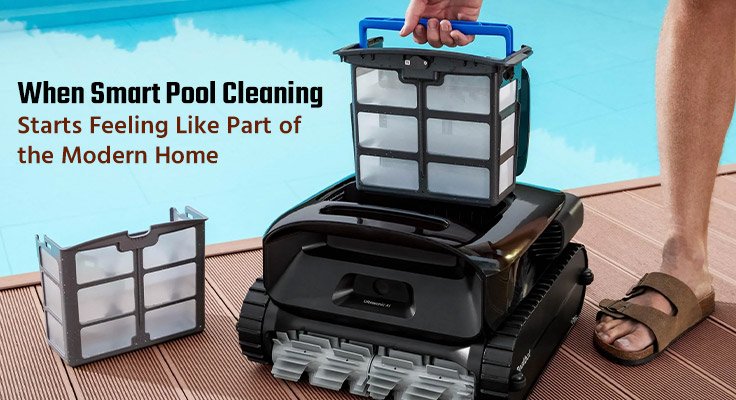
This is where pool cleaner robot systems begin to move from optional tools to regular components of home maintenance. The significance here is not simply that the category exists. It is that the category fits naturally into a larger pattern of home adoption: recurring task, visible payoff, repeated use.
That is how integration often begins. A household does not adopt a category because it wants one more device. It adopts it because the recurring work around a space becomes regular enough that a dedicated system begins to make sense.
The Real Change Happens When a Tool Becomes Part of the Routine
The most important shift in household adoption happens when a product stops being treated as a tool and starts functioning as part of a routine. That is the point where usage changes from deliberate to habitual. The product is no longer something brought in occasionally to solve a problem. It becomes part of the normal maintenance structure of the home.
That distinction matters. A tool is something people think about using. A routine is something they live inside without much conscious attention. The deeper a category moves into that second state, the more fully it becomes integrated.
A product becomes part of the home when it is no longer something you think about using. That is often the real marker of adoption. Not purchase, not trial, but normalization through repetition.
Normalization Matters More Than Novelty
Categories become normal in stages. First, they are noticed. Then they are tried. Then they are repeated. Eventually, their presence stops standing out. At that point, the conversation around them changes. The category is no longer judged mainly by novelty, but by how well it fits the ordinary expectations of home life.
This is how broader normalization takes shape. As robotic pool cleaners become more common, they reflect how entire categories move from novelty to expectation. The category itself becomes easier to understand because it now belongs to a familiar pattern: recurring problem, repeated use, household integration.
That matters because normalization is what turns a product space into a stable part of the home market. Once adoption reaches that stage, the category is no longer defined by whether it belongs. It is defined by how broadly it can spread.
A Technology Feels at Home When It Creates Less Friction
When a technology becomes part of the home, it does not necessarily become more visible. Often, the opposite happens. It becomes less noticeable because it creates less friction. Its role is not to demand attention, but to remove repeated points of interruption from the household routine.
That is why integration is not really about presence in a visual sense. It is about fit. A category feels fully integrated when it supports the environment without needing to be constantly managed as something separate from it.
Integration is not about visibility—it’s about absence of friction. That is what makes a technology feel native to the modern home rather than attached to it from the outside.
The Next Stage of Home Integration Is Happening Outdoors
The next phase of household technology is likely to depend less on introducing entirely new forms of automation and more on deepening integration across spaces that have remained more manual until now. Outdoor environments are a natural part of that shift, not because they are newly important, but because they are becoming more fully absorbed into the everyday logic of the home.
That means the larger trend is not simply adoption. It is normalization. A category becomes significant when it stops feeling like a separate improvement and starts feeling like part of the expected system around the space.
The most important shift is not adoption—it’s when the technology stops feeling like an addition at all.