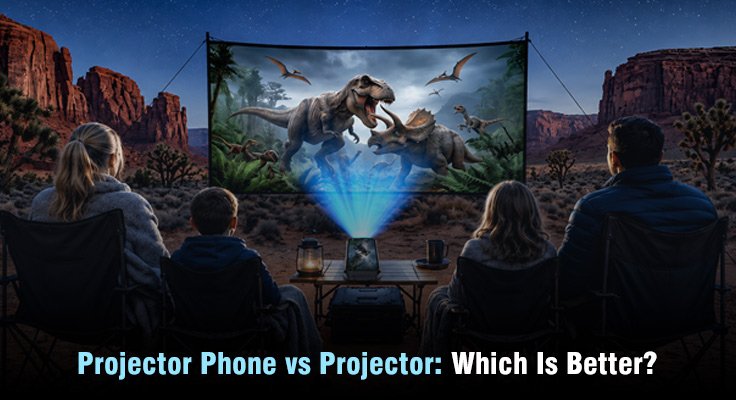
Wanting to project a movie, a slideshow, or a set of plans onto a wall used to mean one thing: buying a portable projector. Now there’s a second option. A handful of rugged phones build a real DLP projector directly into the device, removing the need to carry anything extra at all. Both approaches can put a large image on a wall, but they get there in very different ways, and one will fit your actual habits better than the other.
This guide compares projector phones and portable projectors across the things that actually matter: size, image quality, battery life, and cost, and looks at where a device like the 8849 Tank 5 Pro fits into that decision.
What’s the Difference Between Projector Phone and Projector?
A portable projector is a standalone device built specifically to project. It needs a separate content source, a phone, laptop, or streaming stick, connected by cable or wireless casting, along with its own battery or a power outlet.
A projector phone is a smartphone with a projector module built into the body. The phone is both the content source and the projector at once, with no pairing step, no cable, and nothing extra to charge or pack.
Portability
This is where the gap is widest. A portable projector, even a compact one, adds a separate item to carry, along with its charging cable and sometimes a small tripod. For a fixed setup like a home theater, that’s a non-issue. For anything spontaneous – a campsite, a hotel room, a job site visit – it’s one more thing that has to be packed and remembered.
A projector phone eliminates that entirely. If you’re carrying your phone, which you already are, the projector is already with you.
Image Quality and Brightness
Standalone projectors generally win on raw output. Many portable models, especially ones plugged into wall power, produce more lumens and larger screen sizes than anything phone-sized. For a fixed home theater setup, a dedicated projector will usually look better.
Projector phones have closed the gap considerably, though. The better ones now use full 2K DLP modules in the 200+ lumen range, producing a genuinely sharp, watchable image in shaded or normally lit rooms, not just pitch darkness.
Screen Size and Viewing Environment
A portable projector is generally the better choice when maximum screen size matters. Its larger optics and higher output make it easier to fill a large wall or dedicated screen, especially in a dark room.
A projector phone takes a different approach, prioritizing convenience over scale. It works best for moderate-size projection in bedrooms, hotel rooms, campsites, and other temporary setups where portability matters more than filling an entire wall. The Tank 5 Pro’s 220-lumen projector is best suited to darker or shaded environments rather than direct sunlight.
Setup and Convenience
A portable projector usually needs a few minutes of setup: positioning it, connecting a source, focusing, and sometimes correcting keystone distortion by hand. That’s a reasonable tradeoff for a setup you use repeatedly, but it adds friction for a one-off use.
A projector phone with laser autofocus and automatic keystone correction gets a sharp, square image within seconds of pointing it at a surface, with no remote, no second device, and no cable to route.
Content and Connectivity
How each device gets content onto the screen is where the two approaches diverge most. A portable projector needs a source: casting from a phone over Wi-Fi, plugging in via HDMI or USB-C, or using a built-in smart TV-style interface. Casting brings its own friction, weak Wi-Fi drops the connection, and DRM protections on paid streaming services frequently block mirroring outright, resulting in a black screen instead of video. A wired connection avoids that but brings back the cable you were trying to avoid.
A projector phone sidesteps all of it, because the phone is the source. Streaming apps run natively, so there’s no mirroring, no DRM conflict, and nothing to project except whatever the phone can already play, directly and at full resolution.
Battery Life and Power
Most portable projectors run on wall power or a battery in the 2 to 2.5 hour range at watchable brightness, enough for a single movie but not much beyond it.
Projector phones built for this specifically carry much larger batteries, often well past 15,000mAh, supporting several hours of continuous projection while still leaving power for normal phone use. Fast charging in the 100W-plus range also keeps recharge time well under two hours.
Cost and Value
A capable portable projector with real brightness and a good battery typically costs $200 to $600, before factoring in a phone or laptop to feed it content. A projector phone folds the projector, the phone, and the battery into one purchase, usually closer to flagship phone pricing, often $900 to $1,200, but that price also replaces the phone itself rather than adding a projector on top of one you already own.
Why the 8849 Tank 5 Pro Stands Out
The Tank 5 Pro is built for people who’d otherwise be choosing between these two categories and want to stop compromising. Its 2K DLP projector (2048×1080, 220 lumens) uses laser autofocus across 0.5 to 4.0 meters and ±45° keystone correction, so setup is closer to “point and go” than anything a standalone projector offers, and its 17,600mAh battery backs up to 5 hours of projection runtime, well beyond what most portable projectors manage on battery power alone.
It’s also IP68 and IP69K rated for dust and water protection, while its rugged construction is designed for demanding environments, and it stays a full flagship phone underneath, with a MediaTek Dimensity 9400e chipset and a 6.73-inch 3K AMOLED display, once the projector is off. The Pro also adds a 95° ultra-wide FLIR Lepton 3.1R thermal camera, giving it a capability that a conventional portable projector simply doesn’t offer.
Projector Phone vs Portable Projector at a Glance
| Factor | Portable Projector | Projector Phone (Tank 5 Pro) |
| Extra device to carry | Yes | No |
| Setup time | A few minutes | Seconds, with autofocus |
| Peak brightness | Often higher (wall-powered) | 220 lumens, strong for the category |
| Battery-powered runtime | ~2–2.5 hrs | Up to 5 hrs |
| Rugged durability | Rarely | IP68 / IP69K |
| Also functions as a phone | No | Yes |
Which One Should You Choose?
If you’re setting up a permanent home theater or need the largest, brightest image possible and don’t mind the extra gear, a dedicated portable projector is still the better tool for that job. If you want to project spontaneously, outdoors, on a trip, or at a job site, a projector phone removes the friction that makes a portable projector impractical to use often, and the Tank 5 Pro adds rugged protection and a long-runtime battery on top of that.
Conclusion
Neither option is universally better; they’re built for different habits. A portable projector wins on raw image quality in a fixed setup. A projector phone wins on convenience, battery life, and not needing a second device at all. For anyone who values convenience, portability, and an all-in-one device over maximum brightness and screen size, the 8849 Tank 5 Pro makes a compelling case for replacing a separate projector with one rugged phone.