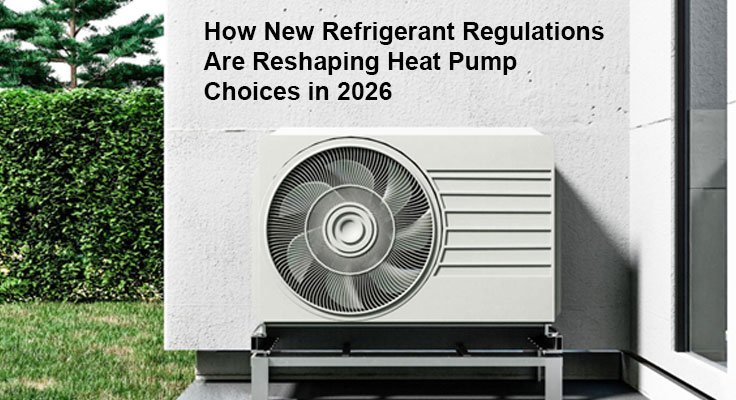
Strict federal regulations and a global movement toward environmental sustainability are causing the home temperature control market to undergo its biggest change in decades. For many, this means that a typical heat pump installation now requires a thorough understanding of the new chemical requirements and equipment architectures that are currently on the market, rather than just choosing a model from the shelf. In order to keep California homes pleasant and compliant, businesses like Fuse Service HVAC, Plumbing & Electrical have had to quickly adapt and make sure their staff is informed on the subtleties of these next-generation systems.
The Regulatory Drivers Behind the 2026 Changes
The American Innovation and Manufacturing (AIM) Act is the main force behind this change. It gives the EPA the power to slowly stop making and using hydrofluorocarbons (HFCs). By 2026, the sector will have passed the first “grace periods” for a lot of types of equipment. The goal is to cut HFC consumption by an incredible 85% by 2036. However, the immediate effect for 2026 is that new residential systems will have a strict cap on GWP levels.
Every newly installed central heat pump or air conditioning system must use a refrigerant with a GWP of 700 or less in order to comply with current residential HVAC compliance. Because of this, it is practically hard to install new equipment that uses the long-standing industry standard R-410A, which forces the market to change to solutions that were previously thought to be experimental.
Key Refrigerants in Transition: R-410A vs. New A2L Options
R-32 and R-454B are the two main heat pump refrigerants that the industry has mainly agreed upon in 2026.
- R-32: An easier-to-recover and recycle single-component refrigerant. With a GWP of about 675, it securely stays below the 700-limit.
- R-454B: A blend that has an even lower GWP (approximately 466). Many major manufacturers have opted for R-454B as their “future-proof” choice because it provides a larger margin of safety against future, even stricter regulations.
While both are superior for the planet, they belong to a new safety class known as A2L, which stands for “mildly flammable.”
Impact on Heat Pump Performance and Efficiency
One might assume that moving to “greener” chemicals would hamper performance, but the opposite has proven true. These new heat pump refrigerants are really increasing system efficiency in 2026. For example, manufacturers are able to construct systems with smaller refrigerant charges and more compact heat exchangers because R-32 has superior heat transfer capabilities compared to R-410A.
In addition, variable-speed compressor integration has advanced to meet the thermodynamic requirements of A2L gases. As a result, 2026 models are more adept at keeping interior temperatures steady even in the face of the unpredictable weather patterns that are now typical in the South Bay and elsewhere.
Safety Considerations with Mildly Flammable A2L Refrigerants
The “mildly flammable” label often gives homeowners pause, but the reality is far less dramatic than the term implies. Heat pump safety considerations have been baked into the very design of the 2026 equipment. Because 2L refrigerants require a high-energy ignition source and a highly particular concentration in the air to catch fire, they are extremely difficult to ignite.
2026-compliant units come with the following features to reduce even these minor risks:
- Integrated sensors that can identify a refrigerant leakage before it reaches a hazardous concentration are known as leak detection sensors.
- The system will immediately activate the indoor blower fan to dilute the gas and may even activate shut-off valves to isolate the refrigerant if a leak is detected.
Economic and Cost Implications for Buyers
There is no sugar-coating the fact that 2026 technology comes with a higher upfront price tag. Equipment prices have increased by about 10% to 15% due to the addition of safety sensors, specialist control boards, and the R&D expenses associated with developing units for A2L gases.
The long-term economics, however, paint a different picture. The cost of gas for repairs is soaring as R-410A is being phased out. An aging R-410A system may cost three times as much to recharge by 2026 as it did five years ago. The homeowner can enjoy contemporary federal tax credits under the Inflation Reduction Act and safeguard themselves from these skyrocketing maintenance expenses by investing in a new, compliant system.
How Market Availability and Choices Are Evolving
Manufacturers have fully transitioned their assembly lines. While you might still find some “new old stock” R-410A units in a warehouse, they are becoming increasingly rare and, in many jurisdictions, illegal to install for new construction.
Many of the 2026 heat pump models are designed to operate at 100% capacity down to $5°F$ ($-15°C$), making them viable primary heat sources even in regions that used to rely on gas furnaces. The “hybrid” strategy, which combines a gas furnace and a heat pump, is also evolving to employ intelligent switching logic depending on current ambient temperatures and utility rates.
Practical Guidance for Homeowners in 2026
If your HVAC system is more than 12 years old, you shouldn’t ignore the change to 2026 regulations. When searching for a replacement, it is important to inquire about the specific experience that potential contractors have with A2L gases. Heat pump safety considerations require technicians to use spark-proof vacuum pumps and recovery machines, tools that weren’t necessary for older A1 refrigerants.
In conclusion
Our perception of how pleasant our houses should be has completely changed as a result of the 2026 refrigerant regulations. The end result is a generation of HVAC systems that are safer, more effective, and more ecologically friendly than their predecessors, despite the fact that moving from R-410A to A2L replacements like R-32 and R-454B added complexity. By keeping up with these developments, homeowners may make choices that will protect both the environment and their household budget for many years to come.
Also Read: Efficient Cooling Options for Single Rooms and Studios