Here’s an uncomfortable truth: most internal communication is being actively ignored. Not skimmed. Not half-read. Ignored.
That should sting a little if you’re a company leader when every update, announcement, and “quick note” you send is meant to align people. Rather, it’s getting lost in a vastness of pings, emails, and dashboards.
The data doesn’t lie. The State of Workplace Communication Survey found that 44% of employees are overwhelmed by the volume of workplace messages. A further 46% said they were more likely to disconnect if an internal comms message was too monotonous.
Why do employees mostly ignore internal comms? We’ll get to the answers below.
More Messages, Less Meaning
Most organizations assume that if something is important, it needs to be repeated across multiple channels. Email. Slack. Meetings. Intranet posts… and maybe a reminder email for good measure. The result? Fatigue.
Bestselling author and workplace culture expert Bruce Daisley explains that much of internal communication today is “noise.” Not because the information is irrelevant but because it’s delivered without clarity, prioritization, or restraint.
“It’s a big wake-up call for how we allow corporate bloat to ruin work.” – Bruce Daisley via LinkedIn.
Employees aren’t disengaged. They’re filtering.
Why Employees Are Tuning Out
Everything Sounds Urgent
When every message is marked “important,” employees stop believing any of it is. A lack of clear prioritization is one of the main reasons internal comms fail. People ignore messages because they can’t tell what matters.
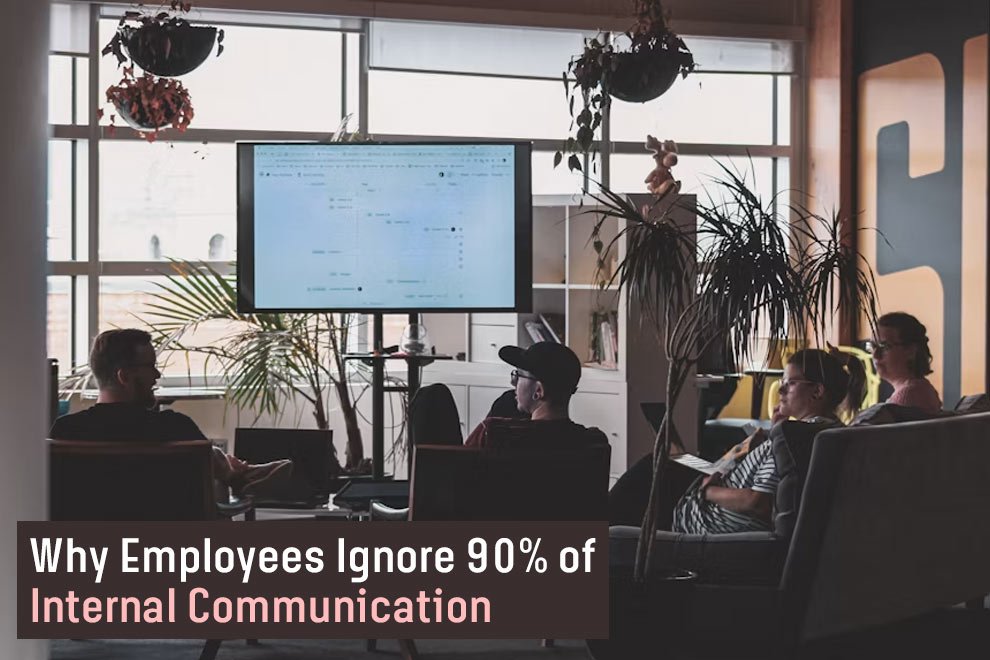
Newer approaches are gaining traction. Digital displays are being used to surface key messages in physical office spaces. Digital display screens for business make communication more visible and less intrusive. It also becomes harder to ignore without adding to inbox clutter.
Some interactive digital displays are more than typical interactive whiteboards. Digital display software solutions are designed for smooth, effortless communication in a wide range of contexts, says The Office Technology Group.
Email Is Broken
Email remains the default channel for internal communication. It’s also one of the least effective.
Employees associate internal emails with long-winded updates, generic announcements, or information that doesn’t impact their day-to-day work.
There’s a Growing Trust Gap
Sometimes employees ignore communication because they don’t fully trust it. There’s a growing skepticism in workplaces. Employees think that internal messaging doesn’t always reflect reality.
Overpolished or delayed communication is a red flag. And that disconnect from lived experience turns people off.
It’s Not Relevant to Them
Relevance is everything. And most internal communication is too broad.
Poor targeting leads to disengagement, lower productivity, and higher turnover. If a message doesn’t clearly answer “Why should I care?” it’s gone.
The Bigger Cost: Quiet Quitting and Disconnection
When communication breaks down, the impact surpasses missed emails.
Poor internal communication is closely linked to disengagement and “quiet quitting.” Employees do the bare minimum since they feel detached from the bigger picture.
Once that disconnect sets in, it’s hard to reverse.
What Actually Works?
Say Less and Say It Better
Clarity trumps volume. Focus on fewer, high-impact messages that are easy to understand and act on.
Prioritize Ruthlessly
Not everything deserves equal attention. Make it obvious what’s critical, what’s optional, and what can wait.
Match the Message to the Medium
Stop defaulting to email. Use the right channel for the right message. A quick team huddle. A short video. Ambient tools like digital displays for visibility.
Build Trust Through Consistency
Transparency doesn’t say more. It says things people recognize as true. Align communication with reality, even when it’s uncomfortable.
Make It About Them
Every message should answer one question: What does this mean for me? If it doesn’t, it won’t land.
FAQs
1. Why do employees ignore internal communication?
Mostly due to overload, lack of relevance, and low trust in messaging.
2. Is email still effective for internal communication?
It can be, but only when used sparingly and with clear, relevant messaging.
3. What is the biggest mistake leaders make?
Treating all communication as equally important, which leads to message fatigue.
4. How can companies improve engagement with internal messages?
By simplifying communication, targeting messages better, and using a mix of channels.
Internal Communication Insights at a Glance
| Insight | Finding |
| Employees overwhelmed by workplace messaging | 44% report overload |
| Workers more likely to disengage due to poor communication | 46% |
| Companies improving communication see better retention | Up to 25% improvement |
| Employees who feel informed are more engaged | Strong, positive link |
Don’t Take it Personal
Employees aren’t ignoring internal communication because they don’t care. They’re ignoring it because it doesn’t cut through.
Attention is earned, not assumed.
The companies that win won’t be the ones who communicate the most, but the ones that communicate the clearest.