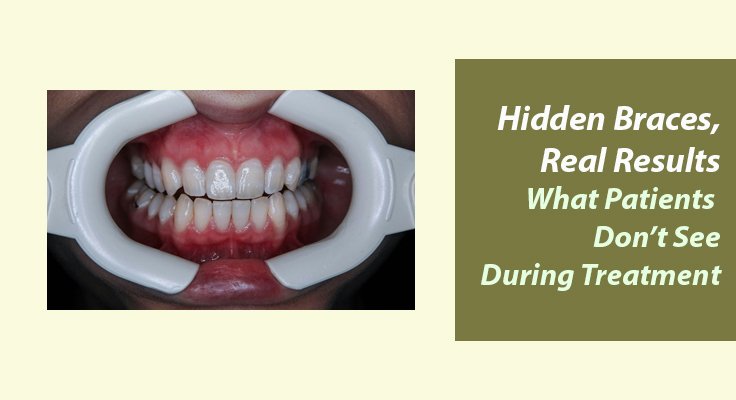
Many patients seeking orthodontic procedures prefer not to use traditional braces. Hidden braces offer them the alternative to look good aesthetically while their dentition is being corrected in the background.
The hidden braces, also called lingual braces, sit behind the teeth. The lingual braces are the choice for professionals who want to look smart and look good while they go about their lives.
As modern technology advances, hidden braces become more comfortable and work better. Hidden braces deliver treatment that works and maintains the look of the patients. The new technology makes hidden braces easier to wear. These hidden braces allow families to have healthy teeth and smiles while the correction happens underground.
Types of Hidden Orthodontic Solutions
Hidden braces generally refer to braces in which the wires and bands are attached to the inner surfaces of the teeth.
Some options for hidden braces are:
Incognito: These are customizable brackets and robotic wires that are placed for a precise fit.
InBrace: These use smartware technology that can adjust themselves while they still stay hidden.
Hidden braces work as well as regular braces. Hidden braces can fix an overbite, an underbite, overcrowding, malalignment, and other bite issues. Smiles+Grins Clinic offers the Incognito and InBraces systems. With Smiles+Grins, each hidden braces treatment is tailored to the patient’s needs for an effective experience.
The Invisible Planning Stage: Digital Precision Before Treatment Begins
Hidden braces require careful planning before they are placed. This planning typically involves the use of digital tools to ensure a smooth process. For example, intraoral scanners are used to capture the 3D model of the teeth. This helps eliminate messy impressions. Also, CBCT and AI software are used to simulate the movement of the teeth, helping the orthodontist create a unique bracket that works for each patient.
The virtual setup ensures the accuracy of the process. It ensures the braces fit properly and minimizes adjustments later on.
Clinics experienced with Hidden braces use these preparatory steps to help patients visualize what they will be getting and build confidence in the process to come.
The Biology of Tooth Movement: What Happens Beneath the Surface
Orthodontic forces start a controlled body response. The response moves the teeth. One side’s pressure causes the ligament to be squeezed, which in turn causes the osteoclasts to break down bone. And tension on the side pulls the ligament, which then prompts osteoblasts to build new bone. The remodeling of bone shifts the teeth into place.
Hidden braces work the same way. Hidden braces apply a force from behind the teeth, and the constant, gentle force reshapes the alveolar bone without any visible hardware. Inflammatory mediators such as the RANKL and the cytokines guide the process, and the inflammatory mediators keep the movement safe and predictable.
Ongoing Monitoring and Micro-Adjustments During Treatment
InBrace has a smart wire technology. The technology allows for self‑directed adjustments, which in turn demands fewer visits compared to the transitional braces.
Incognito, on the other hand, requires more visits to the orthodontist because the wires and bands need manual adjustments. The orthodontists refine the wires based on the progress during the check‑ups.
The digital monitoring tools include scans that are used during clinic visits. The digital monitoring tools track subtle alignment. Digital monitoring tools help the orthodontist catch and address any misalignments early. Precise oversight keeps the treatment on track.
Complications and Solutions
Although invisible braces work well, they can bring early challenges. Some of the challenges a patient can experience are,
Tongue irritation or soreness: This is common as the mouth adapts. Wax and time usually fix tongue irritation or soreness.
Temporary speech changes: A slight lisp can happen. The slight lisp usually fades after a week.
Hygiene demands: The lingual placement needs brushing and flossing. Water flossers help the lingual placement prevent plaque buildup.
Experienced providers mitigate the problems with custom low-profile designs and patient education.
Informed Choices for Discreet Treatment
Choosing hidden braces means thinking about the look, the case complexity, and the time it takes to get used to braces. Hidden braces work well for moderate to severe issues where clear braces may not work. Invisible braces give control without being seen.
Talk to specialists who know about braces, such as the team at Smiles+Grins. The specialists will give you advice on the best choices for you.
In conclusion
Invisible braces deliver great results to patients while hidden. The hidden braces work in the background through their design, body changes, and small tweaks. Patients do not see those steps, but the outcomes are telling.
In practice, the hidden braces keep getting better. They use smarter materials and offer fewer problems, and provide a reliable process to good dental health. Lingual braces are a choice for correction.
Have you ever used hidden braces? Please leave a remark with your thoughts or questions. I’d love to know how secret therapies have impacted your life.
Also Read: Dental Braces in Glendale, CA – Gold Coast Dental